





 Portuguese
  English
  Spanish
  6 min of reading
  0 comments


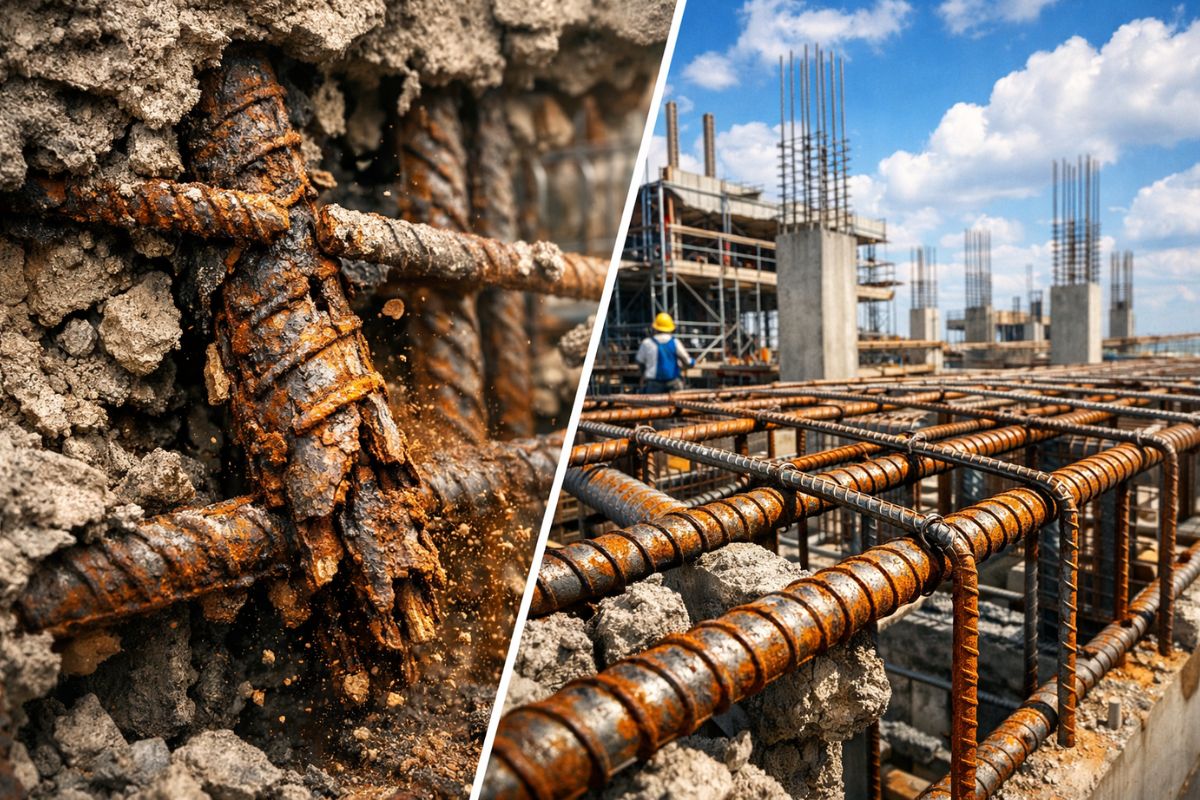
Rusty Rebar Can Be Used in Concrete If the Superficial Rust Does Not Compromise the Structure, But Deep Corrosion With Diameter Loss Requires Discarding.
The doubt about using rusty rebar in concrete is common on any construction site, especially when the bar has been exposed to the weather and has acquired that orange coloration. But the central point is not just the appearance: what really matters is knowing when this oxidation does not compromise the structure and when it already indicates dangerous corrosion.
Practically, a thin, uniform, and adhered layer of rust is usually classified as superficial oxidation and generally does not compromise the structure. The problem begins when scales, loose plates, deep irregularities, and diameter loss appear, because then the steel’s strength may decrease and the safety of the work is at risk.
What Causes Rust on Rebar
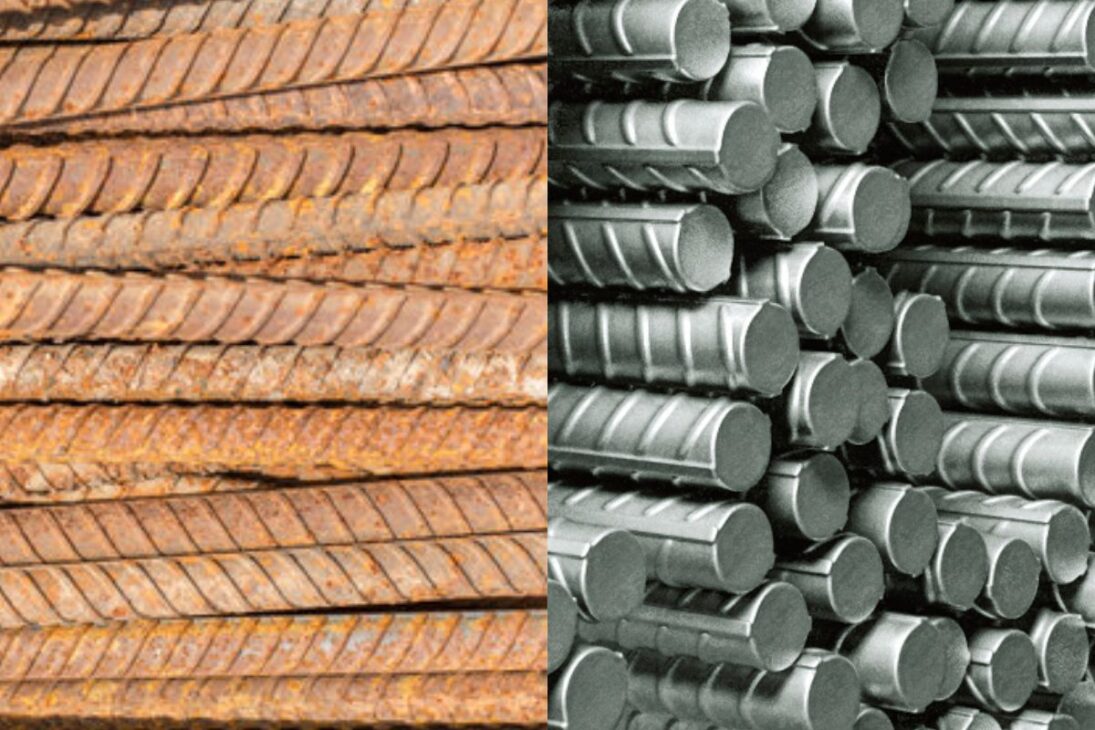
Rust appears because of a natural chemical reaction between iron, oxygen, and water. This process forms the visible orange layer on the surface of the steel, something relatively common on construction sites, especially in humid environments.
-
Live fence that saves on construction: Virginia jasmine grows up to 60 cm per year, reaches 10 m, and closes the yard with a dense and fragrant green wall, without aggressive roots and with simple, inexpensive, and quick pruning.

-
This is the cost to build a simple 60 m2 house in 2026, including contingencies, foundation, finishing, labor, and hidden fees.

-
Amphibious houses with a floating dock system gain global attention by revealing technology that allows homes to rise with floods and avoid losses in high-risk areas.

-
Between tunnels, bridges, and billions in investment, Istanbul is preparing to receive a 125-kilometer railway that crosses continents, enhances the circulation of goods and passengers, and changes the strategic outlook of Turkish transportation.


This explains why many rebars start to oxidize even after a short time exposed. Not all rust indicates structural damage, and this is the most important point for a correct assessment.
When Rust Does Not Compromise the Structure
When the rebar presents only a thin and adhered layer, without scaling and without loose thick material, the tendency is that it is superficial oxidation. In this scenario, rust does not compromise the structure automatically.
According to the base of the submitted material, the standard does not require the steel to be shiny or completely clean to be used.
What needs to be observed is whether this condition interferes with the performance of the bar within the concrete.
Moreover, when the oxidation is light and well-adhered, it does not hinder the interaction between steel and concrete. In some cases, the very roughness of this superficial layer may even enhance adhesion.
Why the Adhesion Between Steel and Concrete is So Important
The reinforced concrete structure works because concrete withstands compression very well, while steel is used to resist tension. For this to work, both materials need to work together as a single element.
This is precisely why the surface condition of the rebar deserves attention. If the rust is light and adhered, the adhesion tends to be preserved.
But if there is loose material, plates, or coarse dust, a barrier forms that hinders proper contact between the fresh concrete and the steel.
In more severe situations, this can reduce the anchoring capacity of the bar and encourage the appearance of cracks and failures.
The Difference Between Superficial Oxidation and Advanced Corrosion
This is the most important distinction when deciding whether the rebar can be used or not. Superficial oxidation forms a thin, uniform, and adhered layer. It usually does not shed scales and, by itself, typically does not compromise the structure.
On the other hand, advanced corrosion is a different situation. In this case, thick, loose, and scaled layers appear. This indicates real loss of section of the bar, meaning part of the diameter of the rebar has been consumed.
When steel loses diameter, it also loses load-bearing capacity. And when the strength decreases, the safety of the structure is compromised.
How to Identify if the Rebar Can Still Be Used
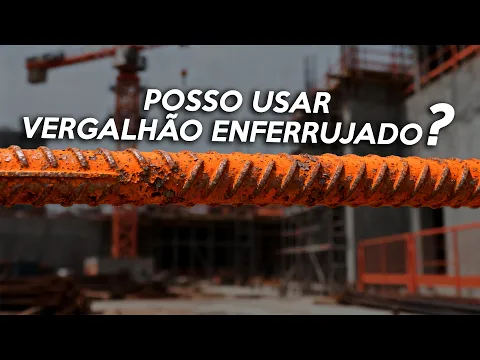

Visual inspection is essential, and according to the base content, there is a practical verification widely used at construction sites. You just need to run a wire brush over the bar and observe what happens.
If only a fine powder comes off and the rebar looks intact just below, the tendency is that the oxidation is superficial. In this case, the material may still be suitable for use.
However, if the brush removes plates, scales, or reveals deep irregularities, this is already a sign of severe corrosion. In this condition, it is difficult to ensure that the bar still meets the diameter specified by ABNT NBR 7480.
Diameter Loss is the Real Warning Sign
The greatest risk is not in the orange color itself, but in the reduction of the steel section. When corrosion advances and consumes part of the rebar, it no longer provides the resistance for which it was designed.
This is the point at which rust ceases to be superficial and becomes a structural problem. If there is a loss of diameter, corrosion compromises the structure as it reduces the load-bearing capacity of the steel.
In more critical projects, the practice of measuring the diameter of bars helps confirm whether they still meet the nominal specification before concreting.
Concrete Protects Steel, But Does Not Correct Existing Damage
Another essential point is to understand the role of concrete after pouring. Concrete has high pH, generally above 12, which creates a passivation layer around the steel and halts oxidation, provided there is no excessive entry of aggressive agents.
In practice, this means that concrete helps protect the rebar after it is properly encased. But this protection does not recover existing damage.
If the bar enters the construction with section loss, scaling, or deformation, concrete does not restore the original resistance. Therefore, the ideal is to pour concrete only with bars that exhibit, at most, superficial oxidation.
Aggressive Environments Require Even More Care
The decision to use or not use an oxidized rebar also depends on the environment where the structure will be executed.
Coastal regions, industrial areas, and locations with high pollution tend to have a higher presence of aggressive agents, such as chlorides.
In these conditions, the structure will already be more exposed to corrosion over time. Therefore, starting the work with already compromised rebar is even riskier.
In such scenarios, inspection care must be doubled, because any prior loss of steel may accelerate future problems.
When Rebar Should Be Discarded
The practical rule presented in the base is straightforward. If the rust is light, simply brush and check the bar. If it remains intact, without section loss, it can be used.
On the other hand, if the corrosion is deep, irregular, scaled, or with diameter loss, the rebar must be discarded. In this situation, there is no way to guarantee that it still fulfills the structural function expected in the project.
In other words, it is not the presence of rust alone that defines everything. What determines if the steel can be reused is the degree of corrosion and its real effects on the bar.
After All, Can Rusty Rebar Go in Concrete?
Yes, rusty rebar can go in concrete when it shows only superficial, thin, adhered rust without section loss. In this condition, rust does not compromise the structure and does not prevent the use of the bar.
But when there is deep corrosion, scaling, loose plates, and diameter reduction, the scenario changes completely. Then the steel loses strength, adhesion may be compromised, and the safety of the work becomes threatened.
The difference between acceptable use and structural risk lies in the accurate evaluation of the surface of the bar. And it is this analysis that prevents the placement of material into concrete that has already entered compromised.
And you, have you ever encountered rusty rebar on a construction site and wondered whether to use it or not?








-

-

-

-

-

-

102 pessoas reagiram a isso.