





 Portuguese
  English
  Spanish
  7 min of reading
  0 comments


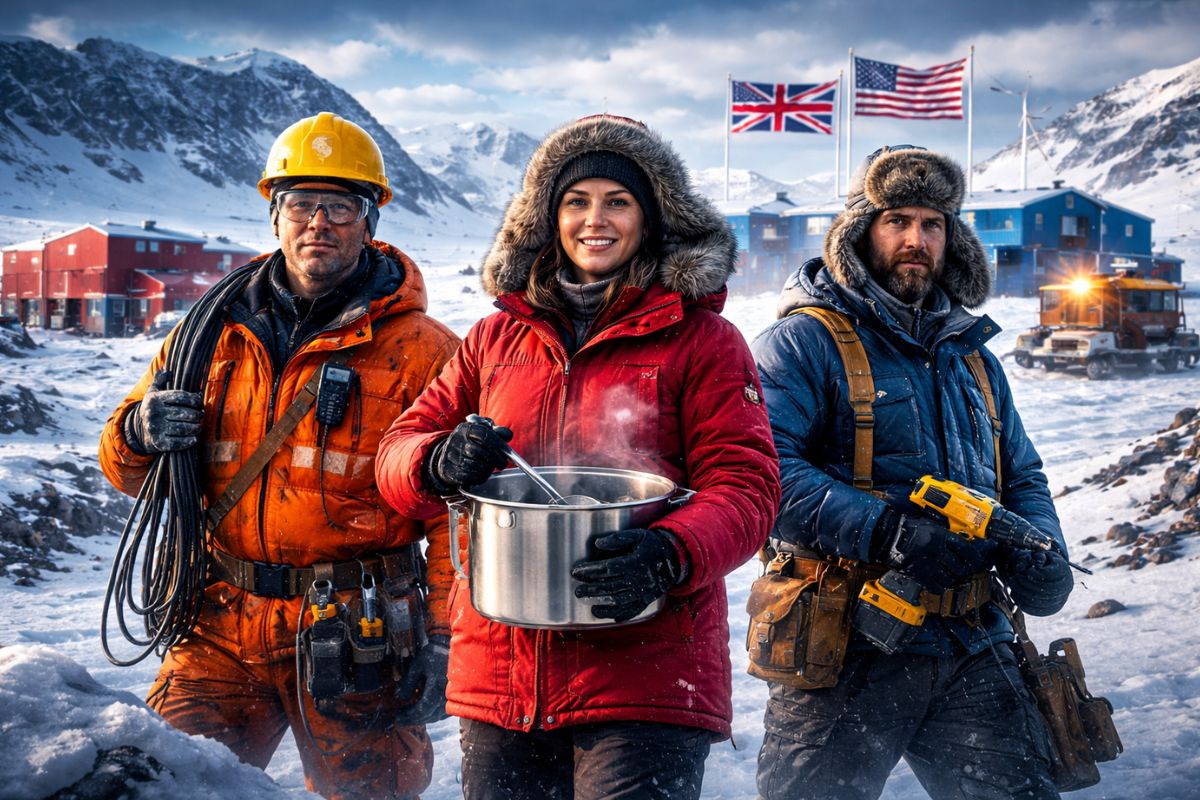
United Kingdom and USA Recruit for Antarctica Professionals Outside Science: Electricians, Carpenters, Chefs, Plumbers, Doctors, and Even Hairdressers. UK Salaries Start at £31,244, with Travel and Accommodation. At Bases Like Halley VI, Freezing at -40°C, Continuous Light and Shared Dormitories Shape Routine and Coexistence Without Weekly Time Off.
Antarctica has come back on the radar of those who never imagined themselves in a lab: British and American bases are making room for operational professionals who keep a station alive when the ice dictates the rules. According to G1’s portal, it is not a “tourist expedition” disguised as a job: it is real work, with an intense routine, strict protocols, and coexistence without escape.
At the center of this machinery is a question that almost no one voices aloud before applying: what weighs more, the brutal cold or the total isolation? Among salaries paid in pounds, covered accommodation, and the promise of a unique setting, the experience puts ordinary people in an environment where the basics (sleep, privacy, silence) become a luxury.
A Recruitment That Is Not for Scientists, but Is Also Not “Just Any Job”

When a research station operates at the edge of the planet, it relies less on the glamour of discovery and more on what no one sees: maintenance, food, energy, water, health, security.
-
Friends have been building a small “town” for 30 years to grow old together, with compact houses, a common area, nature surrounding it, and a collective life project designed for friendship, coexistence, and simplicity.

-
This small town in Germany created its own currency 24 years ago, today it circulates millions per year, is accepted in over 300 stores, and the German government allowed all of this to happen under one condition.

-
Curitiba is shrinking and is expected to lose 97,000 residents by 2050, while inland cities in Paraná such as Sarandi, Araucária, and Toledo are experiencing accelerated growth that is changing the entire state’s map.

-
Tourists were poisoned on Everest in a million-dollar fraud scheme involving helicopters that diverted over $19 million and shocked international authorities.


That’s why both the British Antarctic Survey (BAS) and the American program recruit professionals from practical areas to “go south,” including electricians, carpenters, plumbers, chefs, paramedics, doctors, and even hairdressers. Antarctica needs people who solve problems before they become risks.
In the British case, BAS manages five stations and recruits up to 150 new professionals a year. The composition of the workforce draws attention: scientific and specialized engineering roles support research, but about 70% of the positions are operational, which keep heating, food, communication, and infrastructure running predictably, even when the environment is unpredictable.
Halley VI: The Base on Moving Ice and the Logistics of Keeping Everything Working

The Halley VI station, led by Dan McKenzie, provides a real measure of what it means to work in Antarctica.
At 38, after a trajectory in remote locations and a previous career as a naval engineer, he describes the role as the most isolated and challenging. Leading a base is not just commanding: it’s preventing small problems from becoming emergencies.
During the Antarctic summer, Halley VI operates with a team of around 40 people, in a season that runs from November to mid-February.
It is situated on the Brunt Ice Shelf, a vast ice mass that has broken off the continent and floats in the ocean, moving at a rate of 400 meters per year.
This detail is not just curious: it conditions planning, positioning, safety, and the way infrastructure is designed to exist over “ground” that is moving.
The mission of Halley VI includes collecting spatial and atmospheric data and monitoring the ozone layer hole.
However, this research depends on daily tasks that resemble any city with an aggravating factor: there is no quick external assistance.
The station chief is responsible for supplies, health and safety protocols, team training, and incident management, as well as mediating conflicts and emotionally supporting those who feel the weight of isolation.
Brutal Cold, Endless Light, and Then Darkness: The Body Needs to Relearn Routine
The climate in Antarctica is not just a number on a thermometer; it is a factor that reorganizes the day. On a summer day, McKenzie spoke of a temperature of -15°C, describing that “minus five” would be the maximum that usually occurs, with the possibility of dropping to -40°C and an average around -20°C.
Even the “tolerable” in Antarctica is extreme by common standards, which translates into layers of clothing, adequate equipment, and rules of exposure.
Summer, however, brings a challenge that seems contradictory: the uninterrupted daylight. The natural cycle distorts, and sunset can last weeks. This affects sleep, mood, and perception of time, especially in work environments that operate on a seven-day scale.
The body tries to impose a biological clock, but the landscape does not cooperate, requiring discipline to maintain routine and health.
When summer ends, the experience turns into something else. About 50 people remain during winter, when the continent plunges into darkness.
For many, this is the turning point: fewer people, less movement, more silence, and a paradoxical sense of freedom not because there are more options, but because the outside world nearly disappears.
Intense Coexistence: The “Positive Stress” and the Invisible Risk of Conflicts
Between cold and storms, the factor that wears people down is not always physical. Mariella Giancola, HR Director of BAS, points out that constant coexistence and structured routine often create more difficulties than the weather.
She compares the experience to “going back to university”: shared dormitories, little privacy, clear rules, and the perception that someone is always nearby. In Antarctica, intimacy is not a choice; it’s a condition.
Clinical psychologist Duncan Precious, with experience in British and Australian armed forces, reinforces this idea from another angle: even with elevated physical risk, social dynamics can be even more problematic because persistent conflicts in a closed environment are difficult to repair and control.
At the same time, he notes that those who are attracted to this type of work tend to thrive under “positive stress,” similar to what happens with profiles that choose military life—people who function well with mission, routine, and rules.
In practice, this means that technical skills alone are not enough. Knowing how to do electrical installations, cook for dozens, or keep systems running is essential, but dealing with human friction is part of the package.
The station chief himself reports common situations found in any work environment—disagreements, bad days, difficult news from home—only amplified by a brutal detail: there is no “going away to cool off.”
What BAS Seeks and How the Selection Process Tries to Forecast Social Winter
BAS does not approach going to Antarctica as a simple hire for a “remote location.” There are tests aimed at conflict resolution and problem-solving skills, followed by rigorous pre-departure training.
The logic is straightforward: in a place where logistics are limited and support routes are complex, prevention is safer than remediation. The selection process tries to measure temperament as much as competence.
The living conditions are part of the filter, even before the contract: fresh food is scarce, alcohol consumption is limited, and accommodation includes shared dormitories.
The seven-day work scale also changes the perception of rest and personal life. In return, BAS offers a package that includes travel, accommodation, food, and equipment suited for extreme temperatures, with salaries starting at £31,244 per year.
Another relevant aspect is understanding that the season has a beginning, middle, and end, affecting expectations.
For instance, McKenzie started in Antarctica in 2019 as a mechanical maintenance engineer at the Rothera station, about 1,600 km from Halley VI, before taking over as chief.
Part of the team returns to the UK by the end of May, and for the rest of the year, he is based at BAS headquarters in Cambridge. This alternation creates adaptation cycles: returning home can be as challenging as going.
Why So Many People Accept to Go: Environmental Research, Wildlife, and a Rare Sense of “Concentrated Life”
Even with the demands, Antarctica attracts for reasons that do not fit into a list of benefits. McKenzie describes the satisfaction of contributing to environmental research and admits that the adaptation may start poorly: sharing a room, facing unpleasant weather, and thinking in the first month that “it might not be for me.” The turning point, for some, comes when the place stops being just harsh and becomes extraordinary.
He cites experiences that few will have in a lifetime: seeing whales, seals, islands on boat trips, small flights in light aircraft, and, in one of the years, a colony of emperor penguins.
This is not about romanticizing everyday life because it continues to be demanding, but recognizing that Antarctica delivers moments that reconfigure the perception of work, time, and purpose.
In the broader picture, there is a collective dimension: around 5,000 people work in Antarctica during the summer months, spread across 80 research stations operated by approximately 30 countries. This helps explain why operational positions exist and renew: the continent does not “stop” in summer; it accelerates.
And for science to happen, someone needs to ensure that light, heat, food, water, communication, and safety are standing.
Conclusion: Courage Is Not Just Enduring Cold, It Is Bearing Its Own Routine Without Escape
Antarctica does not select solely based on resumes; it exposes habits, limits, and how each individual reacts when the world becomes a corridor, a cafeteria, and a shared dormitory.
The cold may be the first shock, but constant coexistence tends to be the longest test. Yet, there are those who return saying they have never felt so free precisely because life becomes intense, concentrated, and without easy distractions.
If you had the chance to work in Antarctica, what would be the deciding factor: sharing a room for months, working on a seven-day scale, spending weeks with constant light, or facing the darkness of winter with a small group?
And, more personally: what kind of professional would you be when isolation becomes routine—what solves, what cares, or what needs to be cared for?










Seja o primeiro a reagir!