





 Portuguese
  English
  Spanish
  3 min of reading
  0 comments


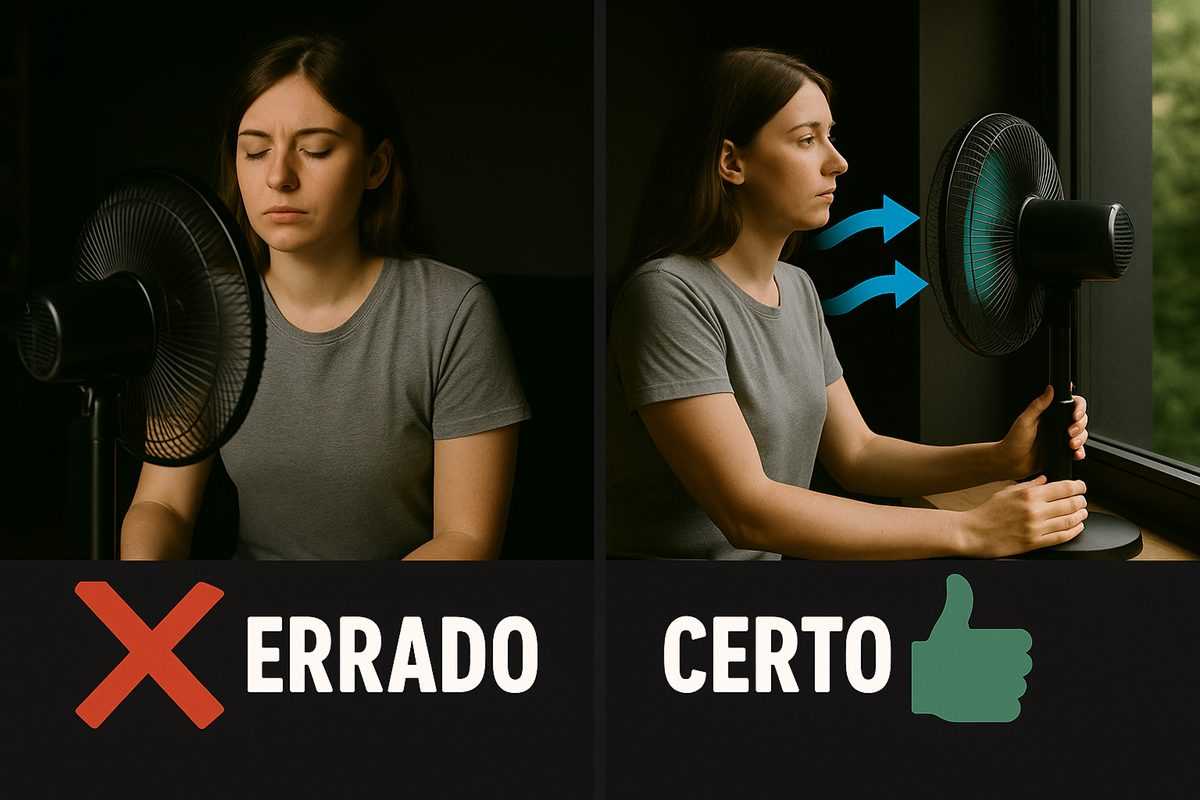
With the rise in temperatures, many people rush to turn on the fan and try to make the house cooler. But are you using the appliance the right way? A simple trick, revealed by experts, can transform the way air circulates within the home — and still generate savings.
With extreme heat, many people turn to the fan to try to alleviate thermal discomfort inside the house. But a simple guideline can completely change the way this equipment is used — and save money in the process.
The Trick of the Fan Facing Out
According to experts, if you position the fan to blow air directly at you, you are doing it less efficiently. The recommendation is to place the fan facing out of the window.
The idea is that by pointing the appliance outward, it helps to push the warm air from inside the house outside. At the same time, with another window open on the opposite side, the cooler air enters the environment, creating a natural airflow.
-
Drought may be creating stronger superbugs in the soil and helping antibiotic resistance reach hospitals, warns a study highlighting a problem that could grow alongside extreme weather.

-
The biggest scam in history: Napoleon’s France deceived the United States by selling them a territory that was Spanish.

-
Why is the Danakil Desert so dangerous? It has unstable terrain and how extreme temperatures and toxic gases turn the region into one of the most hostile environments on Earth.

-
With a height of 221 meters and a capacity for trillions of liters, Hoover Dam still holds a trick that makes water defy logic.


In other words, opening opposite windows or doors allows air to flow through the space.
Cross Ventilation and Energy Savings
To enhance this effect, you can use a second fan positioned at the other opening, facing inward.
This creates an even more efficient cross ventilation, with fresh air coming in from one side and warm air being expelled from the other.
This method is more effective when the outside temperature is lower than the inside. In other words, it works better during the night, early morning, or at dusk.
The temperature difference creates a natural airflow. This improves the fan’s performance, allowing it to remove heat from inside and pull in fresh air from outside. This can make the environment more comfortable without resorting to air conditioning.
Reducing Energy Costs
According to experts, replacing the use of air conditioning with a fan can lead to significant savings on the electricity bill. To understand better, just do the math.
An air conditioner with a consumption of 0.396 kWh per hour, running for 8 hours a day, consumes 3.168 kWh daily. At the end of a month, this value reaches 95.04 kWh. Considering the average price of R$ 0.90 per kWh, the monthly cost is around R$ 85.54.
In contrast, a regular fan consumes much less energy — on average 0.1 kWh per hour. Using it for the same 8 hours a day, the monthly consumption is about 24 kWh. This represents a cost of only R$ 21.60 per month (24 x R$ 0.90).
In other words, by replacing the air conditioner with a fan on less hot days, it is possible to save more than R$ 60 per month on the electricity bill without giving up thermal comfort.
Other Simple Ways to Cool the House
In addition to the fan, there are other simple measures that help keep the house cool. One of them is to keep curtains and blinds closed during the hottest hours of the day, blocking out the sun.
It is also advisable to avoid using ovens and stoves, which generate a lot of heat. Instead, opt for cold foods or cook using methods that don’t heat up the environment too much.
Longer-Lasting Changes
For those considering long-term solutions, planting trees in the yard can create natural shade. Additionally, changing the colors of the interior of the house can make a difference.
Dark colors absorb more heat. In contrast, light colors reflect sunlight and help keep the environment cooler.
It concludes by stating that choosing light paints and furniture is a simple way to reduce heat and also decrease energy expenses — something important as heatwaves become more frequent.









-

-

2 pessoas reagiram a isso.