





 English
  Francês
  Alemão
  Italiano
  Japonês
  Norueguês
  Portuguese
  Spanish
  4 min of reading
  0 comments


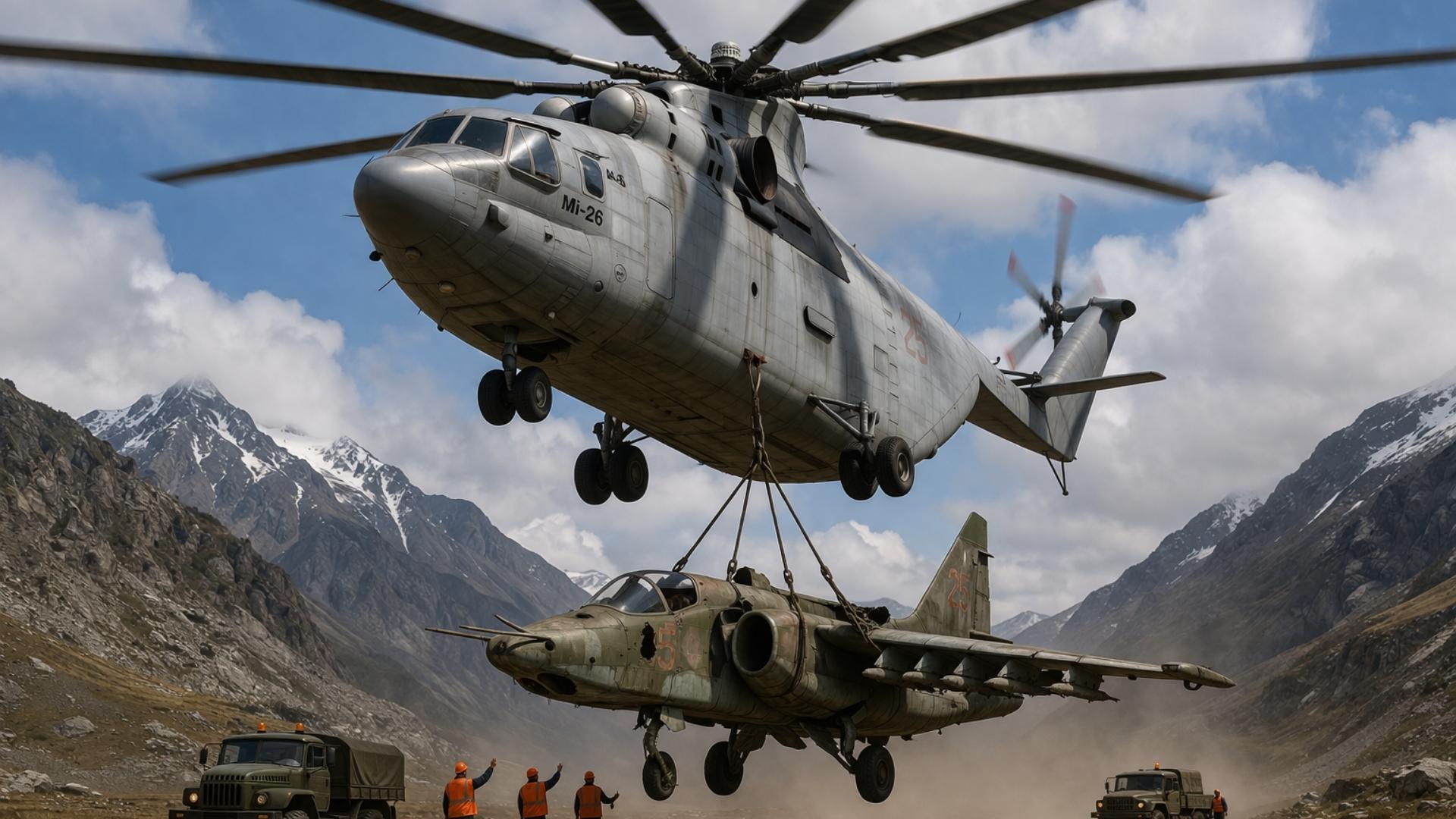
Soviet giant redefined the limits of heavy aviation by combining extreme dimensions, incomparable cargo capacity, and operations in military, civil, and humanitarian missions in different parts of the world, maintaining operational relevance even after more than four decades of continuous use.
The Mil Mi-26, known by its NATO code as Halo, remains the largest helicopter produced in series in the world and holds a rare place in heavy aviation for combining extreme dimensions, a cargo capacity of up to 20 tons, and proven use in military, civil, and humanitarian operations.
The design originated in the Soviet Union, flew for the first time on December 14, 1977, and entered service in the following years, consolidating itself throughout the 1980s as a reference in large-scale air transport.
Although the title presents it as the largest helicopter in the world, the formulation requires an important technical adjustment: the Mi-26 is the largest serial production helicopter still in service, not the largest rotary-wing aircraft ever built.
-
What motivates children to learn and what doesn’t work: a study with over 200,000 students reveals why curiosity outweighs rewards and how grades, praise, and prizes can reduce performance and creativity.

-
The metal that withstands 3,422 degrees without melting is almost as dense as gold, and when combined with carbon, it forms a material with hardness close to that of diamond, which can penetrate rocks and tank armor.

-
With 40% of all the gold on the planet buried in a single geological basin that is 2.7 billion years old in South Africa, the Witwatersrand still hides R$ 3 trillion in unreachable reserves.

-
At over 80° south latitude on Mars, a formation called “Inca City” reveals a network of kilometer-scale ridges that forms an impressive geometric grid visible from space, created by deep fractures and sculpted by ice in one of the most extreme environments on the red planet.


This historical title belongs to the Soviet experimental Mil V-12, which was limited to prototypes and never entered regular production.
Dimensions and structure of the Mi-26 impress in heavy aviation
The grandeur of the Mi-26 begins with its proportions.
The aircraft measures about 40 meters in length, has a height of 8.145 meters, and operates with a main rotor of 32 meters in diameter, consisting of eight blades.
Visually, the height really approaches that of a three-story building, while the rotor assembly helps explain why the model stands out even among the largest military helicopters in operation.
The weight also helps to gauge the size of the aircraft.
The Mi-26 reaches a maximum takeoff weight of 56,000 kilograms, a mark that places it in a category of its own within rotary-wing aviation.
On February 3, 1982, the aircraft also recorded a recognized feat by lifting 56,768.8 kilograms to an altitude of 2,000 meters, a cargo record for helicopters that reinforced its reputation as an out-of-the-ordinary machine.
Cargo capacity and versatility in military and civil missions
The structure was designed for missions where conventional helicopters simply do not deliver results.
The spacious cabin and rear ramp allow for the transport of light armored vehicles, industrial equipment, bulky cargo, and troop contingents.
The standard configuration accommodates up to 90 soldiers or 60 stretchers, in addition to internal or external cargo of up to 20 tons, a combination that has made the model useful in both war scenarios and heavy logistics and rescue operations.
At the heart of this performance are two Lotarev D-136 turboshaft engines, each with about 11,400 hp.
Together, they provide enough power to sustain the helicopter in heavy transport flights and, under certain load conditions, allow the aircraft to continue flying even after losing one engine.
The fuel capacity is another objective data point that helps to understand the scale of the operation.
The Mi-26 has 12,000 liters of fuel in the main tanks, a range of about 800 kilometers in the standard configuration, and a maximum speed close to 295 km/h.
Extreme rescues and historical operations with the Halo helicopter
The history of missions helps explain why the Mi-26 has surpassed the status of an engineering curiosity.
In April 2002, during the war in Afghanistan, a specimen contracted by the United States was used to extract a damaged MH-47E Chinook helicopter from a mountainous area in the Takur Ghar region.
The episode became one of the most well-known examples of the Halo’s ability to recover entire aircraft in hostile terrain.
This was not an isolated case of unconventional employment.
In October 1999, a Mi-26 transported a large frozen block of permafrost containing the so-called Yarkov mammoth in Siberia, an operation often cited for the logistical difficulties involved.
The aircraft also played a significant role in the aerial response to the Chernobyl disaster, following the explosion of reactor 4 on April 26, 1986.
Reports indicate that the model was employed to drop materials over the exposed area and support the initial containment of the nuclear accident.
Modernization maintains relevance after decades of operation
At the same time, the operational history of the helicopter includes tragic episodes.
On August 19, 2002, a Mi-26 from the Russian Air Force was shot down in Chechnya and crashed in Khankala, becoming the deadliest accident in helicopter aviation history, with 127 fatalities.
The case drew increased attention to operational safety and vulnerability in conflict zones.
It was in this context that the more recent versions gained importance.
The modernization Mi-26T2V incorporated an updated avionics suite, automatic navigation features, integration with night vision, satellite communications, and defensive systems.
Even after more than four decades, the Mi-26 remains associated with a niche in which few competitors can operate.
Its value lies in the ability to move loads that would normally require a combination of aircraft, ground convoys, and prior infrastructure.
In remote areas, disaster zones, or mountainous terrain, this advantage remains the main reason the Halo continues to be one of the most enduring symbols of heavy aviation.








Seja o primeiro a reagir!