Portuguese
  Spanish


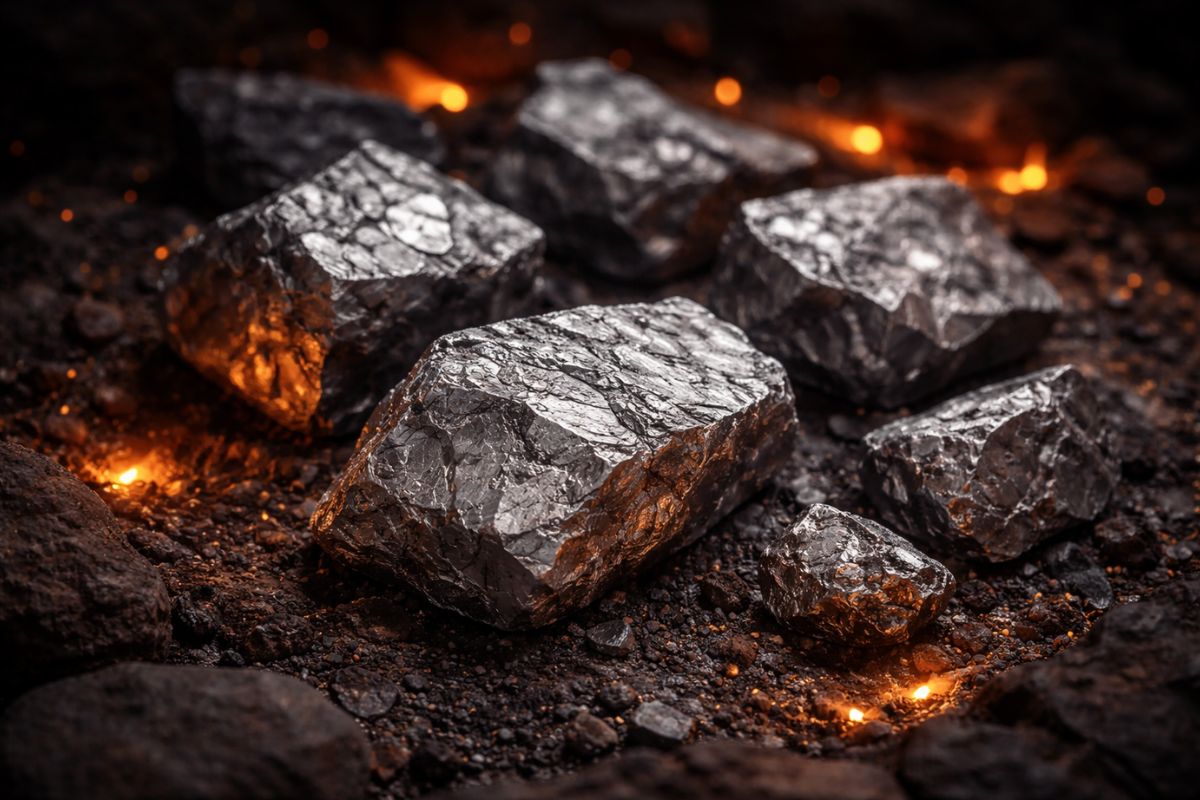

Tungsten is the metal with the highest melting point in the periodic table, with a density of 19.25 g/cm³ that rivals gold, and its carbide has hardness comparable to natural diamond, being used to drill rocks, cut steel, and penetrate military armor with extreme precision
There is a metal in the periodic table that seems designed to withstand the impossible. With a melting point of 3,422 degrees Celsius, tungsten remains solid at temperatures that turn iron into liquid and copper into vapor. Its density of 19.25 g/cm³ places it side by side with gold, but while gold melts before reaching 1,100 degrees, tungsten remains intact under conditions that no other metal can withstand.
The versatility of this element goes beyond thermal resistance. When combined with carbon, it forms tungsten carbide, a compound with hardness close to that of natural diamond. This material is capable of drilling rocks, cutting hardened steel, and penetrating tank armor using pure kinetic energy. It is the kind of metal that supports entire industries without ever being in the spotlight.
Why tungsten resists 3,422 degrees while other metals melt

The answer lies in the atomic structure. Tungsten has exceptionally strong metallic bonds between its atoms, which requires an absurd amount of energy to break the crystal lattice and turn the metal into liquid.
-
Brazilian YouTube Sensation “Galinha Pintadinha” Celebrates 20 Years, Amassing 65 Million Subscribers and $700 Million in Annual Revenue

-
Fifth-grader’s Project Turns Used Cooking Oil into Over 160,000 Gallons of Biodiesel, Cuts CO₂ Emissions, and Inspires Law in Rhode Island

-
Started with $80 at 17 Selling Used Clothes, Now Aiming for $18 Million with a Network of 50 Thrift Stores

-
17-Year-Old Develops Free App to Prevent Hot Car Deaths, Launches National Campaign in the U.S.




No other metallic element in the periodic table reaches such a high melting point. Rhenium, which ranks second, is over 400 degrees lower.
This thermal resistance makes tungsten the mandatory choice in extreme heat environments.
It is the metal behind incandescent light bulb filaments, high-performance welding electrodes, and rocket nozzles that need to withstand combustion without deforming. Where heat destroys everything, tungsten remains.
Comparison of heavy metals
| Metal | Melting Point (°C) | Density (g/cm³) | Main Application |
| Tungsten | 3,422 | 19.25 | Cutting tools and defense |
| Gold | 1,064 | 19.30 | Jewelry and electronics |
| Lead | 327 | 11.34 | Radiation shielding |
Tungsten carbide and its hardness comparable to diamond
When tungsten combines with carbon atoms, the result is tungsten carbide, a ceramic compound with hardness approaching that of natural diamond.
On the Mohs scale, diamond ranks at the top with a score of 10; tungsten carbide reaches between 8.5 and 9, easily surpassing any conventional steel alloy.
This property makes it the preferred material for tools that need to cut, drill, and resist wear for extended periods.
The mining industry relies on these drills to penetrate extremely compact soils and blocks of granite.
In civil construction, tungsten carbide ensures that the cutting wire remains sharp even under constant friction and heat. Without this metal and its carbon compound, drilling rocks at great depths would be drastically slower and more expensive.
From tank armors to airplane counterweights: the metal in the military and aerospace industry
The high density of tungsten allows for the manufacture of armor-piercing projectiles that penetrate tank armor using pure kinetic energy, without the need for explosive charge.
In the aerospace sector, the metal is used as a compact counterweight to balance airplane wings and helicopter rotors, as a small volume concentrates enough mass to ensure the stability of the aircraft.
Another strategic use is in radiation protection. Tungsten absorbs gamma radiation more efficiently than lead and without the associated toxicity.
Hospitals use this metal in collimators of imaging diagnostic equipment, where precision in shielding defines the quality of the exam and the safety of the patient.
Brazil and its tungsten deposits in Rio Grande do Norte
Brazil has significant deposits of scheelite, the base ore of tungsten, concentrated mainly in Rio Grande do Norte.
The city of Currais Novos is the historical hub of this activity and has been driving the economy and employment of the Potiguar region for decades. The extraction of this metal in Brazilian territory is essential for the autonomy of the national manufacturing industry.
A large part of the national tungsten production is destined for export, supplying international markets that demand the metal to manufacture cutting tools, electronic components, and defense parts.
The Brazilian production chain faces logistical and investment challenges, but the quality of the ore extracted in the Northeast keeps the country on the global map of suppliers of this strategic element.
Why tungsten is classified as a conflict mineral in some regions
In some parts of the world, the extraction of this metal is linked to human rights violations and the financing of armed groups in war zones.
International regulations have begun to require complete traceability of the supply chain to ensure that the tungsten traded does not come from illegal sources.
Global companies now require certificates of origin as a condition for closing purchase contracts. Transparency in the supply chain has become as important as the physical properties of the metal.
This change has forced mining companies in countries like the Democratic Republic of the Congo to adopt auditing standards that previously did not exist in the sector.
Recycling and sustainability: the metal that returns to being a tool
Despite its extreme hardness, tungsten is highly recyclable. Worn tools, used drills, and industrial waste can be reprocessed to generate new products with quality equivalent to that of virgin material.
This cycle reduces pressure on natural deposits and decreases the environmental impact of primary mining.
The recycling process consumes significantly less energy than extracting and refining raw ore.
In a global scenario where industrial sustainability has become non-optional, the ability to recover this metal and return it to the production chain represents a real competitive advantage for companies seeking to reduce costs and carbon footprint at the same time.
The invisible metal that sustains modern technology
Tungsten does not shine in store windows, does not make headlines in financial newspapers, and does not arouse the envy of collectors. But it is the one that makes drills drill, projectiles penetrate armor, rockets withstand combustion, and filaments glow.
It is a metal that works behind the scenes of practically all contemporary engineering, from medicine to defense, from civil construction to space exploration.
Did you know all these applications of tungsten? In your opinion, should Brazil invest more in the exploration of this strategic metal or focus on industrial recycling? Leave your comment and share this article with those interested in materials science and engineering.