





 Portuguese
  English
  Spanish
  5 min of reading
  0 comments



Weapons presented by Turkey are once again catching attention for combining controlled fragmentation, deep penetration, and own military development, in a scenario that also arouses interest in engineering, materials, and technologies applied to conventional bombs.
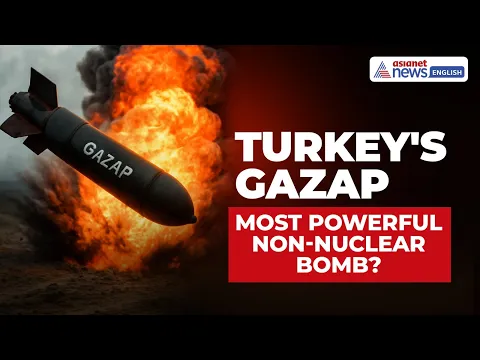
The aerial bomb GAZAP, presented by Turkey at IDEF 2025 in Istanbul, has started to attract attention for bringing together, in a single project, large explosive charge and a controlled fragmentation system.
Developed by the research and development center of the Turkish Ministry of Defense, it was showcased as the most powerful conventional bomb ever presented by the country and made international news for the set of technical characteristics associated with the ammunition.
The emphasis given to the artifact is not only on the size of the bomb.
-
After a submarine disappeared beneath the “Doomsday Glacier,” scientists announce a new monstrous machine capable of operating at 3,000 meters depth to return to the heart of the ice and investigate a threat that could raise sea levels worldwide.

-
NASA has set a date for the beginning of the end of Earth, and it won’t be an asteroid or an explosion: the planet will slowly lose its oxygen over the course of 1 billion years because the Sun is getting hotter every day.

-
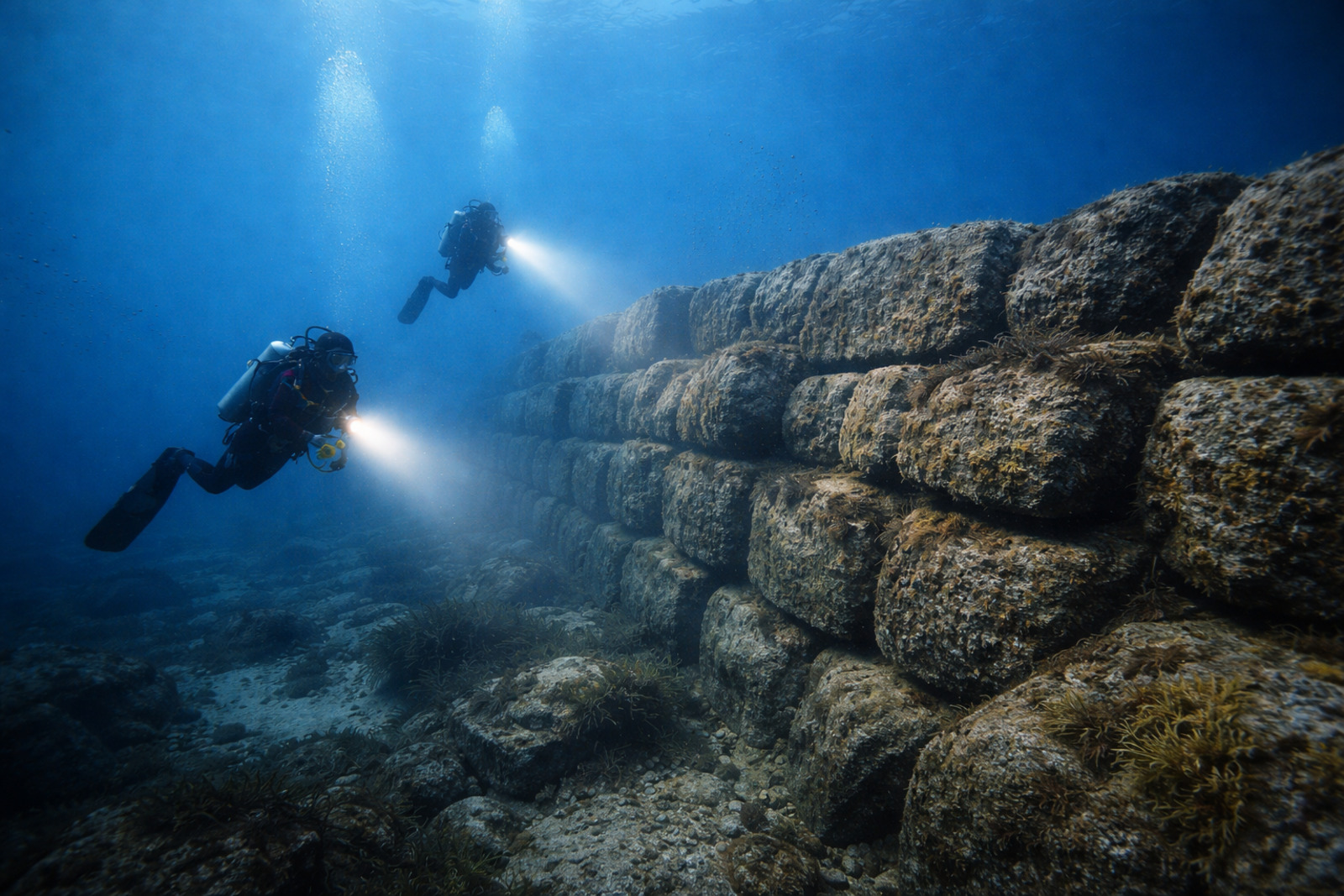
Archaeologists have discovered a colossal submerged wall in the Atlantic, dating back 7,000 years and weighing 3,300 tons, regarded as the largest prehistoric submerged structure ever found in France.
-
Scientists have discovered a gigantic magnetic anomaly hidden beneath the soil of Australia that mirrors the shape of the entire continent and holds geological records of two and a half billion years that could change what we know about the Earth.


According to information released by Turkish authorities during the presentation, the GAZAP was designed as a high-power fragmentation bomb, capable of dispersing 10,000 fragments and achieving a density of 10.16 fragments per square meter, a rate higher than that cited for equivalent conventional bombs.
Instead of relying solely on the rupture of the metal casing in a less predictable manner, the design seeks to distribute the fragments in a more controlled way.
In practice, this design expands the coverage of the affected area after detonation, according to data presented at the defense fair.
Controlled fragmentation and area effect of the GAZAP bomb
In military engineering, the difference between bombs of the same class often lies in how the energy and fragments spread after the explosion.
In the case of the GAZAP, the proposal presented by Turkey is for ammunition that amplifies the destructive effect through a more controlled fragmentation pattern.
After impact or programmed detonation, the bomb’s body ruptures to launch thousands of fragments over the surrounding area.
This type of configuration is employed to increase the effect against personnel, light structures, and targets with less protection, according to analyses published by defense-focused outlets.

It was this set of characteristics that put the GAZAP in the spotlight during IDEF 2025.
The fair, held between July 22 and 27, 2025, in Istanbul, served as a showcase for the Turkish military industry and brought together national and foreign companies in four locations in the city, including the Istanbul Fair Center, Atatürk Airport, WOW Hotel, and Ataköy Marina.
According to the organizers and Anadolu Agency, the event featured more than 900 Turkish companies and over 400 international ones.
In this environment, the presentation of the GAZAP was part of a broader strategy to showcase industrial and technological capacity in the defense sector.
Thermobaric effect and compatibility with F-16 fighters
Another aspect associated with the bomb is the use of thermobaric effect.
This type of technology combines intense shock wave and high heat, amplifying the impact of the explosion in enclosed areas or over certain structures.
In the case of the GAZAP, reports published after the presentation stated that this effect could potentially cause severe damage to concrete and steel.
Still, some of the exact numbers attributed to the artifact, such as maximum temperature and precise extent of some structural damage, appeared more prominently in secondary coverage than in basic technical statements released during the presentation.
In addition to its destructive potential, the ammunition was also presented as compatible with platforms already used by the Turkish Air Force.
Anadolu reported that the GAZAP can be launched by F-16 fighters, while reports derived from the fair also mentioned the possibility of integration with other aircraft certified for Mk 84 class munitions and, in the future, potential adaptation for other platforms.
The specialized publication Janes described the bomb as part of the Mk 80 family of general-purpose bombs, equipped with four tail fins for stabilization and compatible with guidance kits developed for the Mk 84.
This type of compatibility tends to facilitate the operational incorporation of the weapon without requiring complete infrastructure changes, according to specialized literature on munitions of this category.
NEB-2 Ghost and the logic of the penetration bomb
At the same event, Turkey also showcased the NEB-2 Ghost, or Hayalet, a penetration bomb aimed at hardened targets.

Unlike the GAZAP, which emphasizes fragmentation and area effect, the NEB-2 was presented as ammunition designed to penetrate barriers before exploding.
According to Anadolu, Turkish authorities stated that the bomb would be capable of penetrating 7 meters of C50 concrete.
The material released also highlighted a delayed detonation system of 240 milliseconds, above the approximately 25 milliseconds cited as a reference for bombs of the same category.
This delay in explosion is pointed out as one of the main technical differentials of the NEB-2.
Instead of detonating immediately upon impact, the bomb continues to advance for a fraction of a second and only then releases its explosive charge.
According to the explanation presented at the event, this shifts the peak of destruction to the interior of the structure or ground hit.
The same source reported that, in testing, the bomb was launched over an island and penetrated 90 meters into the ground before causing landslides, gas leaks, and destruction of rocks in an area of about 160 meters in diameter.
The difference between the two munitions, therefore, lies less in weight and more in the function designed for each.
While the GAZAP was presented with an emphasis on area effect and fragmentation density, the NEB-2 appeared associated with deep penetration and internal explosion capability.
Military engineering, materials, and defense technology
Although showcased in a defense context, the GAZAP and NEB-2 also attract attention for involving areas such as materials science, explosion modeling, metallurgy, casing design, and electronic timing.
Therefore, the interest surrounding these systems is not limited to military debate.
In the case of the GAZAP, the presentation highlighted fragment density, constructive logic, and integration with already operational platforms.

In the case of the NEB-2, the focus was on concrete resistance, detonation delay, and penetration depth.
These elements help explain why certain munitions also gain space in coverage focused on technology and innovation.
More than the weight or size of the ammunition, what tends to attract attention is how design solutions translate into measurable physical effects in tests and public demonstrations.
The Turkish presentation, in this context, served as a demonstration of industrial capability applied to the development of conventional munitions.
The technical interest generated by the GAZAP and NEB-2 stems precisely from this point: both were exposed as examples of military engineering aimed at enhancing performance, whether through controlled fragmentation or deep penetration.






Seja o primeiro a reagir!