





 Portuguese
  English
  Spanish
  9 min of reading
  0 comments



With about 5,000 sailors on board, the USS Gerald R. Ford operates like a floating city that requires mass feeding, controlled showers, cramped accommodations, and an intense maintenance routine to sustain missions that can last up to six months away from shore
The channel The Daily Navy revealed details of the routine aboard a United States aircraft carrier and showed how thousands of military personnel live for months in a structure that functions as a floating city.
On the USS Gerald R. Ford, about 5,000 sailors coexist with industrial-scale food, cramped dormitories, controlled showers, and a continuous maintenance operation to keep the ship at sea.
The portrait presented revolves around a vessel valued at $13 billion, capable of carrying 75 fighter jets and striking targets up to a thousand miles away.
-
Man plays the same numbers in the lottery for 22 years, hits everything at once, and wins a prize of $3.5 million.

-
Where there was only sand and wind at 40 degrees, China built a megacity of 500,000 inhabitants with farms, vineyards, and universities in the middle of the desert using melted glacier water from hundreds of kilometers away.

-
In the middle of the desert, Saudi Arabia wants to make it snow, build a billion-dollar ski resort on a 2,600-meter mountain, and prove to the world that even sand can become a luxury winter destination.

-
Without a button, sensor, or any electronic system, Harvard scientists create a solar device that autonomously decides whether to generate energy or heat and can transform energy use in homes and buildings.


While concentrating this military power, the ship relies on a highly organized routine to meet basic needs such as eating, sleeping, and maintaining hygiene in an environment that can go without touching land for up to six months.

City-scale feeding inside the aircraft carrier
The feeding operation is among the largest daily tasks on board. On an aircraft carrier like the USS Gerald R. Ford, the culinary team serves up to 17,300 meals per day, including breakfast, lunch, dinner, and the so-called “mids,” intended for military personnel working the overnight shift.
To sustain this pace, the Navy employs between 93 and 114 culinary specialists trained at a service school in Fort Lee, Virginia. Once in operation, they face shifts of 12 to 16 hours in intensely hot environments, with temperatures that can exceed 135 degrees Fahrenheit.
The daily consumption numbers help to gauge the scale of this routine. The crew consumes, in a single day, 1,600 pounds of chicken, 350 pounds of lettuce, 160 gallons of milk, 30 boxes of cereal, and 20,000 cups of coffee.
Over a typical six-month deployment, this means processing millions of pounds of food.
The cost of this operation is also high. The daily grocery bill for the USS Gerald R. Ford ranges from $45,000 to $65,000, exceeding $1 million per month just to keep the crew fed.
As the ship cannot simply refuel when needed, resupply follows a strict schedule. Every seven to ten days, supply vessels approach, match the speed of the aircraft carrier, and transfer between 400,000 and 700,000 pounds of food via cable systems, with both ships in motion.
The distribution of food also follows defined criteria. Men receive 2,850 calories per day, while women have an allocation of 2,100 calories, and the menus rotate in cycles of 14 to 21 days to avoid excessive repetition. The preparation also considers food allergies, religious restrictions, and personal preferences whenever possible.
In practice, mealtime resembles that of a large cafeteria in continuous operation. Breakfast is served from 6 AM to 9 AM, in lines that cross different decks, with trays, utensils, and prior consultation of the menu, in a cafeteria system.
Not everyone, however, experiences this in the same way. Enlisted sailors eat in large communal halls, while officers have separate areas, with better furniture and more formal service; higher-ranking officers have private rooms with white tablecloths and higher standard meals.
Once a month, military personnel celebrating their birthdays receive special treatment. They are seated at tables with white tablecloths, glasses with non-alcoholic drinks, background music, and dishes like lobster or prime rib, in an attempt to boost the morale of those far from home.
Even with the setup in place, feeding can be interrupted at any moment. In case of an alarm, emergency drill, or activation of combat stations, those in line must abandon their meal and rush to their sector, potentially going seven or eight hours without another chance to eat, depending on the shift.
There is also the issue of waste disposal. Food scraps, uneaten meals, and packaging must be managed under strict environmental protocols, and much of it ends up compacted and thrown into the sea in ocean areas where this is legally permitted, according to the report presented.


Sleeping on the aircraft carrier means living with minimal space and constant noise
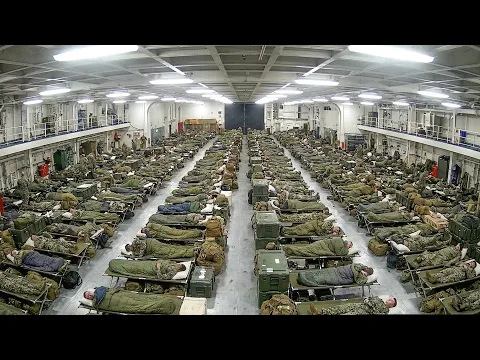
After feeding, the other central axis of the routine is rest. On aircraft carriers, sailors’ accommodations consist of metal bunks stacked three high, installed in cramped compartments shared with dozens of people.
On the newer Ford-class ships, the compartments house 40 people, while those of the Nimitz class can concentrate up to 180 military personnel in the same space. The change is treated as an important improvement, as it reduces noise, intense circulation, and pressure on the attached facilities.
Each standard bed measures 77 inches long by 27 inches wide, a size slightly smaller than a twin bed. The mattress is described as a thin piece of three-inch foam, and the space between one bed and another is only 20 inches, a limit that makes it difficult to even turn comfortably.
Military personnel positioned in the lower and middle bunks often refer to these spaces as “coffin lockers.” The feeling of confinement is amplified by the fact that each person has only a small storage compartment and a narrow locker, about 10 by 22 by 41 inches, to store everything they will take for six months.
The accommodations are located deep within the vessel, far below the flight deck. As a result, many sailors spend weeks without contact with natural light, waking, working, and going back to sleep under artificial lighting, a condition described as disorienting and mentally demanding.
Sleep, moreover, coexists with constant noise. The ship operates 24 hours a day, which means takeoffs and landings of jets on the upper deck, engines running continuously, doors slamming, and constant movement of people through the corridors.
To cope with this environment, sailors resort to earplugs, eye masks, and curtains around the bunks. On the newer Ford-class aircraft carriers, these curtains are already part of the standard equipment and offer a minimum of privacy amid the collective use of space.
The work scale exacerbates wear and tear. Shifts are rotating, which can lead a service member to work days one week and nights the next, making it difficult for the body to adapt and amplifying the effects of sleep deprivation, compounded by the stress of deployment and distance from family.
Even so, the accommodations have some supportive resources. There are small common areas with satellite television, and on Ford-class ships, rooms with access to Wi-Fi located in front of the dormitories, considered a significant advancement over older vessels.
The hierarchical difference appears again in the way of living. Younger officers share cabins with one to five colleagues, while lieutenant commanders and higher ranks usually share with only one other person, while higher-ranking officers and the ship’s commander have private cabins with a table, private bathroom, and more space than enlisted personnel.
Showers, bathrooms, and laundry require discipline and deal with frequent failures
Daily hygiene also depends on discipline and adaptation. In a typical enlisted sailors’ accommodation, three to four showers, three to four toilets, and some urinals must serve between 80 and 100 people, making shared use one of the most visible aspects of life on an aircraft carrier.
On the newer Ford-class ships, the bathrooms have become completely gender-neutral, with no urinals and only toilets. The justification is to allow for the quick conversion of male areas to female, or vice versa, depending on the crew composition, without the need for renovation.
The flushing system uses vacuum suction similar to that of commercial aircraft. Although efficient, it is described as prone to clogs, and the USS Gerald R. Ford has faced recurring issues since it entered service, averaging two major obstruction episodes per day.
When this happens, several bathrooms can go out of use at the same time. Repairs take from 30 minutes to two hours, forcing sailors to seek alternative facilities on other decks, while the source of the clogs is attributed to the improper disposal of items such as t-shirts, mop heads, and other objects.
The text also mentions a problem with the sizing of the pipes, pointed out by the Government Accountability Office in 2020. In the most severe cases, the Navy must resort to a chemical procedure called acid flush, costing $400,000 for each application.
In situations of accumulated failures during missions, improvised measures arise. The report mentions the use of showers, industrial sinks, bottles, and even the side of the ship, along with information that women sometimes end up holding their needs for long periods, with health consequences.
In the case of showers, controlling water consumption is part of the routine. Even with nuclear desalination systems, fresh water is treated as a valuable resource, and sailors are trained to take what is called a “Navy shower,” where the water is turned on to wet the body, turned off during soap use, and turned back on only for rinsing.
This model consumes about 11 liters, or three gallons, per shower, while a typical civilian shower would use 230 liters, or 60 gallons. In a universe of 5,000 people per day, the savings generated by this method are presented as crucial for the operation.
The shower stalls are small, simple, and delineated by metal partitions, without any additional comfort elements. During peak hours, especially after shift changes, lines of sailors waiting to clean themselves form.
Personal cleanliness is treated as an operational requirement. In such closed and shared spaces, an outbreak of flu or stomach virus can sideline dozens of military personnel and compromise the ship’s mission, which leads the Navy to maintain strict hygiene standards.
The laundry completes this set of basic needs. During deployment, aircraft carriers process 150,000 pounds of clothing per week, in facilities that operate 16 to 20 hours a day, six or seven days a week, with nine heavy washers, two smaller ones, 11 industrial dryers, and 12 steam presses.
These areas are located below the waterline and operate under extreme heat, with temperatures between 120 and 135 degrees Fahrenheit. When the environment exceeds 100 degrees, sailors are limited to one-hour shifts to reduce the risk of heat-related illnesses.
Clothes must be labeled with the users’ names for later return. Even so, the system is described as slow, prone to losses and exchanges of items, which leads many sailors to wash some of their own clothes in the sinks of the accommodations, although this goes against the rules.
On the newer ships, the adoption of ozone cleaning systems has reduced the use of soap and hot water, cut costs, and decreased wear on uniforms. Even with these improvements, however, the laundry service remains among the least appreciated tasks of life on board.
Closed structure supports the routine and the mission
In addition to feeding, accommodation, showers, and laundry, the ship includes other internal services. There are medical and dental clinics, barbershops, cashless stores, gyms, libraries, chaplain services, post offices, and small banks, composing a structure designed to operate autonomously for months.
According to the report, the USS Gerald R. Ford can launch 270 sorties in a single day and operates with two nuclear reactors, which provide it with virtually unlimited range. In this context, the living conditions of the crew appear as a direct part of the operational capacity of the aircraft carrier, as the vessel depends on thousands of sailors to keep all systems running.
The Navy has been investing in improvements in habitability conditions, such as smaller accommodations, better food, access to Wi-Fi, and updated laundry systems.
The logic presented is that morale, rest, feeding, and hygiene are not accessory items, but factors linked to the daily performance of the crew on a vessel that remains in constant operation.
The described routine, therefore, combines military power and severe limitations of space, comfort, and privacy. Inside the aircraft carrier, the projection of force depends on a human mechanism subjected to lines, heat, noise, shift rotations, and permanent discipline to keep a floating city functioning at sea.







Seja o primeiro a reagir!