





 Portuguese
  English
  Spanish
  7 min of reading
  0 comments


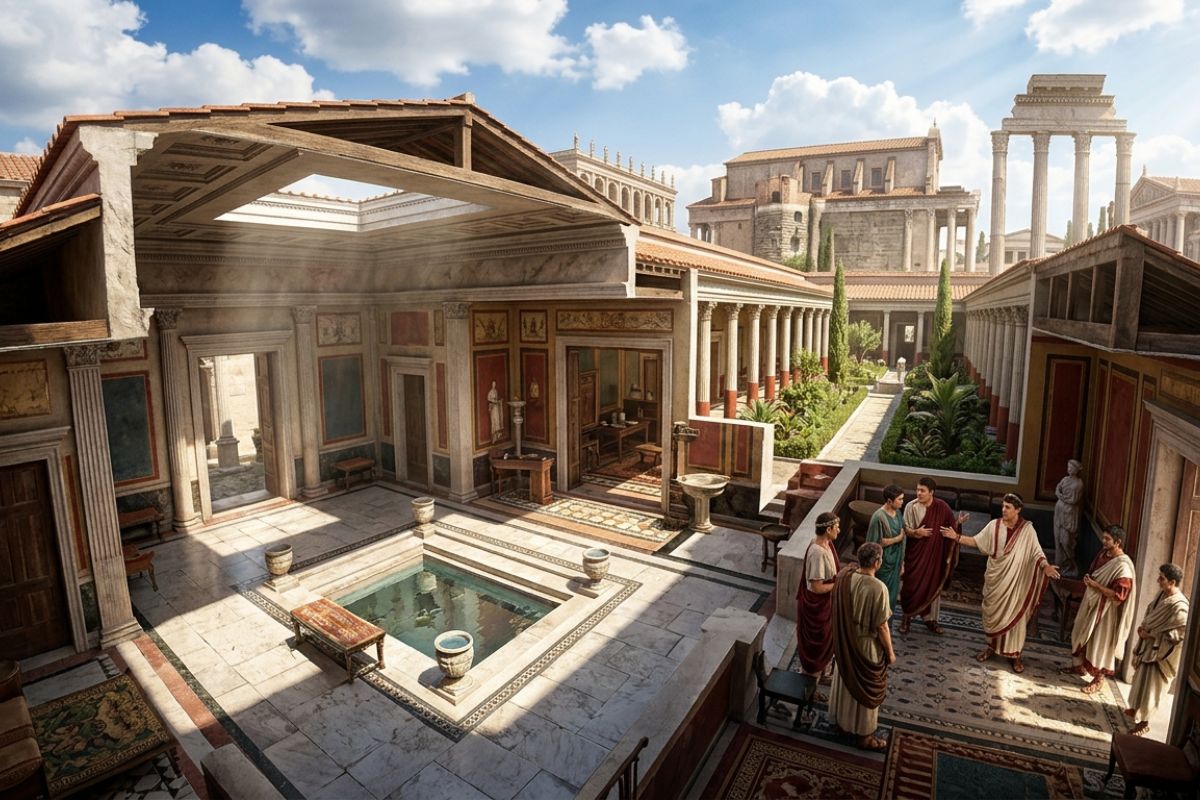
In the Public House of Julius Caesar, in the Roman Forum, the AI recreation shows the atrium, tablinium, and peristyle and recounts the Bona Dea in the Roman context
The Public House in the Roman Forum was not just Julius Caesar’s home. It was an address where religion, politics, and influence mixed daily, with lines of people seeking favors, documents being kept under lock and key, and decisions affecting the Roman State happening behind partially open doors.
Now, an AI recreation, built as a simulation from historical records, archaeological finds, and descriptions from ancient authors, attempts to restore the form and atmosphere of the interior of this official residence. The result helps visualize the layout, environments, and routines, as well as the backdrop of the Bona Dea scandal, which shook Rome at the very heart of Roman society.
Where the Public House was located in the Roman Forum and why it mattered

The Public House, called the “house of the State,” was located on the Via Sacra, the ceremonial avenue of the Roman Forum, between the Temple of Vesta and the House of the Vestal Virgins.
-
While digging a trench next to a pool in Germany, workers found more than 1,500 silver coins from 1320 in the rubble, revealing a treasure buried for over 700 years.
-
Flight Helios 522, the “ghost” flight with 121 people: the commercial aircraft flew for more than 2 hours on autopilot after a pressurization failure left pilots and passengers unconscious and only stopped when it ran out of fuel.

-
Researchers have located a nearly intact vessel that disappeared 125 years ago on the bottom of icy waters, with masts still preserved and rare details that impress archaeologists.

-
Mars may have hidden for a long time an answer to the loss of its atmosphere, after the Curiosity rover found a mineral that stores carbon in rocks from Gale Crater.


It was a strategic position, close to the most sacred religious center of the city, separated from the complex of the Vestals by a wall from the Republican era.
To the north, a row of taverns, small shops facing the Via Sacra, helped conceal the entrance. Between two of these shops, a discreet vestibule served as a portal to a much grander interior than the traffic of the Roman Forum would suggest.
The entrance: discreet vestibule, short corridor, and service rooms
The arrival was calculated. The vestibule led to a short corridor, with a service room on each side, leading to the heart of the residence.
Nothing there was “casual”, because the Public House needed to filter who entered, who waited, and who really got close to the owner of the house.
This type of organization was not just architecture. It was social control in the Roman world, where access to the powerful was as valuable as a formal audience.
The atrium with compluvium and impluvium: light, water, and power at the center of the house

The atrium was the most important space in any elite house, and in the Public House, it had dimensions and decoration commensurate with the office.
The ceiling had an opening called compluvium, through which light and rain entered. The water fell into the center of the floor, into a shallow basin called impluvium, usually made of marble or polished stone.
The impluvium was not just beautiful. It fed an underground cistern, and a cylindrical well with a lid, the puteal, allowed water to be drawn with buckets.
On hot days, evaporation helped cool the environment, a practical detail that shows how Roman daily life knew how to use simple engineering efficiently.
Salutatio: the daily ceremony that filled the Roman atrium

At dawn, the Public House became the stage for a political routine. It was there that Caesar received clients in a ceremony called salutatio. Senators, merchants, and citizens formed a line in the atrium, surrounded by symbols of tradition and prestige.
The walls could have paintings from the second Pompeian style, creating architectural illusions of columns, porticos, and landscapes to enlarge the space. It was visual propaganda in the Roman style, transforming reception into a demonstration of power.
Lararium, arca, and imagines: domestic religion and public memory inside the house

In one corner of the atrium was the lararium, an altar dedicated to the Lares and Penates, protective deities of the home and pantry.
Daily offerings were left there, because honoring the household gods was an non-negotiable part of Roman routine, especially for the pontifex maximus.
Also in the atrium was the arca, a robust chest, sometimes chained to the floor, for documents, money, and valuables.
In the side wings, the alae, there were cabinets with imagines, wax masks of ancestors displayed as lineage and curriculum. It was a repository of Roman prestige in the form of a face.
Cubiculum: small rooms and privacy made with curtains

Around the atrium were the cubicula, surprisingly small bedrooms by today’s standards.
There was usually a narrow bed, a thin mattress, and sometimes a couch. Privacy came more from heavy curtains than from internal doors.
Domestic slaves slept in even more modest spaces, sometimes on thresholds or in rooms so simple that they are not always easy to identify. The social difference, in the Roman world, was also spatial.
The tablinium: where the Roman calendar could be manipulated

At the back of the atrium, prominently positioned, was the tablinium, the main office and reception room. There, Caesar exercised the functions of pontifex maximus, including reviewing the Roman calendar, one of the most sensitive responsibilities of the office.
The pontiffs had the power to insert intercalary months to adjust the calendar to the seasons, something that could be used politically to extend or shorten mandates.
This detail helps understand how the house was also a center of Roman control, with a direct impact on public life.
A curtain separated the tablinium from the atrium and could be drawn back, creating a continuous view from the entrance to the peristyle, enhancing the sense of perspective and grandeur.
The peristyle: internal garden for silence and private conversations

Behind the tablinium, the peristyle was an internal garden surrounded by a colonnade. Aromatic herbs, flowers, and small fruit trees grew there. Statues, benches, and sometimes fountains transformed the space into an outdoor room.
For Caesar, who spent hours in meetings and ceremonies, the peristyle offered a rare respite. It was the Roman breath within the machinery of power, and also a useful place for conversations away from the ears of the atrium.
The triclinium: banquets that were politics disguised as dinner

Next to the peristyle was the triclinium, a formal dining room with three couches in a U-shape. Guests leaned on their left elbow and ate with their right hand, while the free side was for the service of slaves. The position of each guest indicated social status.
The walls were decorated with mosaics and frescoes of mythological scenes, divine banquets, or landscapes. Dinners could start around late afternoon and continue into the night, with courses of appetizers, main dishes, and desserts. In the Roman environment, eating well was also negotiating well.
Kitchen, slaves, and olive oil light: the house functioning behind the spectacle
The kitchen was located further away, near the peristyle, with a masonry counter and charcoal to heat bronze and ceramic pots.
There was no chimney in the modern sense. Iron tripods supported containers over the coals, and utensils were kept on shelves.
After sunset, the lighting came from ceramic and bronze lamps burning olive oil, an expensive resource.
Having light at night was a sign of Roman wealth, and maintaining it depended on an invisible work structure, sustained by slaves.
The Bona Dea: the scandal that profaned the house of the pontifex maximus

In the winter of 62 BC, the festival of the Bona Dea, a deity associated with fertility and healing, was celebrated inside the Public House. It was an exclusively female ritual. No man could participate, not even the pontifex maximus himself.
Caesar’s wife, Pompeia, was the host, assisted by Aurelia, Caesar’s mother, and supervised by the Vestal Virgins. The doors were closed, and the female elite gathered for prayers, sacrifices, and offerings.
Then came the unthinkable: Publius Clodius Pulcher, a patrician senator known for provocative behavior, entered disguised as a musician to approach Pompeia.
A servant of Aurelia noticed something strange, the alarm was raised, and the scandal shook Rome. Clodius was tried for sacrilege.
Cicero testified against him, but with financial support from Crassus and bribery of jurors, Clodius was ultimately acquitted. Caesar divorced Pompeia and left the phrase that has crossed centuries: Caesar’s wife must not even be the subject of suspicion.
Omen, death, and what remains today of the Roman heart
The Public House held religious objects of great importance, linked to the Regia, the ancient palace of the kings of Rome. There would be sacred shields of Mars, the ancilia, and spears consecrated to the god of war. Tradition said that if the spears vibrated spontaneously, something terrible was approaching.
According to the account, on the night of March 14, 44 BC, the spears would have shaken. The next morning, despite warnings and omens, Caesar left home and went to the Senate, where he was assassinated with 23 stab wounds. The body was laid in state for three days at the residence before proceeding to the Roman Forum for the public funeral.
After Caesar’s death, the Public House passed to Marcus Emilius Lepidus. Decades later, Augustus took the title of pontifex maximus, moved the official residence to the Palatine Hill, and donated the Public House to the Vestal Virgins.
Today, foundations and archaeological fragments remain in the Roman Forum, hidden beneath layers of later constructions.
If you could “enter” this recreation and choose a room to see from the inside, which would it be: the atrium, the tablinium, or the peristyle?






Seja o primeiro a reagir!