





 English
  Francês
  Alemão
  Italiano
  Japonês
  Norueguês
  Portuguese
  Spanish
  4 min of reading
  0 comments


Study identifies that the tilt of the Earth, in a 40 thousand year cycle, influenced the expansion of ice in Antarctica and changed nutrient transport, affecting marine productivity in subtropical regions thousands of kilometers from the poles
The tilt of the Earth, in a 40 thousand year cycle known as obliquity, has been linked to changes in marine biological productivity in subtropical areas about 34 million years ago, during the first expansion of the Antarctic ice sheets.
The conclusion integrates new research led by scientists from the University of Wisconsin-Madison, who identified the influence of this polar process on oceans located thousands of kilometers away.
The study was published in the Proceedings of the National Academy of Sciences and analyzed a 1 million year interval associated with the initial advance of Antarctic ice.
-
350-year mystery may have been solved: remains of a soldier who inspired the hero of The Three Musketeers found beneath a church in the Netherlands.

-
NASA photographed a nearly perfect square with 3 km sides on Mars, 13 times larger than the Great Pyramid of Giza, but the official explanation is natural erosion; still, no one has explained why the four sides have almost identical lengths.

-
Starlink breaks the barrier of 10,000 satellites in orbit and takes its expansion to an unprecedented level, with a direct impact on global internet, technological competition, and the race for space.

-
Japan finds an alternative to oil amid rising prices by transforming ocean balance into electricity with a new technology that maintains efficiency even when the sea changes.

The researchers found that the obliquity cycle exerted a strong and unique influence on the bioproductivity of the ancient subtropical ocean, something considered unexpected for regions close to the equator.
The discovery caught the team’s attention because, in general, this astronomical cycle is treated as a more important factor for polar conditions than for climate and oceanic conditions at lower latitudes. According to Stephen Meyers, a professor of geosciences at UW-Madison and one of the lead authors of the study, it is typically expected that other astronomical cycles would have a greater influence in such environments.
40 Thousand Year Cycle Appeared Strongly Outside Polar Regions
Even so, scientists found a striking signal of the 40 thousand year cycle in records of subtropical marine productivity. For Meyers, the result indicates that bioproductivity was being influenced by a distant process, located at high latitudes, through nutrient transport to lower regions.
The observed relationship directly connects the dynamics of the Antarctic ice sheets to changes in marine ecosystems far beyond the polar surroundings. The study shows that during the emergence and initial expansion of this ice, changes in one part of the planet had measurable effects in another, on an oceanic scale.
The authors associate this behavior with the time when the Antarctic ice sheet began to grow more broadly, about 34 million years ago. During this period, the rate of obliquity began to impact the supply of nutrients to the subtropical location analyzed by the research.
Seafloor Sediments Helped Reconstruct the Past
The team reached these conclusions from the analysis of chemical signals preserved in ocean sediments. These records allowed for the reconstruction of past biological productivity and understanding how marine life responded to the dynamics of the Antarctic ice sheets.
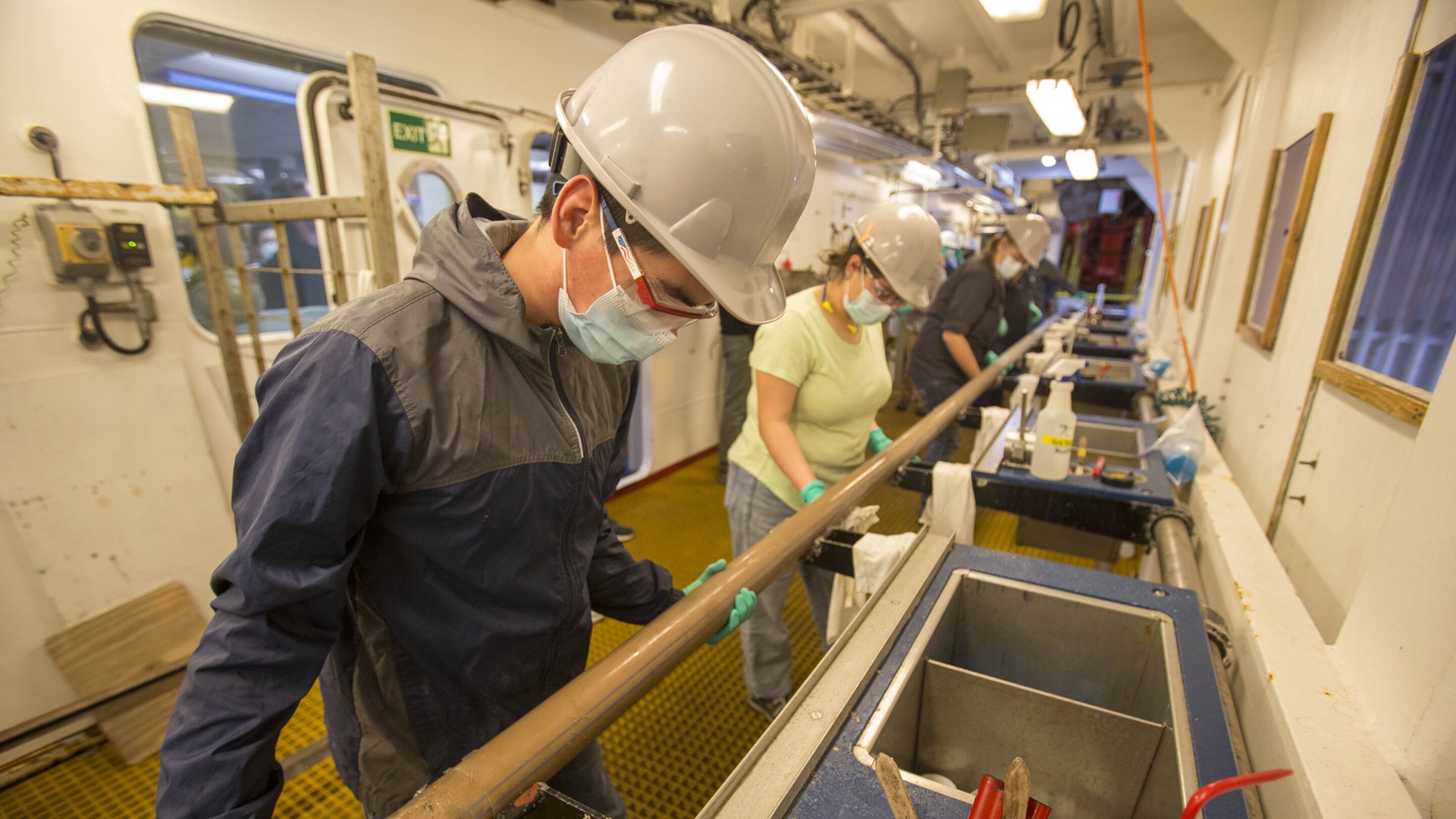
The samples were collected during ocean drilling expeditions conducted between 2020 and 2022 aboard the now-retired scientific vessel JOIDES Resolution. For decades, the vessel gathered seafloor sediments used in research on the geological history of the oceans and the Earth.
Alexandra Villa, who co-led the study with Meyers while she was a PhD student at UW-Madison, participated in the expedition as a scientist on board. Now a postdoctoral researcher at MARUM in Bremen, Germany, she continues to use scientific drilling archives in her investigations.
According to Villa, the ship produced archives that supported major scientific discoveries related to global climate events, the evolution of life, and plate tectonics. In this case, the sediment cores gave researchers the chance to reconstruct whether and how life in subtropical oceans changed in response to processes occurring thousands of kilometers away.
How Antarctic Ice Altered Nutrient Transport
To understand this connection, Villa emphasized the need to consider how ocean circulation is related to bioproductivity. Today, about three-quarters of all marine bioproductivity north of 30 degrees south of the equator depends on nutrients derived from the circulation of the Antarctic Ocean, which surrounds Antarctica.
These nutrient-rich waters sink and move towards lower latitudes, where they mix back with the surface. This process directly influences marine bioproductivity in subtropical areas, connecting the dynamics of the polar south to distant ecological chains.
When the Antarctic ice sheet emerged, about 34 million years ago, it altered ocean circulation patterns and the movement of nutrients through the seas. According to Villa, when this ice became large enough to extend into the Antarctic Ocean, the 40 thousand year obliquity cycle of the marine ice sheets began to affect the nutrient supply to the subtropical site studied.
This connection helps explain why a cycle associated with the tilt of the Earth and polar regions appeared so prominently in an ancient subtropical environment. What seemed to be a limited influence outside the poles turned out to be an important component in the distribution of nutrients and biological productivity of the ocean.
Study Reinforces the Interconnection of the Earth’s Climate System
The research expands on previous results from UW-Madison, which had already shown the strong action of the 40 thousand year obliquity cycle on marine polar caps. Now, scientists claim to connect this same cycle to the global dynamics of the oceans and their long-range effects.
For Meyers, the Earth system is so interconnected that changes in one part of the planet can propagate in unexpected ways. He points to the polar caps and global ocean circulation as central examples of this functioning, with impacts on marine food chains far beyond the areas covered by ice.
The study, according to the researcher, shows how these global teleconnections can be dynamic, variable, and at times surprising. By relating the tilt of the Earth, the expansion of Antarctic ice, and productivity in subtropical seas, the research reinforces the planetary dimension of the climatic connections recorded in geological history.







Seja o primeiro a reagir!