





 Portuguese
  English
  Spanish
  6 min of reading
  0 comments


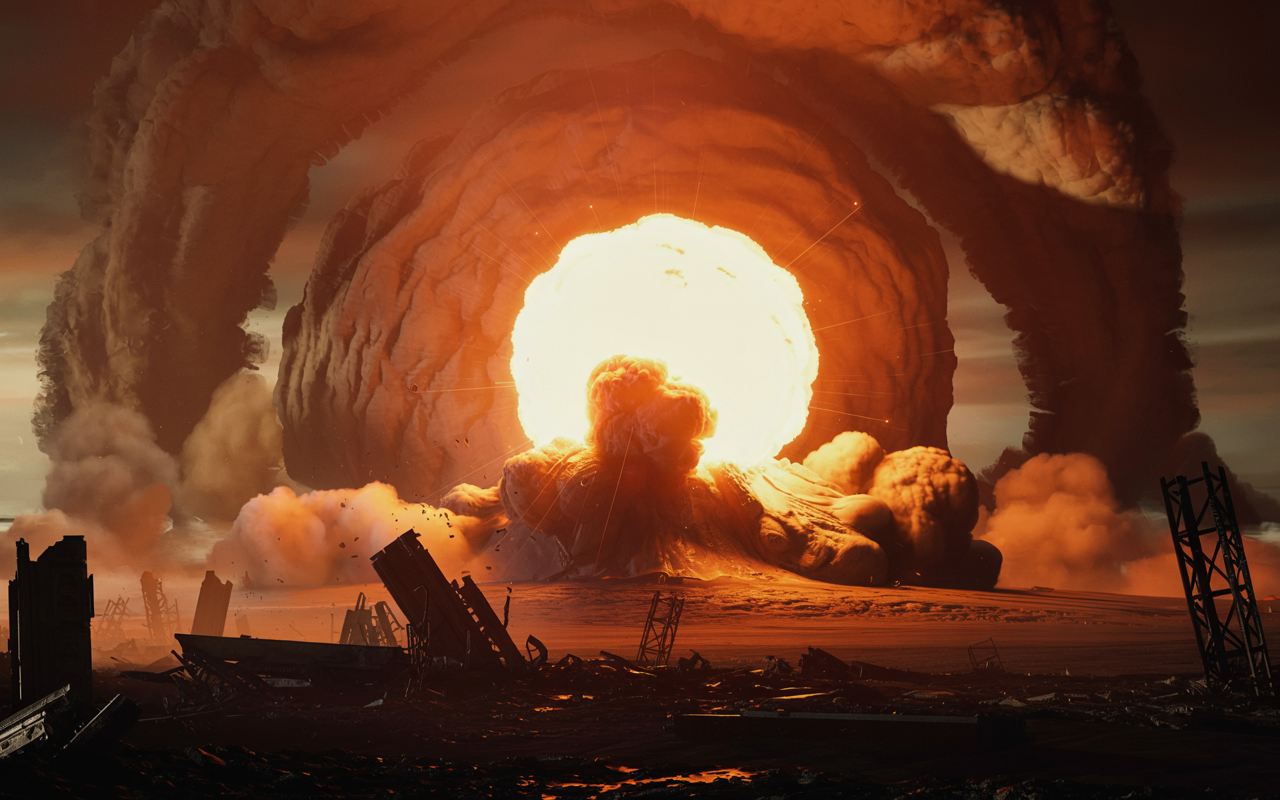
What Would Happen If We Detonated An Antimatter Bomb On Earth? ChatGPT’s Response Is Frightening: Understand The Real Effects Of This Theoretical Explosion Based On Modern Physics And See Why It Would Outperform Any Nuclear Bomb.
Antimatter has been featured in science fiction films and futuristic novels. However, modern physics confirms that it is a real substance, predicted by theories such as quantum mechanics and verified in experiments at cutting-edge laboratories like CERN. But one intriguing question remains: what would happen if we detonated an antimatter bomb on Earth? The answer, based on real physics, is frightening due to the unimaginable scale of destruction — and involves concepts ranging from Einstein to total annihilation of matter.
Let it be clear: This article presents a theoretical simulation developed with the assistance of ChatGPT’s artificial intelligence, using only data and laws of physics accepted by the scientific community as a basis. The question is provocative: what would happen if we detonated an antimatter bomb on Earth? While this scenario does not represent a real risk at present, the answer — as speculative as it may be — is frightening due to the scale of destruction involved.
Antimatter, while exotic, is a reality in particle physics laboratories and already has practical applications in fields such as medicine. However, its destructive potential, if used as a weapon, would far exceed that of any known nuclear bomb. In this content, you will see what physics says about the effects of an antimatter bomb and why this hypothetical simulation deserves attention, even if it remains in the realm of science fiction.
-
Global warming will expose a treasure hidden under the ice of Antarctica and may spark an international dispute over gold and valuable minerals.

-
A street vendor from Praia Grande built a robot made of scrap from scooters and washing machines that pulls his popcorn cart on the beach, emits sounds, and interacts with customers, becoming an attraction on the coast of São Paulo.

-
The specifications of the Xiaomi 18 Pro Max have been leaked, and the highlight is a dual 200 MP camera with a new 22-nanometer technology that promises to consume less energy and capture details in shadows and bright areas using LOFIC HDR.

-
If the trip to the Moon were a hoax, it would be necessary to keep the secret among 400,000 people for more than 50 years and to deceive even the Soviet Union, which was tracking the radio signals coming from the exact direction of the satellite during each Apollo mission.


What Is Antimatter And Why Is It So Powerful?
Antimatter is the opposite of ordinary matter. For every particle of matter — such as electrons, protons, and neutrons — there is a corresponding antiparticle: positrons, antiprotons, and antineutrons. When matter and antimatter come into contact, they annihilate each other, releasing a colossal amount of energy.
Energy of Annihilation: E = mc² In Action
Einstein’s formula, E = mc², tells us that mass and energy are equivalent. One gram of antimatter annihilating with one gram of matter could generate about 180 terajoules of energy — equivalent to 43,000 tons of TNT. That is more than twice the bomb at Hiroshima.
What If We Detonated An Antimatter Bomb On Earth?
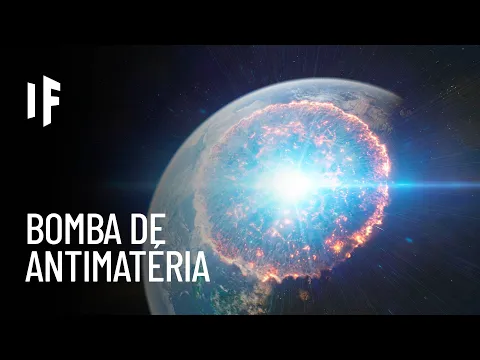

Currently, the creation of an antimatter bomb is still theoretically possible, but practically unfeasible. The production of antimatter is extremely limited: CERN in Switzerland produces only a few billionths of a gram per year, at a cost of trillions of dollars per milligram. Furthermore, there is no safe way to store it for long periods.
But if we disregarded these limitations and imagined the detonation of a 1 kg antimatter bomb on Earth, the effects would be catastrophic.
Immediate Effects: Nuclear-Scale Explosion Multiplied
The annihilation of 1 kg of antimatter with 1 kg of ordinary matter would release energy equivalent to around 43 megatons of TNT — almost 3,000 times more powerful than the Hiroshima bomb.
The immediate effects would include:
- A fireball with diameter of several kilometers;
- Intense gamma radiation, lethal to all living beings within a radius of several kilometers;
- A shock wave capable of destroying entire cities;
- Local earthquakes and possible changes in regional climate;
- Release of dangerous secondary particles, such as muons and positrons.
What If We Detonated An Antimatter Bomb In Space?
If an antimatter bomb were detonated in space — for example, in low Earth orbit — the effects would depend on the altitude. In low orbits, the explosion could damage satellites and communication systems, in addition to creating a cloud of ionizing radiation capable of affecting astronauts and the International Space Station.
If detonated at high altitude, the atmospheric effects would be reduced, but the electromagnetic pulse (EMP) generated could cause a global technological blackout, similar to a devastating cyber attack.
Comparison With Nuclear Bombs
Antimatter Vs. Nuclear Weapons: What Is The Level Of Destruction?
| Type Of Bomb | Energy Per Kg | Equivalent In TNT | Availability |
|---|---|---|---|
| Nuclear Bomb (Fission) | ~83 TJ/kg | ~20 kt | High |
| Thermonuclear Bomb (Fusion) | ~300 TJ/kg | ~70 kt | High |
| Antimatter Bomb | ~90,000 TJ/kg | ~21 Mt | Nonexistent (Theoretical) |
An antimatter bomb is potentially the most powerful weapon ever conceived, but it remains in the theoretical realm. Nevertheless, its scale of destruction exceeds any current weapons technology.
Destructive Power: Simulations Made By Scientists
Theoretical studies, such as those conducted by physicist Gerald Smith from Pennsylvania State University and teams from Fermilab and CERN, explore the use of antimatter for space propulsion — and warn against its military use.
Simulations indicate that the explosion of 10 kg of antimatter on Earth could completely devastate a metropolis like New York or São Paulo, instantly killing millions of people and generating global climatic effects akin to a “mini ice age”.
The Prohibitive Cost Of Antimatter
How Much Would It Cost To Build An Antimatter Bomb?
According to estimates by NASA and the scientific journal Scientific American, the cost of producing 1 gram of antimatter would exceed US$ 62 trillion — more than the combined GDP of all nations on the planet. Moreover, storage is an extreme technological challenge: antimatter needs to be suspended by magnetic fields in absolute vacuum, as any contact with matter causes its instant annihilation.
Asked ChatGPT: What Would Happen If We Detonated An Antimatter Bomb On Earth?
ChatGPT’s Response Based On Real Physics
When asked what would happen with an antimatter bomb detonated on Earth, ChatGPT explained:
“The annihilation of matter with antimatter releases total energy of the mass involved. An antimatter bomb of only 1 kg would have enough energy to completely obliterate a medium-sized city, generating an explosion thousands of times more intense than Hiroshima, with lethal gamma radiation, large-scale fires, and severe environmental impact.”
The explanation aligns with the theoretical models of modern nuclear physics. According to ChatGPT, the scale of destruction is so great that depending on the location of the detonation, the antimatter bomb could:
- Change the course of rivers;
- Melt the local Earth’s crust;
- Launch tons of dust into the atmosphere, causing a localized nuclear winter;
- Generate a permanent exclusion zone due to residual radiation.
Is There A Real Risk Of Antimatter Weapons?
Despite the theoretical possibility, there is no imminent risk of developing antimatter bombs. The costs and technical hurdles are gigantic, and the scientific community prioritizes the use of antimatter for medical and space purposes — such as in PET scans and potential propulsion engines for interplanetary missions.
Still, experts warn that, in the future, advancements in particle technology may change this scenario, making an ethical and legal debate about the military use of antimatter necessary.
Curiosities About Antimatter
- Antimatter is currently used in medical imaging equipment, such as positron emission tomography (PET).
- The universe should contain equal amounts of matter and antimatter, but there is an unexplained imbalance — one of the greatest mysteries of modern cosmology.
- In 1996, scientists created whole atoms of antihydrogen for the first time at CERN.
Antimatter is one of the most incredible discoveries of modern physics — and also one of the most dangerous. Even though its use as a weapon is, for now, just theoretical, the impacts of a potential antimatter bomb would be millions of times more lethal than any conventional explosive.
What would happen if we detonated an antimatter bomb on Earth? The answer, according to ChatGPT and particle physics experts, is clear: the devastation would be total, and the planet would never be the same.





-

-

2 pessoas reagiram a isso.