





 Portuguese
  English
  Spanish
  5 min of reading
  0 comments


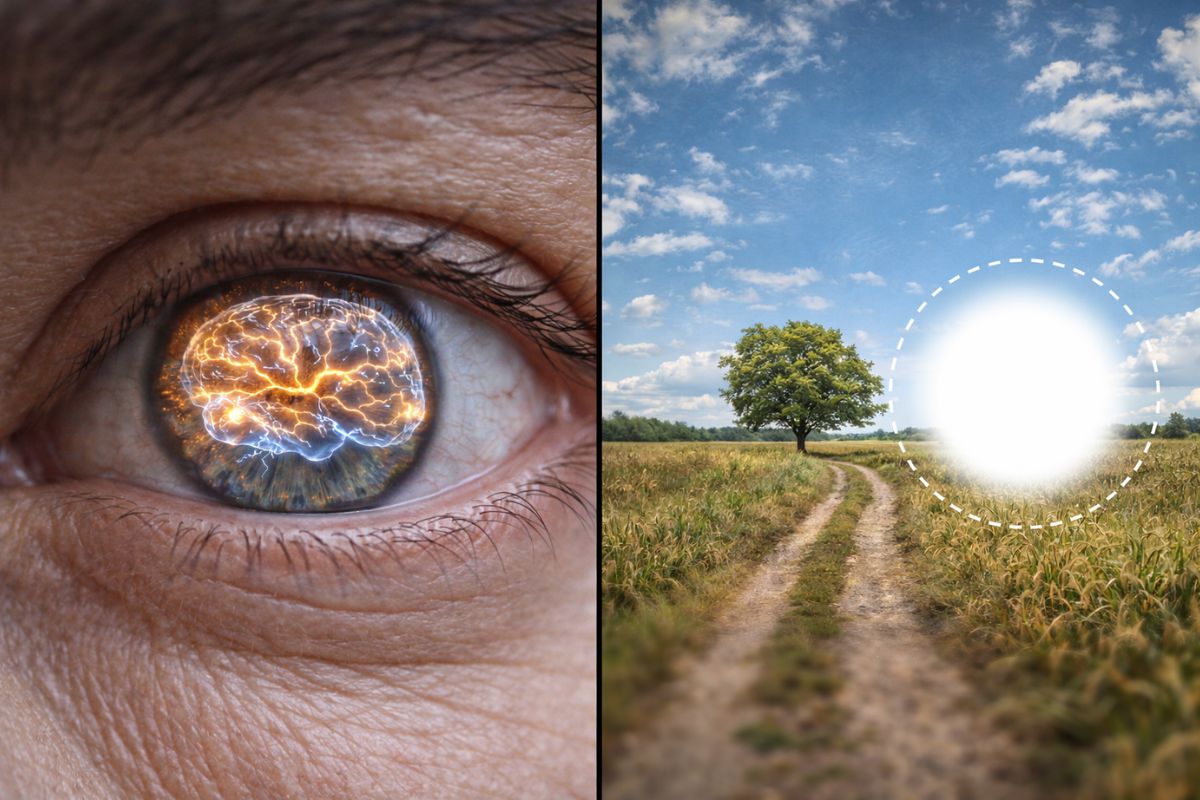
The brain builds a good part of what you call vision because the eye has a blind spot in the retina without receptor cells, and the mind fills gaps using context and pattern, as well as interpreting contrast, depth, and motion before delivering the image that you believe is reality.
Seeing seems automatic, but it is not. The image you call reality goes through cuts, absences, shortcuts, and interpretations all the time, and the brain is responsible for assembling the final version that reaches your consciousness as if it were a faithful copy of the world. The most curious thing is that the visual system works so well most of the time that almost no one notices how much perception depends less on the eye itself and more on the silent work that the brain does behind the scenes.
One of the clearest examples of how the brain dominates vision is the blind spot. Each eye has a small area of the retina without light receptor cells, which means there is literally a part of the visual field where you see nothing. What prevents this hole from appearing all the time is the brain: it uses context, pattern, and continuity to fill in the scene, making the image seem complete even when information is missing. You are seeing less than you think, and the brain is inventing more than you imagine.
Why the brain interprets vision instead of just registering what is in front
The reason is practical. Seeing is not copying the world like a neutral camera, because the brain needs to organize contrast, depth, shape, movement, and meaning quickly to transform electrical stimuli from the retina into usable visual experience.
-
From Napoleon to the lion of the Revenue: how the Income Tax was born in 1922, became the largest source of revenue in 1979, reached the floppy disk, and today generates R$ 2.88 trillion in Brazil.

-
With the new law, Brazilians can obtain a driver’s license at 16 years old; new rules for psychological exams, toxicological tests, speed enforcement, and the electronic free flow toll system will be discussed in the Chamber of Deputies.

-
At 106 years old, Mrs. Maria decided to go back to work to continue buying her wines, but ended up being hired as an influencer by a brand and now calls herself the ‘most empowered grandma in the world.’

-
A 3-year-old child was playing with their father’s metal detector and found a gold pendant over 500 years old, valued at $4 million, a piece with a secret compartment linked to the era of Henry VIII, found by James Hyatt.

If the visual system simply showed the raw data that the eye captures, the image would be fragmented, inverted, and full of gaps that would make navigating the world impossible.
That is why the brain’s interpretation weighs so heavily on vision. Instead of just showing what enters through the eye, the visual system assembles a coherent version of the environment, even though this coherence sometimes comes with errors, shortcuts, or distortions.
The brain prefers to deliver an image that makes sense rather than an image that is technically accurate. For survival, quickly understanding what is ahead has always been more important than recording every detail with photographic fidelity.
What visual illusions reveal about how the brain builds what you see
Visual illusions are not internet tricks. They work precisely because they expose the shortcuts that the brain uses to transform partial information into a scene that makes sense. When two lines appear to be different lengths even though they are the same, when a figure changes without changing, or when an object seems to disappear, what is revealed is not a trivial flaw.
It is proof that the brain is interpreting, prioritizing, and completing what it receives before showing it to you.
Illusions reveal that context changes the reading the brain makes of shape, size, and contrast. The mind prefers visual coherence to raw fidelity with the physical stimulus. The visual system uses prediction and comparison to decide what to show, and when this prediction diverges from physical reality, the illusion arises.
For those studying the brain, each illusion is a window to understand how the mind organizes perception without the person realizing that they are receiving an edited version of the world.
Why the same image can look like two different things to the brain
Ambiguous figures are one of the most intriguing points of human vision.
In these images, the physical information does not change at any moment, but the reading that the brain makes alternates between two or more possible interpretations, as if the mind were testing different hypotheses for the same stimulus and alternating between them when none impose themselves definitively.
This behavior confirms that the brain’s perception is not passive. It chooses, reorganizes, and switches hypotheses in the face of the same visual stimulus.
A figure that sometimes looks like a vase and sometimes looks like two faces has not changed. What has changed is the interpretation that the brain applied to the same data input. For neuroscience, this demonstrates that seeing is an act of active construction, not mechanical reception.
What the brain does to make vision seem complete even when it is not
The visual system operates with three main mechanisms to deliver an experience that seems continuous and total. The first is gap filling: when data is missing, the brain uses continuity and context to close the scene, as happens in the blind spot.
The second is choosing the most plausible reading: in the face of ambiguity, the mind opts for the interpretation that makes the most sense for the moment, even if this choice does not correspond to the actual physics of the image.
The third mechanism is switching interpretation when necessary. That is why ambiguous figures seem to “turn” without the drawing changing: the brain perceives that there is more than one valid reading and alternates between them.
These three processes work together, in milliseconds, creating the fluid visual experience that you call “seeing.” The result is so efficient that most people go their entire lives without questioning whether what they see actually corresponds to what is there.
What it means to say that you see what the brain decides to show
The eye remains essential, but it does not deliver the ready experience. It collects light signals and converts them into electrical impulses.
What transforms these signals into a visible, continuous, and coherent world is the brain, which reconstructs, organizes, and even invents parts of the image so that reality seems more stable than it really is. You do not just see what enters through your eyes. You also see what the mind decides makes sense.
This understanding changes the way we think about perception, memory, and even decision-making. If the brain edits visual reality before delivering it to consciousness, it is reasonable to question how much of everything we perceive is construction and how much is faithful recording.
The answer, according to neuroscience, is that construction is much greater than most people would like to admit. The world you see is real, but the version of it that reaches your mind is a tailor-made edit by your brain.
Have you ever stopped to think that what you see may be more of the brain’s construction than the eye’s recording? Have you noticed the blind spot or fallen into some visual illusion that made you question your own perception? Share in the comments. The way we see the world is one of the most fascinating topics in neuroscience, and most people have never stopped to think about it.










Seja o primeiro a reagir!