





 Portuguese
  English
  Spanish
  4 min of reading
  0 comments



A Recent Update to WhatsApp Brought Apparently Subtle Changes, But That Are Generating Frustration Among Users, Who Accuse the Design of Causing Anxiety.
The WhatsApp, one of the most popular messaging apps in the world, implemented a subtle change, but that provoked intense reactions among its users. The novelty replaces the traditional message “typing…”, which appears below the contact’s name on the chat screen, with a speech bubble animation with three bouncing dots. Although visually discreet, this change has sparked heated discussions on social media.
A Change That Divides Opinions
Initially, the new indicator was tested in October of this year with a restricted group of users. However, in recent weeks, it started appearing for more people, suggesting that WhatsApp is implementing the change more widely. Many users turned to X (formerly Twitter) to share their reactions, and most seemed irritated by the novelty.
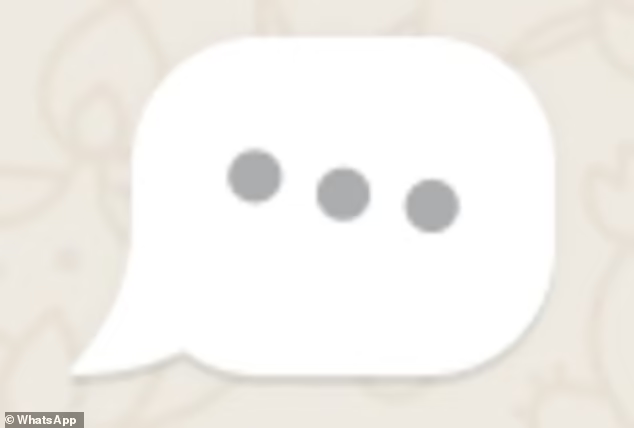
“I hate the new typing box on WhatsApp”, wrote one user in frustration. Another stated: “I just noticed that the typing bubble is now on WhatsApp. This update caught me off guard.” Some went even further, like the user who vented: “The new typing animation on WhatsApp seems to have been designed deliberately to cause me anxiety.
-
Archaeologists have discovered a colossal submerged wall in the Atlantic, dating back 7,000 years and weighing 3,300 tons, regarded as the largest prehistoric submerged structure ever found in France.

-
Scientists have discovered a gigantic magnetic anomaly hidden beneath the soil of Australia that mirrors the shape of the entire continent and holds geological records of two and a half billion years that could change what we know about the Earth.

-
The heatwave that has been affecting Brazil in recent weeks is coming to an end: a cyclonic vortex is moving in during Holy Week with heavy rains, and a cold air mass is already threatening to lower temperatures in the South starting in April.

-
(VIDEO) Cameras from an astronomical observatory captured two meteors falling over Santa Maria in Rio Grande do Sul with only a one-minute difference and such close trajectories that scientists are now investigating whether the two objects have the same origin.


The most common criticism is related to the incessant movement of the three bouncing dots, which, for some, seems to heighten the anticipation while waiting for a response. This seemingly harmless detail brought an unexpected level of discomfort to part of the user base.
Resemblance to iMessage and Other Contexts
The speech bubble animation is not a new idea. It closely resembles the indicator present in iMessage, from Apple. This reference generated additional criticism, with users pointing out that WhatsApp is “copying” features from other apps.
One of the sharpest comments came from a user on X: “I’m not a fan of the 3 bubbles indicator when someone is typing on WhatsApp. iMessage nonsense.”
Despite the wave of disapproval, some users welcomed the change with enthusiasm. “WhatsApp finally removed the ‘typing’ notification from the top and brought it down where it should be”, said one user. Another tweeted: “I like the new typing indicator on WhatsApp. It’s modern and practical.”
A more lighthearted comment joked about the feature: “I loved the new typing indication on WhatsApp. But it would be more fun to see the number of characters being typed.” This lighter tone contrasts with the criticisms dominating the discussions about the novelty.
History of Controversial Changes
This is not the first time WhatsApp has faced adverse reactions to seemingly small changes. Seven months ago, the app generated discomfort by capitalizing the words “Online” and “Typing”, displayed below the contact’s name. At the time, many users reported irritation with the change.
“Did anyone else get irrationally annoyed with the latest WhatsApp update for iOS, where if someone is online, it’s now with a capital ‘O’ (Online), or when someone is typing, it’s with a capital ‘T’ (Typing)? Just one different capital letter, but I hate it”, complained one user.
Another user vented: “This change is driving me crazy. It’s making my eye twitch!” This episode showed how small changes in interface design can have a disproportionate emotional impact on such a wide and diverse user base.
WhatsApp Does Not Officially Position Itself
So far, WhatsApp has not issued official statements regarding the change in the typing indicator. In the initial test, conducted in October, a spokesperson for the company stated that the change was “just a small test”. However, the recent large-scale implementation suggests that Meta, the owner of WhatsApp, may be considering making it permanent.
The Impact of Changes on User Experience
The mixed reactions to the new animation highlight an important point: even seemingly insignificant visual changes can significantly influence user experience. For an app with over 2 billion active users, finding a balance between innovation and familiarity is a constant challenge.
While some consider the novelty an advancement in design and usability, others see it as a distraction or a regression. Feedback from social media will certainly serve as a thermometer for WhatsApp to adjust or reaffirm its decision.
For now, it remains to be seen whether the company will keep the speech bubble, revert to the old indicator, or present another solution. Regardless, the discussion about the change reflects the importance of understanding the expectations and habits of such a diverse user base. After all, in the digital world, even the subtlest details make all the difference.








Seja o primeiro a reagir!