





 Portuguese
  English
  Spanish
  5 min of reading
  36 comments


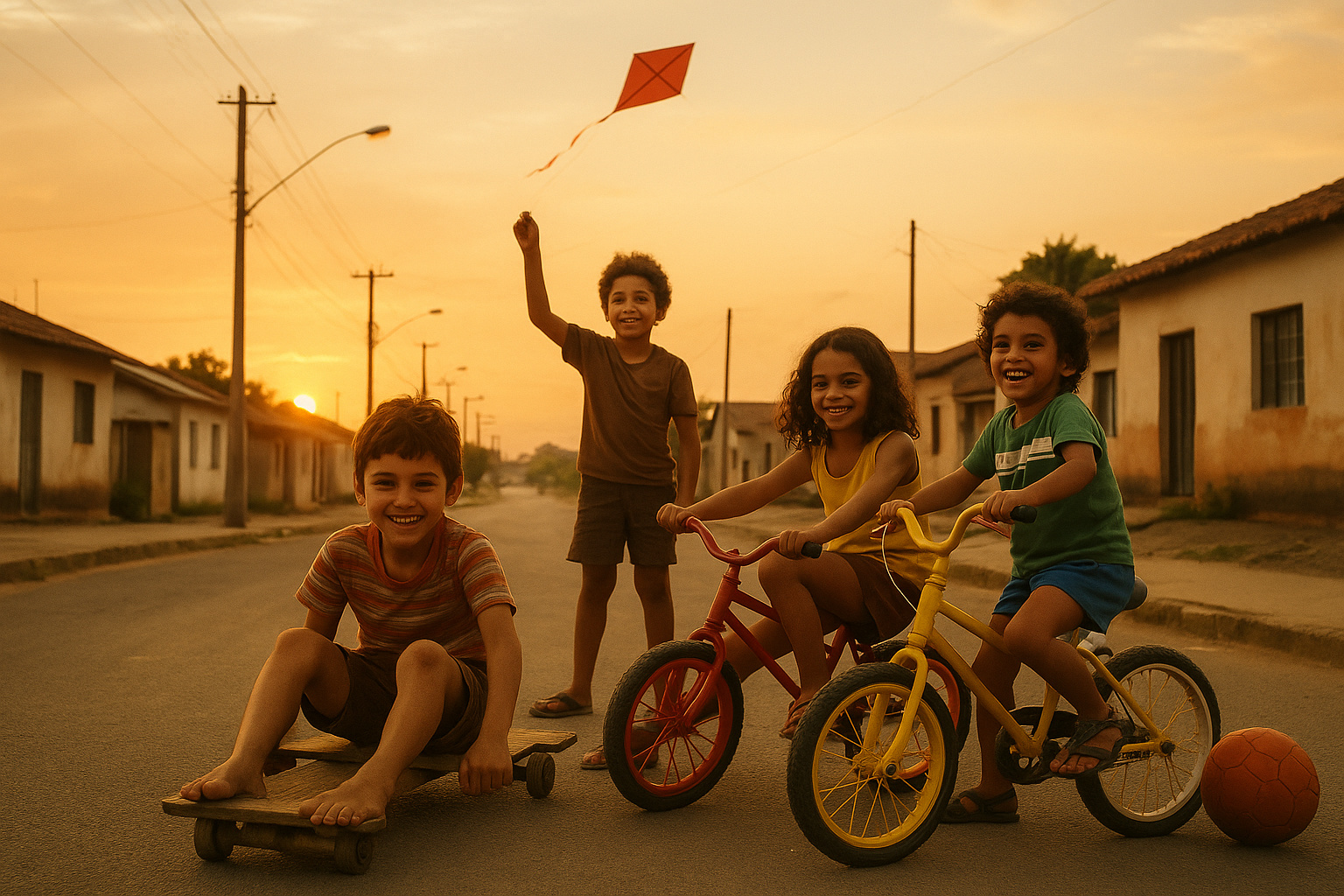


Among Roller Cart Cars, Hopscotch And Marbles, A Generation Grew Up Learning The Value Of Friendship And Imagination, When The Streets Were The Backyard Of Brazil And Happiness Lived In The Little Things Of Everyday Life
There was a time when the streets were filled with voices, laughter, and dust. A time when the end of class did not mean going home, but running into the street.
In the 80s and 90s, Brazilian childhood lived outdoors, without fear, without hurry, without the internet. The sun was the clock, the gate was the meeting point, and the dirt floor was the stage for the most sincere stories.
The sound of the gate slamming announced the beginning of adventures. The shout of “car is stopped!” was the whistle of the improvised referee. The boys marked the goal with flip-flops, and the girls, amidst laughter, alternated between jumping rope and playing volleyball.
Every afternoon was a new chapter of a childhood that needed neither batteries nor Wi-Fi signal — all it took was a little imagination and many friends.
According to a video published by C3N Retrô channel, this was the time when children built their own toys, fell and got up without drama, and learned, with scraped knees, that freedom came at a small price: the sunset.
-
The Argentine government celebrates the lowest poverty rate in 7 years, but experts warn that the methodology has changed, real wages have fallen, unemployment has risen, and the number of people on the streets of Buenos Aires has increased by 57% since Milei took office.

-
7.8 magnitude earthquake in Indonesia frightens the population, triggers tsunami alert, and hits an island with over 200,000 inhabitants this Thursday.

-
Google will finally let you change that embarrassing Gmail address you created in your teenage years without losing any accounts, logins, or old emails: the feature is already available in the United States.

-
Heading to Brazil in a Bonanza F33 single-engine aircraft: a couple departs from Florida on a visual flight, makes technical stops in the Caribbean to refuel and organize paperwork, and begins the staged crossing until they reach the country.


Games That Taught Courage, Friendship, And Imagination
No one cared about notifications on their phones. What mattered was the touch of the ball, the wind on their faces, and the sound of laughter echoing through the neighborhood.
Games like “tag”, “hide-and-seek”, “bat”, “jump rope”, “marbles” and “kite flying” were the passport to a world that today seems distant.
The roller cart was a handcrafted work of art: wood, nails, rusty bearings, and the courage to race down the hill screaming.
The boys turned every descent into a competition, and each fall into a reason to joke. The girls invented choreographies and songs, knowing every verse of “Ciranda, cirandinha” and “I Took The Stick From The Cat”.
There were no helmets or knee pads — just courage, curiosity, and a spirit of adventure that made every day feel like a holiday.
And when the ball popped, no one cried. All it took was some duct tape, re-inflating it, and continuing the game because the fun couldn’t stop.
School, The Notebook, And The Path To The Gate
Childhood in the 80s and 90s started early. The smell of coffee and toasted bread filled the house. The heavy backpacks carried more than notebooks: they held dreams and childhood memories.
Walking to school was a ritual — walking in groups, laughing, kicking pebbles, competing to see who arrived first. There was no school van, and fear was replaced by the adventure of crossing the entire neighborhood with friends.
The teachers taught with patience, and the Caminho Suave Primer educated an entire generation. Cursive writing was a source of pride, and the sound of chalk on the board was the soundtrack of discovery.
The homework came before the street — at least that’s what the mothers said. “First the lesson, then the fun,” they repeated tirelessly. But as soon as the pencil stopped writing, the whole body wanted to run.
And off we went, happy, uniformed, and free, believing that the world fit in the block of our street.
The Sounds, The Scents, And The Soul Of A Brazil That Won’t Return
Those who lived in that time remember the sounds that marked the days: the whistle of the night guard, the call of the ice cream vendor, the neighbor’s whistle calling a friend.
The houses smelled of fresh coffee and bar soap, and the afternoons were brightened by clothes hanging on the line.
The television, with its heavy tube and shaky image, awaited us at night — it was the time of Manchete cartoons, Xuxa and Sérgio Mallandro’s children’s programs, and commercials that stuck in your head.
Toys like Fofão, Pega Varetas, Autorama, Tazo, and Playmobil were the dream of consumption. But most had fun with bottle caps, balls, and rubber bands — because the real toy was time.
Families were large, the streets were safe, and the afternoons were endless. Parents sat on the sidewalk talking, mothers exchanged recipes, and grandparents told stories of a simple Brazil filled with life.
Brazil Of Eternal Friendships And Days Without Rush
It was a time when no one was ashamed to get their feet dirty, climb a tree, or come home sweaty.
Each friend was an extension of the family itself. If one got hit, everyone went together to “defend”. If one cried, everyone was there.
Fights lasted five minutes, but friendships — those last to this day.
June festivals were the peak of creativity: patched clothes, paper flags, and a bonfire made with a wooden box.
The school dances were the first encounter with love and shyness. The girls dressed up, the boys feigned disinterest, and the music from Legião or Roupa Nova played in the background.
On Sundays, the smell of barbecue mingled with the sound of soccer on the radio. Every home had its own soundtrack: Roberto Carlos, Os Paralamas do Sucesso, Kid Abelha, or Balão Mágico.
It was a harmony that united generations — a time when everyone looked into each other’s eyes because there were no screens to divert the gaze.
The Last Goal On The Street And The Silent Farewell
Life changed without warning. One day, someone did not show up on the street. Then, another.
School, work, hurry — everyone gradually drifted away, like the sun hiding behind the buildings that began to replace the houses.
The last goal on the street was scored without anyone knowing. The ball went in, the shout echoed, but no one realized that would be the end.
Kites stopped painting the sky, roller carts were left leaning against walls, and silence took the place of voices.
Today, children look at screens, and the streets look back at them with longing.
Time passed, but the memory remains alive — kept in every adult who still smiles upon hearing the distant sound of a ball hitting the wall.
The C3N Retrô channel, in its video filled with images and sounds from that time, does more than remind us: it returns a piece of what we lost — the power to live in the present with simplicity.


Between Yesterday And Today: What Remains Of Childhood
Technology connected us but also isolated us.
Backyards became condominiums, games became apps, and friendships often boil down to likes.
But there is still time. It is still possible to teach new generations the value of real time, the sun on their faces, eye-to-eye conversation.
Childhood in the 80s and 90s left an invisible legacy: the certainty that happiness doesn’t need a password.
Maybe the secret is to turn off the phone, open the gate, and let the wind tell new stories.
After all, playing in the street was — and always will be — the best part of the day.








A tecnologia, o progresso tem um preço altíssimo. Graças a Deus que eu consegui viver tudo isso, e as minhas amizades de infância, ainda continuam!
Boa noite
Apesar de ter sido uma época bem difícil, não tínhamos muita, era difícil, éramos uma família de oito pessoas, mas tivemos uma infância divertida, apesar de não termos brinquedos, nossa infância foi marcada por muitas brincadeiras. Coisas que as crianças de hoje não tem o hábito de brincar, estão sempre conectadas virtualmente.
Estão perdendo o que mais importa.
Concordo com o texto a cada leitura me reportei ao tempo,sou avó converso com as netas: impossível pensar a nossa geração assim como a organização considerando que pra tudo tinha hora.
Esse aprendizado ajuda- nos a enfrentar os momentos de hoje.
Obrigado!