





 Portuguese
  English
  Spanish
  4 min of reading
  0 comments


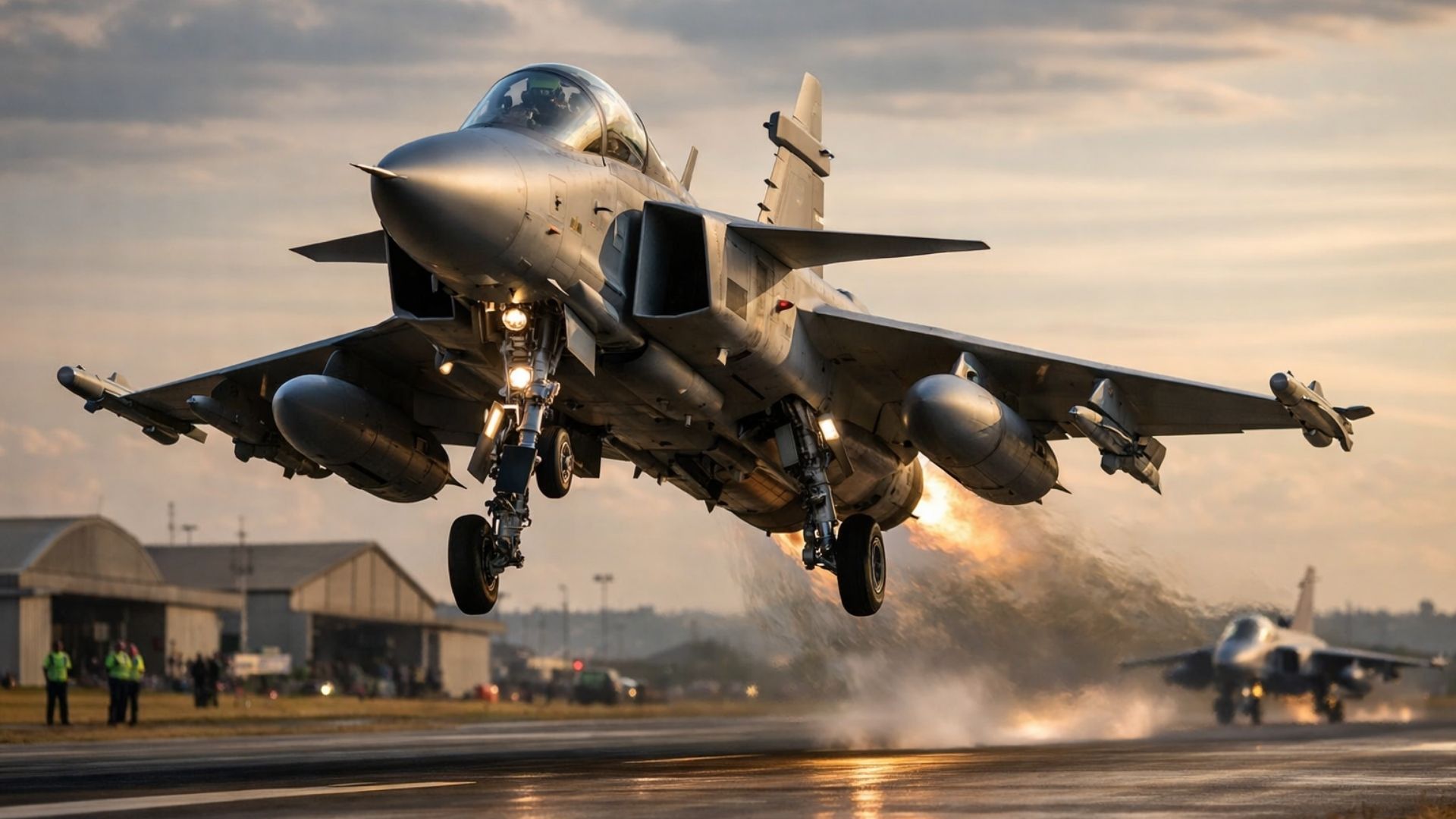
Industrial milestone repositions Brazilian air defense and expands technological autonomy with local production of supersonic fighters, knowledge transfer, and relevant economic impact on the Defense Industrial Base, in contrast to models based solely on the external purchase of ready aircraft.
On March 25, 2026, Brazil presented in Gavião Peixoto, in the interior of São Paulo, the first F-39E Gripen assembled in the country.
The event marked Brazil’s entry into the group of nations capable of producing supersonic combat aircraft and consolidated a step that had been prepared since the signing of the contract with the Swedish Saab in October 2014.
Ceremony marks advancement in Gripen production in Brazil
The ceremony brought together President Luiz Inácio Lula da Silva, Vice President Geraldo Alckmin, Defense Minister José Múcio, representatives from Embraer, the FAB, and Saab.
-
Brazil on alert? Why invading Brazil is a NIGHTMARE for the USA: 8.5 million km², 213 million inhabitants, Amazon covering 60% of the territory, trillion-dollar war, and resistance that even 13,000 aircraft could not control.

-
How to build a floating island from scratch with reeds, giant blocks, and stakes in the lake in a process that needs to be repeated almost every day.

-
A forgotten cord on the floor of a basement in Vienna leads a plumber to a box containing 30 kilograms of gold with Mozart’s face, hidden before World War II. The treasure, worth 2.3 million euros, was just centimeters away from a worker who ignored the sign a day earlier.

-
A couple buys an old chalet, breaks the kitchen floor for renovation, and finds over a thousand coins of gold and silver hidden since the English Civil War over 4 centuries ago.


During the event, Lula named the aircraft and stated that he flew escorted by the first Gripen produced in Brazil, in a moment that symbolizes a country investing in technology and reaffirming its sovereignty.
More than the presentation of a new aircraft, the act had industrial and strategic weight.
Billion-dollar investment and technology transfer
The FX-2 Fighter program anticipates investments of R$ 28.5 billion between 2014 and 2033, including acquisition, production, simulators, logistical support, and technology transfer.
In the official project design, Brazil contracted 36 aircraft, of which 15 are scheduled for production in national territory.
This point helps explain why the Brazilian program is often treated differently from a simple external purchase.
In addition to local assembly, part of the structural components of the Gripen is already produced in the country, such as the front and rear fuselage, tail cone, and aerodynamic brakes.
National production resulted from over a million hours of development, production, testing, and support, combined with 600,000 hours of training.
Choice of Gripen and long-term strategy
The Brazilian option for the Gripen was formalized after a competition that also involved the F/A-18 Super Hornet and the Rafale.
The differential of the Swedish model was in the combination of fleet modernization, technology transfer, and the ability to nationalize production.
Saab also maintains that the Gripen was designed to operate with lower costs than other Western fighters, a relevant factor in long-term planning.
Delays in schedule and new goals


The schedule fell short of what was expected when the contract was signed.
The expected completion date for the project extends to June 24, 2033.
By 2025, ten aircraft had been delivered, and the official goal for 2026 became the delivery of the first two units produced in Brazil.
In celebrating the milestone, José Múcio stated that the delivery expected for 2026 “is a reality today,” while the commander of the Air Force classified the advancement as unprecedented for the region.
Industrial chain and job creation
The economic dimension of the program also appears in the chain formed around the aircraft.
In addition to Embraer and Saab, Brazilian companies participate in the development and supply of the project.
The initiative has an estimated potential of 13,000 jobs in the country, with about 2,200 direct and 10,800 indirect jobs.
The official assessment is that this arrangement strengthens the Defense Industrial Base and reduces external technological dependence.
Regional comparison and distinct strategies
The regional repercussions amplify this significance.
Saab intends to use the Brazilian line as an export platform, a move reinforced by negotiations with other countries in Latin America.
In parallel, Argentina closed a contract in April 2024 for about US$ 300 million to acquire 24 used F-16s from Denmark.
These two movements expose distinct strategies: on one side, the purchase of ready aircraft; on the other, a re-equipment program associated with technology transfer and local production.
Brazil’s role in the global aerospace industry
The comparison gained traction because Brazil did not limit itself to incorporating a new fighter into its fleet.
The project has been presented as a vector of sovereignty, technological development, and international insertion of the national aerospace industry.
Summarizing this reasoning, José Múcio stated that investing in defense allows the country to consolidate its deterrent power and position itself as the largest production hub in Latin America.
The president of Saab highlighted that this is the first time, since the company’s founding in 1937, that a fighter is manufactured outside Sweden.





Seja o primeiro a reagir!