





 Portuguese
  English
  Spanish
  5 min of reading
  0 comments


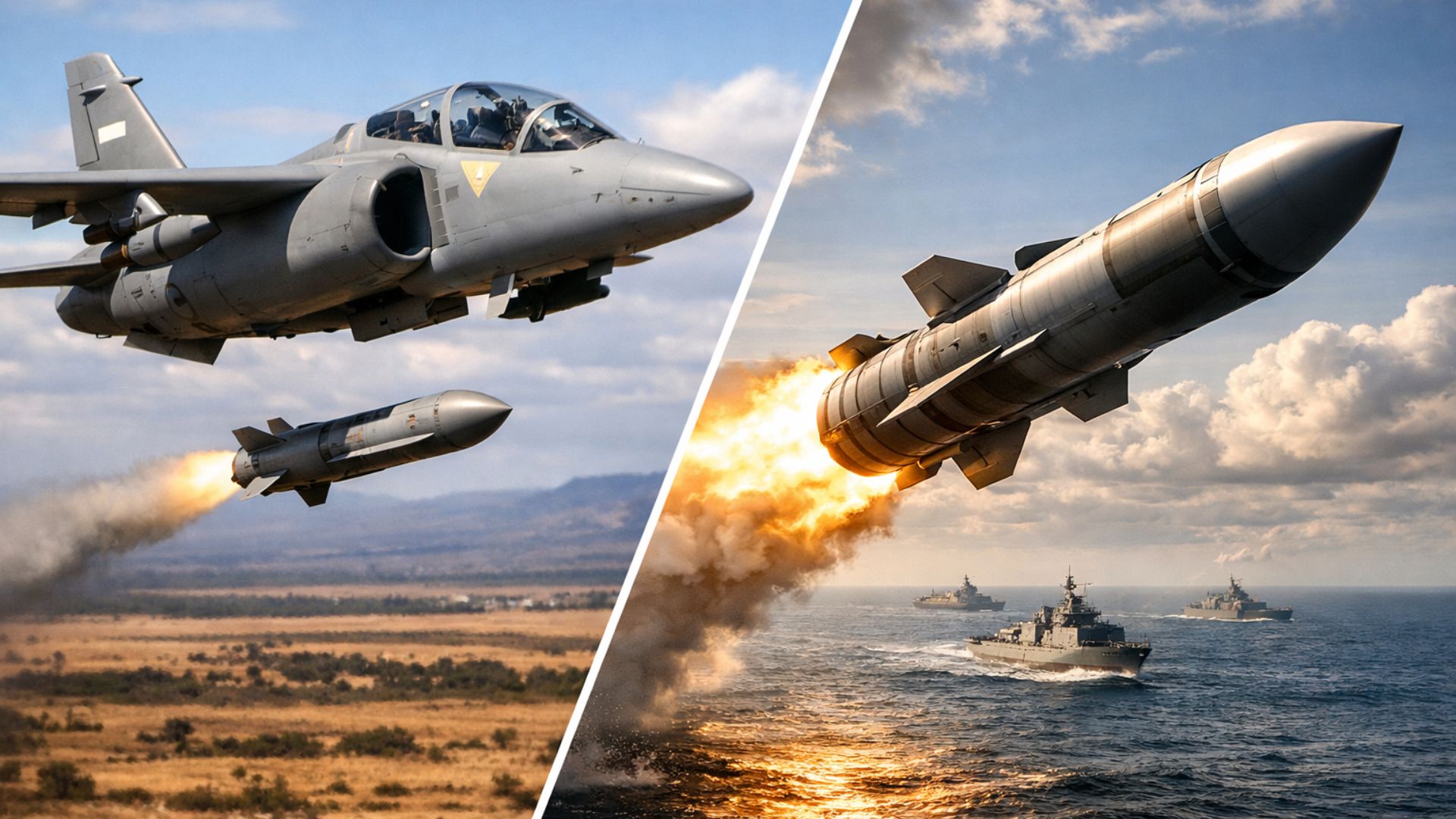
Reactivation of the Dardo in Argentina and the advancement of the MANSUP air program in Brazil place both countries at the center of the dispute for autonomy in guided weapons, with impacts involving military capability, industrial dominance, intellectual property, and space in the international defense market.
The resumption of guided weapon programs in South America has placed Brazil and Argentina in a scenario of technological competition that goes beyond the acquisition of foreign systems, involving industrial dominance, continuity of projects, and self-innovation capability in defense.
On one side, the Argentine Air Force has reactivated the glide bomb FAS 850 Dardo, a national project that remained halted for over ten years and has returned to the agenda with new flight tests conducted on a local testing platform.
In the Brazilian case, the movement occurs at another stage of maturity, with the Brazilian Navy and the company SIATT advancing in the development of the MANSUP missile family, including studies for an air-launched version, expanding the operational scope of the technology.
-
Society says that family is sacred and that a good child can endure everything, but psychology shows that distancing oneself from toxic parents is not ingratitude; it is the only way to preserve one’s mental health and break cycles of abuse.

-
The parakeet owner built a mini submarine with a paintball cylinder to take the bird diving in the Bahamas, and the video went viral, but not everyone found the idea that cute.
-
After leaving engineering and crossing Brazil by bicycle in search of a simpler life, two young people demonstrate in practice how they installed solar energy at their farm with 4 panels of 550 watts and started producing their own energy.

-
A 10-year-old girl is attending both elementary school and college at the same time in the United States, and the school principal says she never imagined something like this was possible.

Argentine Dardo returns to testing and regains space in military debate
According to information from the specialized site Infodefensa, Argentina has resumed testing the Dardo using an inert shell attached to an IA-63 Pampa III aircraft, operated by the Flight Testing Center, marking the practical reactivation of the program.
The history of the system reveals an evolution that began in the 1980s with the emergence of the Dardo I, followed by the Dardo II in the 1990s with the introduction of GPS guidance, culminating in the Dardo III, which incorporated its own propulsion.
This more advanced version had an estimated range of up to 200 kilometers, representing a significant leap in precision strike capability, especially considering the context of budgetary constraints faced by the Argentine armed forces.
More than just technical performance, the resumption of the project indicates an attempt to rebuild local industrial capabilities, in a sector where prolonged interruption often compromises production chains, accumulated knowledge, and technological evolution capacity.
The use of the Pampa III as a testing platform also reinforces this strategy, integrating different segments of the national industry and giving visibility to the effort to regain autonomy in the development of guided weapons.
Airborne MANSUP expands the reach of the Brazilian program
While Argentina reactivates a halted program, Brazil advances in the expansion of an already established system, beginning studies to adapt the anti-ship missile MANSUP for use on Navy aircraft.
The agreement signed between the Naval Weapons Systems Directorate and SIATT provides for technical exchange and development of air-to-surface variants within the MARSUP program, expanding the operational use of national technology.
This initiative does not start from an initial base, as the MANSUP was conceived as one of the main strategic projects of the Brazilian defense industry, focusing on the re-equipment of naval assets, including the Tamandaré Class frigates.
The adaptation for airborne platforms represents a natural evolution of the program, allowing the same technological architecture to be applied in different combat scenarios, increasing the flexibility and reach of military operations.
Range above 200 km and evolution of MANSUP-ER
One of the central points of Brazilian evolution is the long-range version, known as MANSUP-ER, which is associated with a range greater than 200 kilometers, with a speed close to 954 km/h and guidance by active radar.
This advancement has been made possible with the participation of the EDGE group, an international partner of SIATT, indicating a development model that combines external cooperation with the maintenance of technological control and local production.
In the case of MARSUP, there are indications that the more advanced versions may incorporate propulsion systems such as turbojet or turbofan, further increasing the range and engagement capability of the missile in complex scenarios.
This strategy reinforces the idea of building a family of systems, with a common base but distinct applications, which tends to reduce development costs and facilitate maintenance and technological evolution over time.
Royalties and export enter the design of the defense industry
Another element that differentiates the Brazilian program is the model of shared intellectual property adopted between the Brazilian Navy and SIATT, which establishes rights for use, modification, production, and commercialization of the system.
This format provides for the payment of royalties to the naval force in the event of export or commercial exploitation, creating a structure that seeks to balance military demands with revenue generation for the State.
In practice, this is an arrangement that positions the MANSUP not only as an operational project but also as an economic asset within the defense industry, with potential for insertion into the international market.
At the same time, this approach allows for greater control over the developed technology, reducing external dependence and ensuring autonomy in the future evolution of the system, an aspect considered strategic in long-term programs.
Brazil and Argentina follow different paths in military technology
The comparison between the two movements highlights different strategies to face similar challenges, as both countries seek to strengthen their capabilities in guided weapons and reduce dependence on foreign suppliers.
In the Argentine case, the reactivation of the Dardo signals an attempt to resume an interrupted trajectory, gradually rebuilding the industrial and technological base necessary to sustain projects of this nature in the long term.
Brazil, on the other hand, operates at a more advanced stage, expanding a system in continuous development for new applications, consolidating a technological base that can be reused in multiple projects and platforms.
This difference in timing directly influences the potential evolution of each program, especially considering the importance of continuity and industrial integration in high-complexity projects.
The ability to maintain constant cycles of development, testing, and updating tends to be decisive in ensuring competitiveness and relevance in the regional defense scenario, where technology and autonomy go hand in hand.








Seja o primeiro a reagir!