





 Português
  Inglês
  Espanhol
  6 min de leitura
  0 comentários


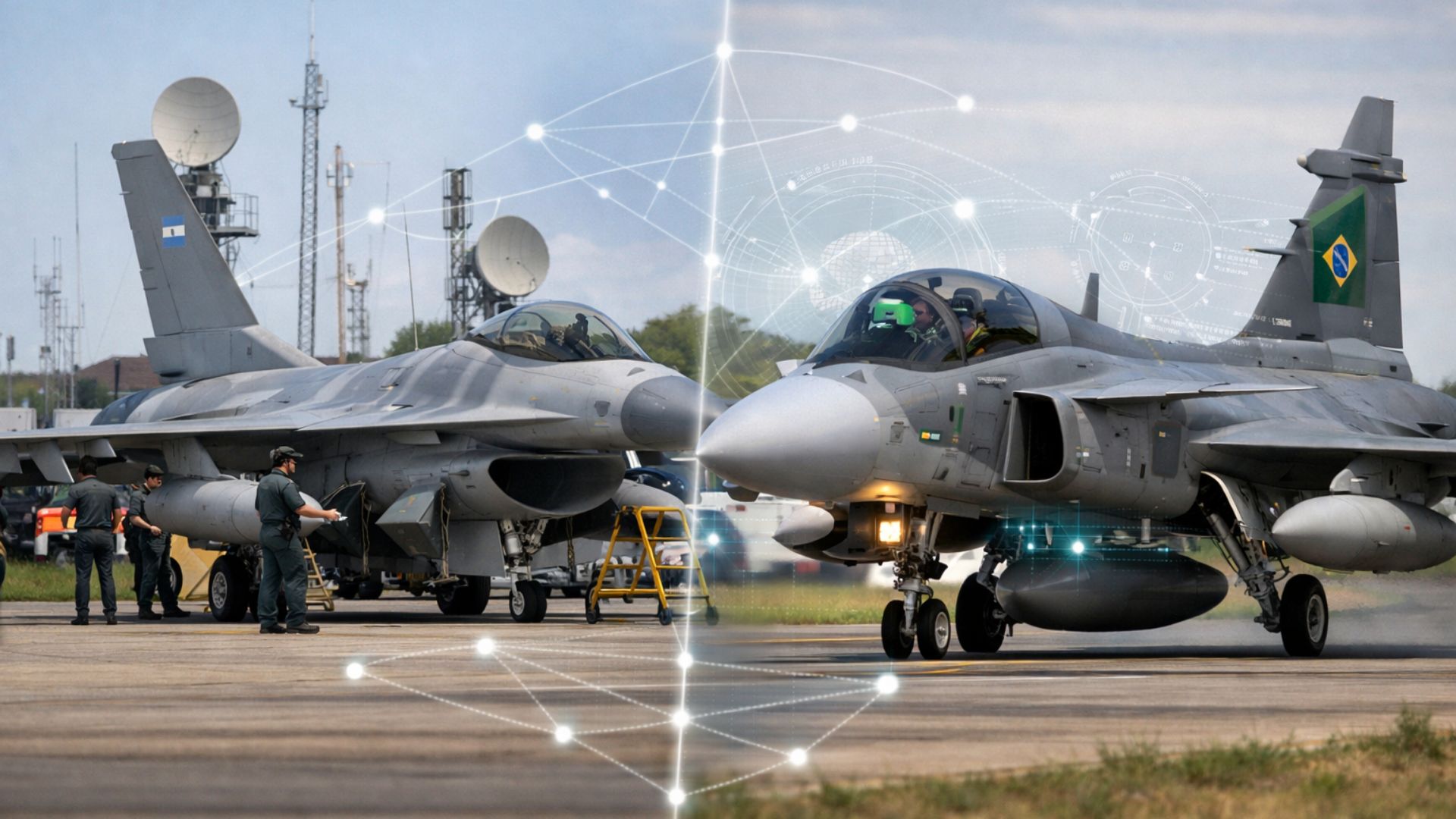
Digital networks and technological dominance redefine air balance between Brazil and Argentina, with distinct paths in the integration of modern fighters, real-time communication, and operational autonomy in South American armed forces.
The regional dispute for air capability is no longer measured solely by the fighter purchased, the radar range, or the number of missiles available.
Today, the strategic weight also falls on the digital network that connects aircraft, command centers, radars, and support systems in real time, and it is precisely at this point that the paths of Brazil and Argentina begin to diverge.
Argentinian F-16 and dependence on external systems
In the Argentinian program, the most recent stage was formalized on December 6, 2024, when the Ministry of Defense announced the signing of the first Letter of Offer and Acceptance with the United States for the F-16 program.
-
The daily shower that seems harmless now worries specialists: a shower uses 6 to 15 liters per minute and is at the center of the water crisis.

-
Goodbye capsule coffee maker: consumers around the world are replacing the old item with this machine that grinds beans on the spot, reduces waste, and cuts recurring coffee expenses.

-
Measuring about 44 meters in length, with a nuclear reactor and retractable wheels in its hull, the NR-1 was the only atomic research submersible in the world capable of moving along the ocean floor and remaining submerged for weeks.

-
Millions of people eat oats without knowing that this simple cereal contains a fiber called beta-glucan, which studies have linked to lower bad cholesterol and smaller spikes in blood sugar.


According to the official note, the agreement incorporates advanced communication technologies, data transmission, and electronic warfare, in addition to armaments, equipment, integrated logistical support, and training for pilots and technicians.
This formulation helps to understand how Buenos Aires structured the modernization of its fighter aviation.
The purchase of the aircraft was made from Denmark, but the critical layer of electronic integration, operational support, and access to certain resources goes through the American partner, which keeps the program anchored in a broader external network than the simple delivery of the jets.
Aircraft purchase and structure of the military package

The material basis of this process was confirmed in Administrative Decision 252/2024, published in the Official Bulletin of Argentina on April 29, 2024.
The document approved the expenditure for the acquisition of the F-16 weapon system from the logistical organization of the Ministry of Defense of Denmark, with 16 single-seat aircraft, eight two-seat, components, and services, for US$ 301.2 million, paid in five annual installments.
When presenting the agreement, the Argentinian government classified the negotiation as the most important in the military field since redemocratization.
Still, the official design shows that the recovery of the supersonic capability of the Argentine Air Force does not end with the Danish batch, because it also depends on integration and support instruments linked to the United States to transform the acquired fleet into effective operational capability.
This technical detail gained centrality because contemporary air operations increasingly depend on the secure and rapid circulation of information.
Instead of acting in isolation, the fighter needs to receive, share, and process data with other vectors, reducing the time between detection, decision, and reaction, especially in surveillance, interception, and electronic warfare scenarios.
Link-BR2 and Brazilian technological autonomy


In the Brazilian case, the debate about the F-39 Gripen advances to a more sensitive dimension of air defense: the dominance of the digital infrastructure that supports the operation.
On July 24, 2025, the FAB announced the holding of a workshop at the Aerospace Science and Technology Department focused on the integration of Link-BR2 with the Gripen, aiming to strengthen interoperability and accelerate the operationalization of command and control systems of the Force itself.
The relevance of this step lies in the fact that the Link-BR2 did not emerge as an accessory to the Gripen, but as a broader project of the Air Force to connect distinct platforms in a national tactical network.
In an official report from 2024, the Air Force Command defined the system as a data link intended for the development, integration, validation, and provision of an environment capable of enhancing situational awareness and improving the command and control mechanisms of the FAB.
The same report states that the project was conceived to allow interoperability between different air means, replacing part of the dependence on exclusively voice communications.
In practice, this means creating conditions for aircraft and control structures to exchange data in flight through a tactical network of their own, with direct impacts on operational safety and response speed.
Operational tests and evolution of the Brazilian system
The trajectory of Link-BR2 has already gone through successive phases of testing, demonstration, and employment in exercises.
In October 2021, the FAB announced the first data link between F-5M fighters with the system, a milestone that confirmed the ability to exchange information between fighter aircraft in an operational environment.
Few months later, in March 2022, during an operational demonstration conducted in conjunction with AEL Sistemas, the FAB itself noted that the Link-BR2 would represent a change in the operational concept of the Force and would function as a force multiplier for its platforms.
The formulation addressed not only technical performance but also a change in the way to coordinate air means and command structures.
In April 2024, during Operation IRIS 2024, the Air Force again associated the datalink with the pursuit of informational and tactical superiority, indicating that the system had moved from being merely a laboratory project to entering an operational maturation stage.
This history helps to explain why the integration with the Gripen has come to be treated as a strategic point, and not just as a technical adjustment of the platform.
Production of the Gripen and industrial integration in Brazil
The characteristic that most distinguishes the Brazilian case is the attempt to internalize the digital link of air operations.
In the FAB’s project report, the Link-BR2 appears linked to the national development of the tactical data link system, and the Air Force notes that the original contract passed from Mectron to AEL Sistemas after a corporate restructuring, preserving the continuity of the program.
Later, in November 2025, the FAB stated during Operation Atlas that the Link-BR2 was developed in the country and has Brazilian intellectual property, placing Brazil among the few nations with mastery of this type of technology.
In another official communication, the Force also referred to the system as a national C4I, developed in partnership between AEL Sistemas, Kryptus, and Aeromot.
This difference shifts the axis of regional comparison.
While Argentina reconstitutes its supersonic capability through a combination of the Danish batch and the electronic, logistical, and training support from the United States, Brazil attempts to connect its main fighter to a tactical network whose architecture, integration, and intellectual property remain under national custody.
The Gripen program amplifies this contrast because it is not limited to the delivery of ready aircraft.
On May 9, 2023, Saab and Embraer inaugurated in Gavião Peixoto the final assembly line of the Gripen E, described by the manufacturer as the only one outside Sweden, with a forecast of producing 15 of the 36 aircraft contracted by the FAB.
This industrial arrangement reached a new milestone on March 25, 2026, when Saab, Embraer, and FAB presented the first Gripen E produced in Brazil.
In the official announcement, the company stated that the aircraft will still undergo functional and flight tests before final delivery, a stage after which it will join the 10 units already delivered to the 1st Air Defense Group in Anápolis.
In this scenario, the comparison between Brazil and Argentina ceases to revolve solely around the age of the cell, the origin of the fighter, or the symbolic weight of each acquisition.
The center of the discussion shifts to the origin of the electronic and industrial layers that support the operation, in a context where the Brazilian Gripen advances simultaneously with local assembly, technology transfer, and integration of the Link-BR2 into the FAB’s command and control system.





Seja o primeiro a reagir!