





 Portuguese
  English
  Spanish
  6 min of reading
  0 comments


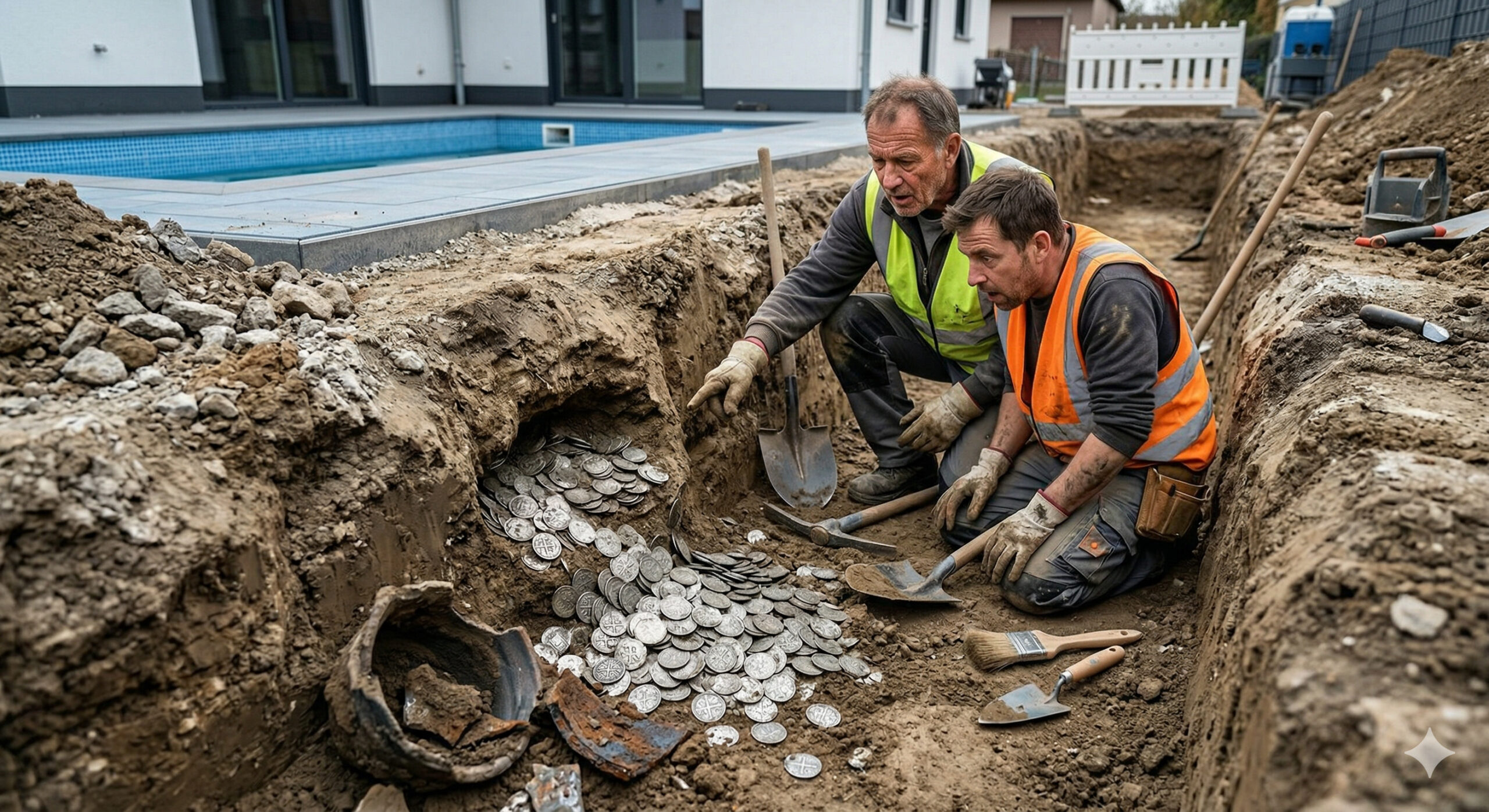
More than 1,500 medieval silver coins found in Germany reveal treasure from 1320 equivalent to 150 sheep and never recovered.
In May 2024, during the installation of a pipeline in Glottertal, a village located in the Black Forest region of Baden-Württemberg, southwestern Germany, a discovery emerged that quickly mobilized archaeologists and heritage authorities. According to information released by the Baden-Württemberg State Office for Monument Preservation in the official statement about the case, resident Claus Völker, who was overseeing the work in early May, noticed the presence of “small metal plates” in the excavated material, leading to the immediate activation of the specialized team. The initial find led to a more careful analysis of the ground and the removed debris. According to the official note, an inspection of the trench section allowed for the recovery of about 1,000 coins right from the start, while additional searches conducted by certified detectorists resulted in the identification of approximately 600 additional pieces, raising the total to more than 1,500 medieval silver coins.
After a preliminary cleaning, experts concluded that most of the treasure was minted around 1320, at the beginning of the 14th century.
The discovery gave rise to what became known as the Glottertal treasure, described by the preservation office itself as one of the most extensive medieval monetary treasures found in recent decades. In addition to the exceptional volume, the collection draws attention for bringing together coins from different mints in the region, which may help archaeologists and historians reconstruct aspects of monetary circulation, silver trade, and even medieval mining activity in southwestern Germany.
-
What the Public House of Julius Caesar was like inside in the Roman Forum: layout, atrium with compluvium and impluvium, tablinium and peristyle, and the scandal of the Bona Dea, revealed in an AI recreation.

-
Flight Helios 522, the “ghost” flight with 121 people: the commercial aircraft flew for more than 2 hours on autopilot after a pressurization failure left pilots and passengers unconscious and only stopped when it ran out of fuel.

-
Researchers have located a nearly intact vessel that disappeared 125 years ago on the bottom of icy waters, with masts still preserved and rare details that impress archaeologists.

-
Mars may have hidden for a long time an answer to the loss of its atmosphere, after the Curiosity rover found a mineral that stores carbon in rocks from Gale Crater.


Treasure includes fine coins called bracteates minted around 1320
The coins found belong to a type known as bracteates, extremely thin pieces, usually minted on only one side, common in Central Europe during the Middle Ages. According to experts, these coins were produced around 1320, in different mints in the Upper Rhine region.
Among the identified places of origin are:
- Freiburg and Breisach, in present-day Germany
- Zofingen, in Switzerland
- as well as examples linked to cities like Basel, Zurich, Colmar, and St. Gallen
Each coin has specific minting characteristics that allow archaeologists to trace patterns of monetary circulation and trade networks of the time.
Discovery happened after resident noticed metal discs in construction debris
An important detail of the discovery is that it would not have occurred in the same way without the attention of a local resident. According to reports, resident Claus Völker observed the small metal discs in the excavated soil and decided to investigate more closely.

From that moment, the authorities were notified, and archaeologists began a systematic recovery of the material. On the first day of controlled excavation, about 1,000 coins had already been identified. Subsequently, the use of metal detectors revealed an additional 500 to 600 pieces, raising the total to more than 1,500.
Value of the treasure equivalent to about 150 sheep in the 14th century
The economic analysis of the collection indicates that the value of the treasure, in the context of the 14th century, was approximately equivalent to 150 sheep, a common reference unit for measuring wealth at the time.
This data, highlighted by researchers and echoed in scientific publications, indicates that the value was significant, especially for an ordinary individual, but not necessarily associated with the aristocratic elite.
The equivalence also helps to contextualize the purchasing power of the coins and the economic dimension of the find within medieval society.
Glottertal region was an important silver mining center
The location of the find is not coincidental. During the Middle Ages, Glottertal was an area known for silver mining, an activity that sustained the local economy and supplied the mints in the region.
According to researchers, it is likely that the owner of the treasure was directly linked to this context, possibly as:
- miner
- merchant
- intermediary in the circulation of coins
This scenario reinforces the hypothesis that the money was accumulated over time in an active economy based on silver extraction and circulation.
Medieval remonetization system helps explain the accumulation of coins
One of the most relevant aspects of the find is its relation to the system known as renovatio monetae, a common practice in medieval Europe. In this system, rulers periodically withdrew coins from circulation and replaced them with new issues, often with an exchange rate that functioned as an indirect form of taxation.

This encouraged people to accumulate coins before the exchange or to temporarily hide them to avoid losses.
The Glottertal treasure may be directly related to this process, functioning as a physical record of a specific moment in the medieval economy.
Treasure was buried and never recovered by the owner
Although there is no direct evidence about the exact reason for the burial, archaeologists believe that hiding coins was a common practice during periods of instability.
Among the possible reasons are:
- fear of theft
- local conflicts
- economic uncertainty
- need to temporarily hide wealth
The fact that the treasure was never recovered suggests that the owner may have died, fled, or simply lost access to the location.
This type of context is recurrent in archaeological discoveries of treasures, where the value remains intact for centuries due to the absence of recovery.
Find allows reconstruction of monetary circulation in the medieval Upper Rhine
For researchers, the scientific value of the discovery is even more relevant than the material value. The coins allow mapping:
- trade routes
- integration between cities
- minting patterns
- circulation of wealth
The collection offers a detailed view of the regional economy in the early 14th century, a period marked by monetary transformations and urban growth.
According to archaeologist Andreas Haasis-Berner, the treasure functions as a “frozen record” of a specific moment in the medieval economy that would be difficult to reconstruct solely through written documents.
Discovery reinforces the importance of accidental finds in archaeology
The case of Glottertal demonstrates how relevant archaeological discoveries can arise in everyday contexts, such as simple infrastructure works. Without the initial observation of the resident and the swift intervention of specialists, a significant part of the material could have been lost.
This type of find highlights the importance of collaboration between the local population and historical preservation institutions.

The quantity of coins, the diversity of origin, and the state of preservation make the Glottertal treasure one of the most relevant recent finds in southern Germany.
Moreover, the fact that it is the first major treasure identified in the region, despite its long mining tradition, enhances its importance for local archaeology. The material is now undergoing cataloging, study, and conservation processes, which are expected to generate new scientific publications in the coming years.
Would you hide your wealth knowing you might never recover it?
The discovery of a treasure buried over 700 years ago raises a question that transcends time: in situations of uncertainty, hiding wealth was a common but risky strategy. The owner of these coins likely believed they would return to recover them, something that never happened.
In your opinion, would this type of decision make sense today? Leave your comment and join the discussion.







Seja o primeiro a reagir!