





 Portuguese
  English
  Spanish
  4 min of reading
  0 comments


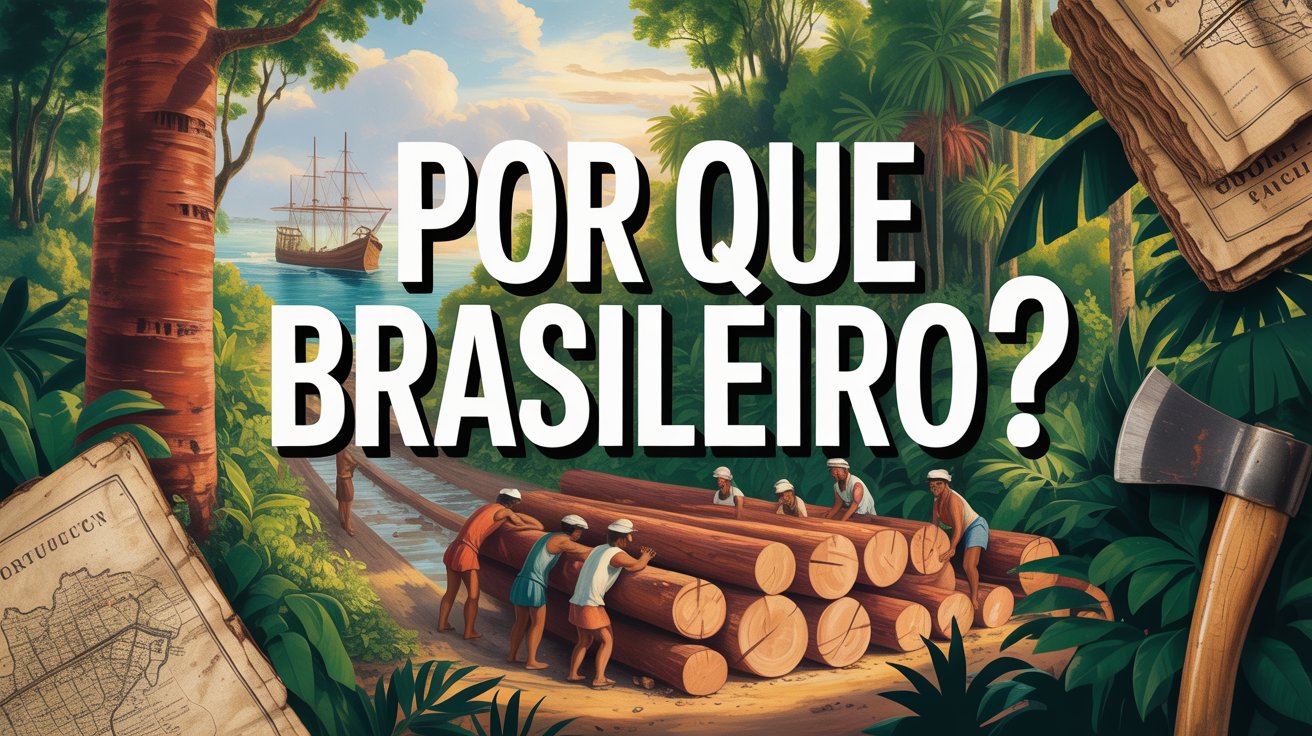
Far Beyond the Valuable Wood That Gave Name to a Country, an Ancient Profession Ended Up Naming an Entire People. Discover How a Simple Colonial Commercial Activity Shaped the Name and National Identity We Carry Until Today.
Unlike many nationalities that follow a linguistic pattern based on geographic origin, the term “Brazilian” did not arise with that purpose.
The word, which today represents the national identity of more than 200 million people, has roots in a trade from the colonial period — and not in a classification of belonging to the territory.
The term “Brazilian” originally designated the traders of brazilwood, the precious wood that marked the beginning of Portuguese exploration in the territory we now call Brazil.
-
Russia reveals that it is already conducting 95% of all its business with China without using a single dollar; dedollarization has ceased to be a promise and has become a reality in record time, and the West watches helplessly.

-
While Brazilians work more than 44 hours a week, Norwegians leave the office at 3 PM and are now testing a four-day workweek with full pay and no loss of productivity.

-
A legend of Brazilian TV is 75 years old, returned to narrate the World Cup for SBT, and still finds time to manage a farm of over 100 hectares in Rio Grande do Sul where she produces award-winning wines, olive oil, and raises cattle.

-
Family buys mansion destroyed by fire for $1.5 million, faces over 500 days of construction, transforms loss into high-end property, and leaves neighbors in awe.


According to historical records, during the 16th century, the Portuguese used the suffix “-eiro” to indicate professions and commercial activities.
Just as the “blacksmith” worked with iron, the “Brazilian” was one who explored or sold brazilwood, a native tree of the Atlantic Forest.
National Name Born from a Profession
Unlike what happens with other nationalities — like French, Japanese, Portuguese, Angolan, or Peruvian — the name “Brazilian” does not follow the logic of geographic origin, which would give rise to terms like “Brasiliano” or “Brasilic,” used in other languages.
The suffix “-eiro,” common in Portuguese to indicate professions, ended up being established as the designation of the people born in Brazil.
This occurred mainly from the 17th century, when the term began to be used more frequently by chroniclers and religious figures.
One of the main responsible for this change was the friar and historian Vicente do Salvador, author of the work History of Brazil, written between 1627 and 1628.
He was one of the first to employ the term “Brazilian” not to identify the wood traders, but rather to refer to individuals born in Brazilian territory.
Why Not “Brasiliano”?
The term “Brasiliano” was used occasionally by foreigners, especially in languages like Spanish (“brasiliano”) or Italian (“brasiliano”), following the more common pattern among nationalities.
However, this term never gained popularity among the inhabitants of Brazil themselves.
According to linguists and historians of the Portuguese language, language evolves with popular use — and it was the people, through their oral and written repetition, that solidified “Brazilian” as a synonym of nationality.
<pThus, terms like “brasiliense,” which today is used exclusively to designate someone born in Brasília, did not replace the more popular and consolidated form.
Moreover, the prestige and strength of oral culture in Colonial Brazil contributed to the establishment of this unusual term for nationality standards.
As the centuries passed, the initial association with the exploration of brazilwood faded, and the word gained new meaning.


The Tree That Named the Country
The connection between Brazil and brazilwood is so deep that the country ended up inheriting the name of the tree — not the other way around.
Brazilwood (scientific name Paubrasilia echinata) is a native tree of the Atlantic Forest, with reddish, valuable wood, widely used for dye production in Europe.
In the early colonial period, brazilwood was the main product explored by the Portuguese, which led the coast of the territory to be called “Land of Brazil” or “Land of Brazilwood.”
The name became established as that of the country itself.
Thus, the sequence was more or less as follows: the tree gave name to the territory and, later, the traders of the tree were called “Brazilians.”
Over time, this term began to identify the people who were born here.
Influence of the Portuguese Language
The formation of words in Portuguese has roots in Latin, and the suffix “-eiro” comes from the Latin “-arius,” which was already used in antiquity to designate professions or occupations.
Therefore, in modern Portuguese, we have words like baker, engineer, sailor, gardener, and bricklayer.
According to linguist Evanildo Bechara from the Brazilian Academy of Letters, “Brazilian” is one of the few nationalities in Portuguese that diverges from the rule and is constructed with this suffix.
The majority, like French (from France), Argentine (from Argentina), and Canadian (from Canada), follow other models of formation.
International Curiosity
In several foreign languages, the name given to the people of Brazil is not “Brazilian,” but rather a variation of “Brasiliano.”
This is the case in Italian (brasiliano), Spanish (brasileño or brasiliano), and English (Brazilian).
This shows that, at an international level, the linguistic standard usually follows the geographic origin of the country.
The Brazilian Portuguese, on the other hand, created an exception that became a rule — one that carries a much more curious history than most people imagine.
A Name with Deep Roots
The fact that the name of a people originated from a profession linked to colonial exploitation is a rare case in the history of linguistics.
Moreover, it is a living reminder of the economic origins of Portuguese colonization and the importance of brazilwood in this process.
Today, the term “Brazilian” is already completely dissociated from its professional origin and has become a symbol of nationality, cultural identity, and pride for millions.
Even so, knowing the trajectory of this word allows us to understand how language is shaped by economic, historical, and social interests, and how everyday expressions carry centuries of history in just a few syllables.
And you, did you already know that the name “Brazilian” had roots in a colonial profession? Do you know other everyday words that changed meaning over time? Share your opinion in the comments!






-

Uma pessoa reagiu a isso.