





 Portuguese
  English
  Spanish
  4 min of reading
  5 comments


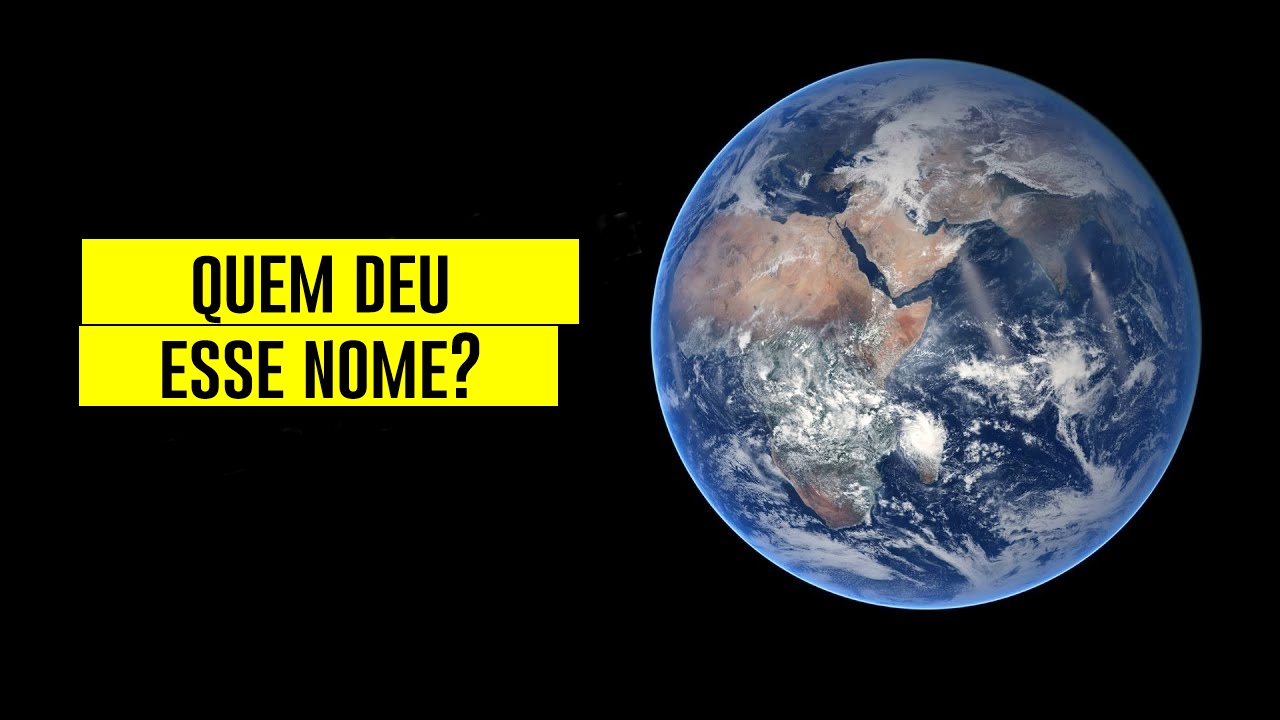


The Word “Earth” Has A Fascinating History And Comes From Ancient Civilizations. Understand How Our Planet Got This Name.
The word “Earth” carries a rich history that dates back thousands of years. Unlike other planets in the Solar System, whose names were inspired by Greco-Roman mythology, “Earth” has origins that connect directly to soil, ground, and the essence of what sustains life.
But how exactly did our planet receive this name and what is its historical and scientific relevance?
In this article, we will explore the linguistic origin of the word “Earth”, how it evolved over the centuries, some surprising scientific curiosities, and the importance of preserving our only home in the vast universe.
-
Motorola launched the Signature with a gold seal from DxOMark, tying with the iPhone 17 Pro in camera performance, Snapdragon 8 Gen 5 that surpassed 3 million in benchmarks, and a zoom that impresses even at night.

-
Satellites reveal beneath the Sahara a giant river buried for thousands of kilometers: study shows that the largest hot desert on the planet was once traversed by a river system comparable to the largest on Earth.

-
Scientists have captured something never seen in space: newly born stars are creating gigantic rings of light a thousand times larger than the distance between the Earth and the Sun, and this changes everything we knew about stellar birth.

-
Geologists find traces of a continent that disappeared 155 million years ago after separating from Australia and reveal that it did not sink, but broke into fragments scattered across Southeast Asia.

The Origin Of The Word
The word “Earth” is an excellent example of how language reflects our perception of the natural world. In English, “earth” means both the soil and the planet as a whole.
This linguistic duality, which associates Earth with the ground we walk on, is also present in various languages around the world.
Latin and Indo-European: The etymological origin of the word “Earth” comes from the Latin terra, used by the ancient Romans to designate the soil and, by extension, the planet. This word has even deeper roots in Proto-Indo-European, with the root ters-, which means “dry”.
- Other Modern Languages:
- In English, the term “Earth” derives from Anglo-Saxon eorðe and Old Germanic erde, both meaning soil or ground.
- In German, we have Erde; in Dutch, Aarde.
- In Turkish, the word “dünya” is used to describe the planet, influenced by Islamic culture.
- In Ancient Greek, the planet was associated with the goddess Gaia, who also personified the Earth.
These linguistic connections reinforce a shared perception among cultures: Earth as a symbol of the soil that sustains life. This view transcends simple etymology, reflecting a symbiotic relationship between humans and the planet we inhabit.
The Uniqueness Of The Name
Unlike other planets in the Solar System, which honor gods and goddesses from Greco-Roman mythology – such as Mars (god of war) and Venus (goddess of love) – Earth has a name that stands out for not being directly associated with mythologies or deities. However, in the Roman mythological context, the goddess Terra (equivalent to the Greek Gaia) was the personification of the planet, highlighting its importance as a source of life and fertility.
This characteristic makes Earth a unique planet, not only in name but also in its physical and biological characteristics.
In addition to being the only known planet that hosts life, Earth is a dynamic and complex system, with singular properties that deserve to be celebrated and protected.
Scientific Curiosities
Although the history of the name “Earth” is fascinating, the planet itself holds many mysteries and characteristics that make it even more extraordinary. Here are some scientific curiosities that reinforce the uniqueness of Earth:
Tectonic Plates
Earth is the only known planet that has active tectonic plates. These plates float on the Earth’s mantle and are responsible for phenomena such as earthquakes, volcanic eruptions, and the formation of mountains. They play a fundamental role in the carbon cycle, helping to regulate the planet’s temperature over millions of years.
The Actual Rotation Of Earth
Although we believe that a day is exactly 24 hours long, Earth actually takes 23 hours, 56 minutes, and 4 seconds to complete a rotation on its axis. This difference is compensated by the orbital motion around the Sun, resulting in the 24-hour cycle we use to measure time.
Co-Orbital Asteroids
In addition to the Moon, Earth has two “companions” in its orbit: the asteroids 3753 Cruithne and 2002 AA29. The 3753 Cruithne follows a peculiar orbit that seems to “accompany” Earth, while the 2002 AA29 has a horseshoe orbit that brings it closer to our planet every 95 years.
The Slowing Of Rotation
The rotation of Earth is gradually decreasing due to gravitational interaction with the Moon. Billions of years ago, an Earth day lasted about 6 hours. Currently, it takes about 24 hours, but in the future, it is estimated that a day could last up to 27 hours.
The Atmosphere That Protects And Sustains
Earth has an atmosphere rich in oxygen and nitrogen, with an ozone layer that protects it from harmful ultraviolet rays from the Sun. This combination is vital for the existence of life, making our planet an exceptional place in the cosmos.
With information from Today I Found Out.








Etimologia induzida, origem da palavra não é latina. Suas primeiras ideias vem dos semitas em língua hebraica.
Moisés escreveu no deserto no livro de Jó: “A terra tem a forma arredondada e está suspensa sobre o nada”
Pois é, é ainda tem gente que duvida da existência de ser que eu conheço como Deus. Veja bem, um ser que fez tudo certinho até com detalhes ele se importou, fez a terra um planeta único, com jardins verdes por todos os lados, mas também criou vulcões e a beleza amedrontadora de suas explosões. E lá em cima colocou sol, lua, e estrelas, enfim Deus o grande arquiteto fez tudo lindo daí os humanos foram ficando inteligentes e devagarinho começaram a destruir a terra, e não contentes invadiram o espaço e hoje até o carro da Tesla flutua a órbita terrestre só faltou o Elon Mosk lá na direção do volante. O mundo, a terra não vai acabar, porque são os humanos poderosos que acabram destruindo a terra e o universo em si, e daí Deus é quem vai levar a culpa, das maldades humanas.