





 Portuguese
  English
  Spanish
  6 min of reading
  0 comments


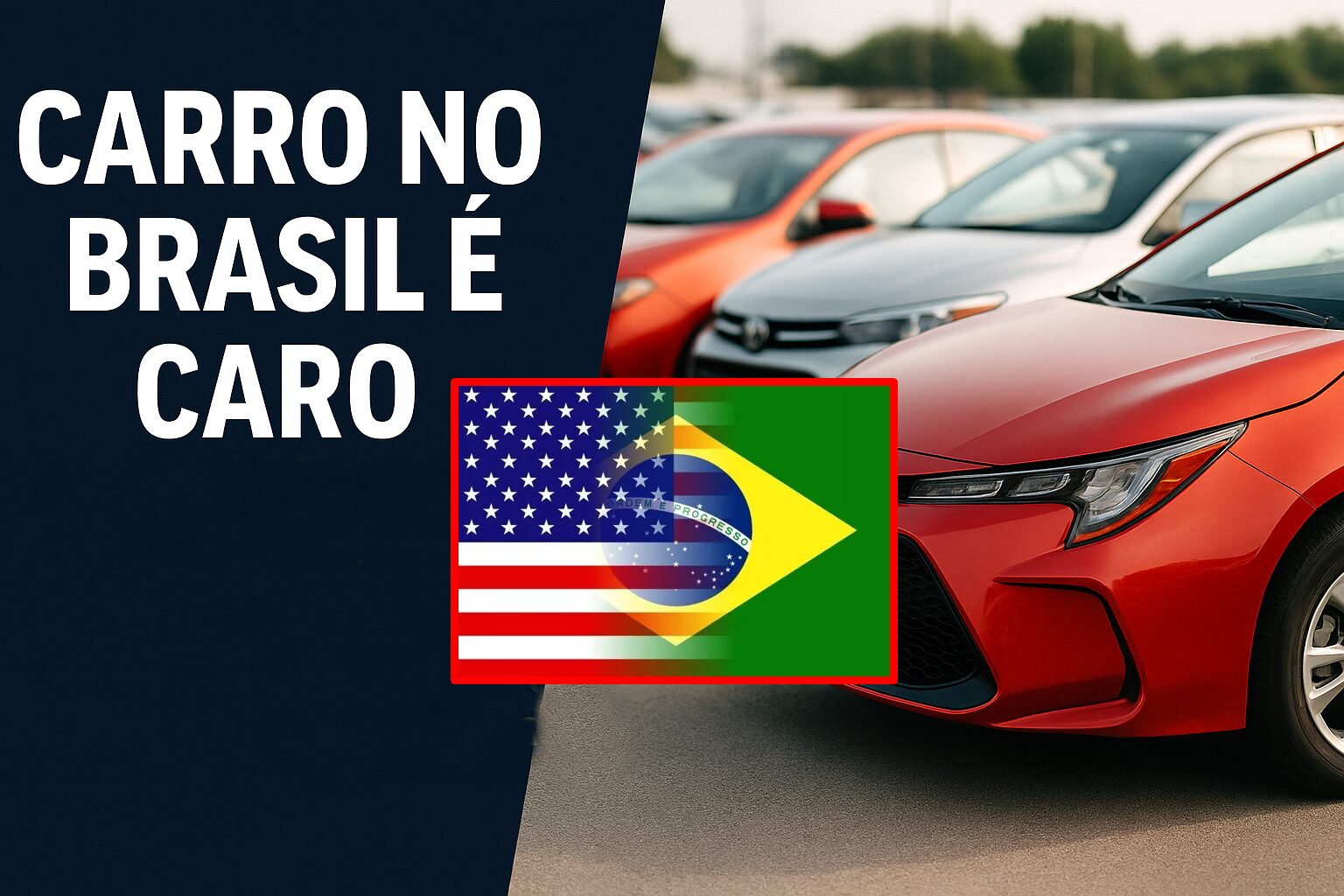
Buying A Car In Brazil Is A Challenge For Millions Of Brazilians, Even When The Model Is Simple. Meanwhile, In The United States, Popular Vehicles Are Much More Affordable, Even For Those Who Earn Little. The Difference Goes Far Beyond The Price On The Shelf: It Involves Taxes, Economic Model, And Even Cultural Issues.
In the United States, a McDonald’s worker can finance a Corolla more easily than a middle-class professional in Brazil. For an average worker, owning a car in Brazil is very difficult.
It may seem exaggerated, but it is a reality based on the difference between the two economic systems. The way each country taxes consumption and distributes its wealth helps explain this disparity.
In Brazil, a car is much more than just a means of transportation. It becomes a revenue-generating vector for the state.
-
The car stored for 38 years: when opening the barn door, what appears is breathtaking and looks like a scene from a movie!

-
Fiat works miracles in the Brazilian market, lowers the price of its 0 km hatch to R$ 69,990, reestablishes the model as the cheapest car in the country, and reignites the battle against Kwid and C3.
-
Chevette with cooking gas: How the gas cylinder ends up being used in cars clandestinely and why this makeshift solution can result in leaks, explosions, damaged engines, and seized vehicles.

-
Fiat launches the new 2027 Toro hybrid with 48V, 176 hp, an electric motor of 15.5 hp, a 0.85 kWh battery, up to 7% fuel savings, 8% fewer emissions, and possible exemption from IPVA.


While in the U.S. the income tax can reach 40% for the wealthiest, in Brazil, the burden is lighter on income and heavier on consumption.
This choice means that basic products, like a popular car, are out of reach for a large part of the population. The result is an unequal chain, where those who earn less pay, proportionally, much more.
Heavy Tax Burden
In Brazil, cars carry various taxes from the assembly line to the moment of purchase and circulation.
Among the taxes levied on vehicles are the IPI (Tax on Industrialized Products), the ICMS (Tax on Circulation of Goods and Services), PIS, and Cofins.
In addition to these, the owner still pays the IPVA (Tax on The Ownership of Motor Vehicles) every year, as well as licensing fees.
These taxes are not applied simply. Many of them appear in a cascading manner, meaning they are charged at different stages of the process.
This means that the tax does not only appear at the final sale but also in parts of the production and transportation. Thus, the car’s value rises several times along the chain before reaching the final consumer.
Just to illustrate, in some models of cars sold in Brazil, taxes account for up to 30% of the total vehicle value.
Not to mention the costs of transportation, dealership profit, and maintenance. In countries like the United States, this percentage is much lower, which considerably reduces the final price.
Larger And More Competitive Market
Another point that explains the price difference between Brazil and the U.S. is the size of the markets.
The United States has a fleet of nearly 290 million vehicles, while Brazil has approximately 58 million. This difference shows how much more mature and competitive the American market is.
The larger the market, the greater the scale of production and, consequently, the lower the costs. In the U.S., the automotive market is about seven times larger than the Brazilian market.
This allows manufacturers to sell more cars, reduce unit prices, and offer better conditions for the final consumer.
Additionally, in the United States, the habit of frequently trading cars is common. This helps keep the sector active and supplied, moving the entire automotive chain.
The Brazilian, on the other hand, tends to take years to pay off the vehicle and rarely trades in a car with less than five years of use.
Frequent Car Trade
The price difference also influences consumer behavior. With more affordable vehicles, Americans tend to change cars more frequently.
In some cases, they pay off the financing in just one year. In Brazil, it’s not uncommon to see consumers paying off their vehicle over five or even six years.
This quicker turnover helps the market move faster. The constant turnover contributes to lowering prices and keeping inventories moving.
It’s a cycle that benefits both the consumer and the industry. In Brazil, low turnover and high costs end up creating a slower and more concentrated market.
Imported Parts And Dollar Variations
A good part of the parts for cars manufactured in Brazil come from abroad. Many of them are even produced in the United States.
Since they are paid for in dollars, the price of the components varies according to the exchange rate. In times of a strong dollar, the price of parts skyrockets.
In September 2022, for example, the dollar was quoted above R$ 5.00. Thus, a part costing US$ 10 would cost R$ 50.
And since a car can have 70,000 to 90,000 parts, the final impact is enormous. Moreover, the imports of parts are subject to additional fees, which further increases the vehicle’s price.
These costs are inevitably passed on to the Brazilian consumer.
Even when the car is assembled here, a good portion of the components comes from abroad and is subject to fluctuations in the exchange rate and import duties.
The Leasing Culture
In the United States, leasing is a common practice. It is a type of contract where the consumer rents the car for a specified period, paying a monthly fee.
At the end of the contract, they can return the car, renew the contract with another model, or even purchase the vehicle.
This model facilitates access to automobiles and allows for a constant renewal of the fleet. In Brazil, this type of contract is still little used and concentrated in corporate fleets.
Most Brazilian consumers still prefer direct and installment buying.
With leasing, an American can maintain a new car by paying less per month. Since the vehicles are cheaper and the conditions more attractive, this practice has become popular and a part of the mobility culture in the U.S.
Transport Costs And The “Cost Of Brazil”
Transportation is also an obstacle in Brazil.
Since the country has continental dimensions and most loads are transported by highways, transport costs further inflate the price of automobiles. From production centers to dealerships, the transport is long and costly.
This contributes to the so-called “Cost of Brazil.” This term is used to describe a series of structural, bureaucratic, and logistical difficulties that make everything more expensive in the country.
In addition to transportation, the Cost of Brazil includes inefficiencies in the supply chain, tax bureaucracy, lack of incentives, and low productivity.
All of this directly affects the final price of cars and many other products.
The automotive industry feels this impact intensely, as it depends on a long and complex chain to deliver a finished product to the consumer.
The Cultural Issue And The Profits Of Manufacturers
Even with all these factors, there is a cultural component that helps maintain high prices in Brazil.
The car is still seen as a status symbol and an achievement. This allows manufacturers to charge high prices, knowing that consumers, even if dissatisfied, continue to buy.
An example is the Volkswagen Polo. In Brazil, the model has a starting price of R$ 83,000. In Europe, the same car costs around 16,000 euros (about R$ 89,000 in direct conversion), but with a more complete version. Here, the same level of equipment exceeds R$ 100,000.
This difference shows that, in addition to taxes, there is a larger profit margin applied by manufacturers in Brazil.
In more mature and competitive markets, like the U.S. and European countries, competition drives prices down. In Brazil, with fewer options and less scale, prices end up rising.
Tax Reform As A Solution
In light of this scenario, the only possible way out seems to be a tax reform.
The ideal would be to reduce the burden on consumption and increase taxation on income. This would bring more fiscal justice and could make products like automobiles more accessible.
However, passing such a reform in Congress is a huge challenge. There are diverse interests and resistance from sectors that benefit from the current model. In the meantime, the car remains an expensive dream for millions of Brazilians.
The Brazilian continues to pay dearly for something that, in many countries, is already a common consumer good. Whether due to taxes, the economic structure, or the culture of consumption, the car in Brazil is still far from being accessible.
Change depends on structural reforms but also on a new way of viewing the role of the automobile in the life of the citizen.









Seja o primeiro a reagir!