





 Portuguese
  English
  Spanish
  5 min of reading
  0 comments


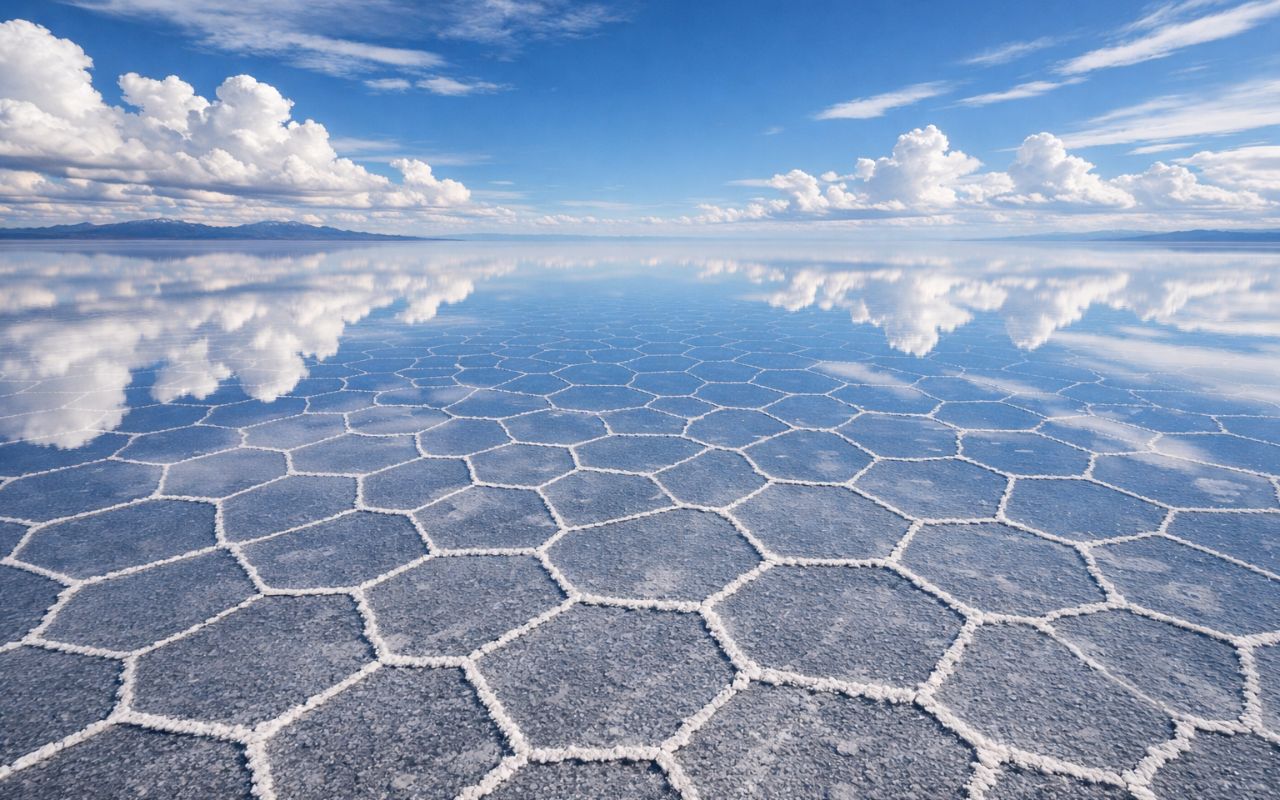
Salar de Uyuni, the largest salt desert on the planet, impresses with mirror effect and houses one of the largest lithium reserves in the world.
In the southwest of Bolivia, the Salar de Uyuni draws global attention for its unique landscape, which transforms into a gigantic natural mirror during rainy periods. With about 10,500 km² and located at an altitude of 3,656 meters, the salt desert attracts tourists, scientists, and photographers throughout the year. The ancient geological formation, combined with the presence of lithium on a large scale, explains why the site is considered strategic for both tourism and the technology industry.
In addition to its unparalleled beauty, the phenomenon occurs mainly between December and March, when a thin layer of water covers the ground. At this moment, the salt desert perfectly reflects the sky, creating one of the most surreal scenes on the planet.
Formation of the salt desert: how the Salar de Uyuni formed over thousands of years
The Salar de Uyuni did not form by chance. In fact, its origin is linked to geological transformations that occurred over thousands of years in the Andean Altiplano.
-
With less than R$ 6,000, you can build an underground cistern in your backyard that collects rainwater and eliminates the fear of rationing while reducing your water bill every month.

-
In France, there is a restaurant that prepares its main dish handmade, prioritizes local agriculture, and has become a culinary trend due to a food that Brazilians love.

-
With a lot of talent and creativity, a couple builds a house completely from scratch, using ceramic tiles, a cement base to level the ground, wood for the flooring, ceiling, and entire structure, transforming the construction with slats that fit together and impressing with an impeccable result.
-
Many said it was impossible, but a man built a house by himself, leveled the ground with soil, used cement blocks with foam to raise the structure, and framed it with wood.
In ancient times, the region was occupied by large prehistoric lakes. With climatic and geological changes, these bodies of water gradually dried up, leaving behind extensive layers of minerals. Thus, the current salt desert was formed, with a crust that can vary between three and ten meters thick.
Moreover, the intense aridity of the region contributed to the continuous accumulation of salt. Over time, this process consolidated an extremely flat and white surface, which today is one of the trademarks of the Salar de Uyuni.
Why does the Salar de Uyuni turn into a giant mirror during the rains?
One of the biggest attractions of the Salar de Uyuni is the famous “mirror effect.” This phenomenon occurs when rainwater spreads evenly over the salt desert.
In this scenario, the smooth surface reflects sunlight accurately, creating an impressive optical illusion. The ground practically disappears, giving the sensation that sky and earth merge into a single horizon.

Therefore, the period between March and April is considered ideal for those who wish to witness this natural spectacle. However, even outside this period, the salt desert remains a fascinating destination.
The largest salt desert in the world is also a lithium giant
Although primarily known for its landscape, the Salar de Uyuni has enormous economic importance. This is because it houses one of the largest lithium reserves on the planet.
It is estimated that up to 70% of the global reserves of this mineral are concentrated in the region. Lithium is essential for the production of batteries used in cell phones, laptops, and electric vehicles.
Still, commercial exploitation in the Bolivian salt desert is limited compared to other countries. Logistical, environmental, and political issues directly influence the pace of this activity.
Why is Uyuni not always the richest in salt?
Although it is the largest in area, the Salar de Uyuni is not necessarily the richest in salt in the world. One example is the Salar de Atacama in Chile.
Studies indicate that the salt crust in Atacama can exceed one thousand meters in thickness, while in Uyuni it is relatively thinner. This occurs due to differences in the geological formation of each region.
Even so, the Bolivian salt desert stands out for its extent and unique visual, making it one of the most iconic places on the planet.
Tourism in the Salar de Uyuni: unique experience at any time of the year
The Salar de Uyuni is one of the most impressive tourist destinations in South America. Its white and infinite landscape can be seen even from space, which reinforces its grandeur.
Photographers from all over the world visit the salt desert in search of creative images. The reflective surface allows for playful perspectives, creating photos that seem to defy the laws of physics.
In addition, the experience varies according to the season. During the dry season, the ground reveals natural geometric patterns. In the rainy season, the mirror effect completely transforms the scenery.

Altitude and care: what to consider before visiting the Salar de Uyuni
- Located at over 3,600 meters above sea level, the Salar de Uyuni requires special attention from visitors due to extreme conditions.
- The so-called “altitude sickness” can cause symptoms such as headache, dizziness, nausea, and fatigue.
- To reduce impacts, gradual acclimatization is recommended, spending a few days in regions with intermediate altitude before the visit.
- Staying well hydrated and avoiding intense physical exertion in the first few days also helps the body acclimatize.
- Local traditional practices, such as the use of coca leaves, are common to relieve altitude symptoms.
- Specific medications for altitude sickness can be found in the city of Uyuni, providing additional support to tourists.
How to get to the Salar de Uyuni?
Despite its remote location, the Salar de Uyuni is relatively accessible. The main gateway is the city of Uyuni, in the province of Daniel Campos, Potosí.
The most commonly used routes depart from La Paz or San Pedro de Atacama. Additionally, it is also possible to reach the salt desert from other regions of Bolivia, Chile, Peru, and Argentina.
The facilitated access contributes to the growth of tourism, making the Salar de Uyuni increasingly popular among international travelers.

A natural phenomenon that unites science, tourism, and economy
The Salar de Uyuni is more than just a simple salt desert. It brings together unique characteristics that make it relevant in different areas.
On one hand, its geological formation reveals natural processes that occurred over millennia. On the other hand, its scenic beauty attracts visitors from around the world.
Meanwhile, its lithium reserves place the site at the center of debates about energy and technology. Thus, the Salar de Uyuni consolidates itself as one of the most fascinating and strategic scenarios on the planet.
Sources: CNN and Salar de Uyuni








Seja o primeiro a reagir!