





 Portuguese
  English
  Spanish
  6 min of reading
  0 comments


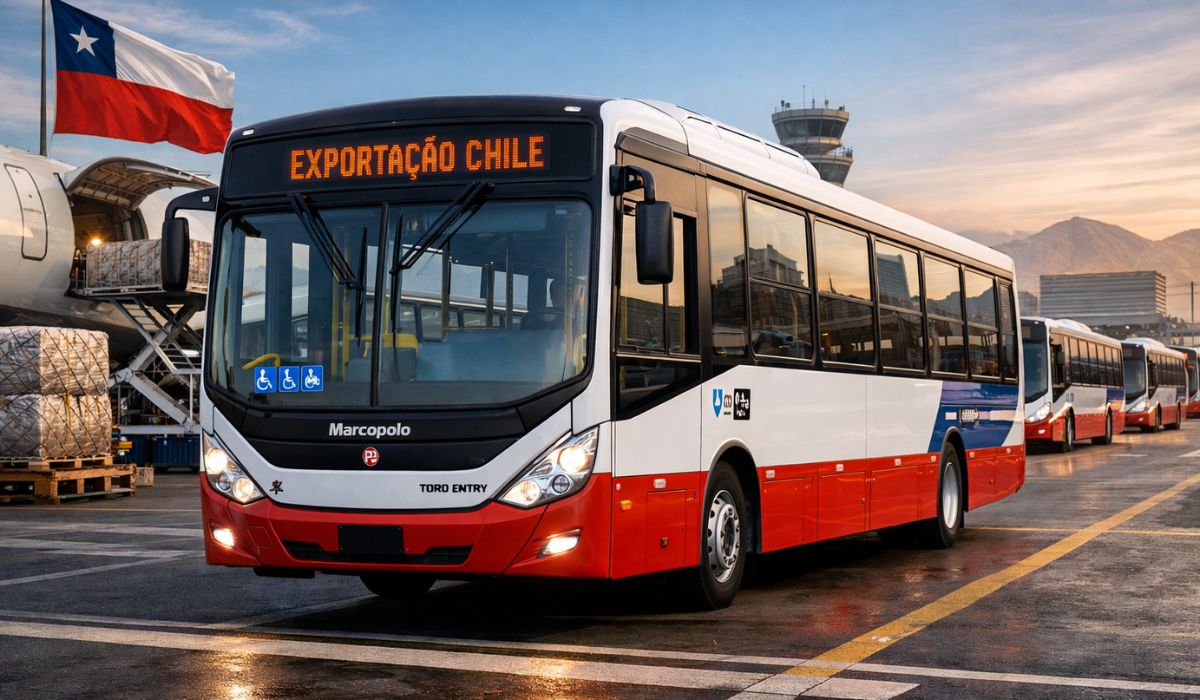
Marcopolo’s exports to Chile have scaled up in recent years and placed the Brazilian industry at the center of discussions about fleet renewal, onboard technology, accessibility, and lower-emission buses in urban transport in Latin America.
Marcopolo has expanded its presence in Chile’s public transport in recent years, turning Chile into one of its main external markets in the urban segment.
In material released by the manufacturer itself, the company reported that, since the end of 2018, it had sent about 800 units to the country by March 2020.
Later, in December 2022, it stated that the volume had reached about 1,000 new buses intended for the Chilean market.
-
While surpassing the mark of Apollo 13 and reaching farther from Earth than any other human mission, Artemis II named two craters on the Moon and immortalized in one of them the memory of the commander’s deceased wife.

-
The “Green Polo” of the Earth has been advancing to the northeast for decades and has been accelerating since 2010, changing the vegetation map and raising alarms about climate and agricultural production.

-
Scientists capture for the first time clear images of a tectonic plate fragmenting in real time under the Pacific Ocean and compare the process to a train derailing in slow motion, car by car.

-
Antarctica hides fortunes in gold and silver that could spark a giant conflict among nations!

These numbers show the relevance of the Brazilian operation in the sector, although they do not confirm, with certainty, a single shipment of 1,000 vehicles in 2026.
Marcopolo in Chile and the Brazilian presence in urban fleets
Marcopolo’s operations in Chile help to gauge the space occupied by the Brazilian industry in this market.
In March 2020, the company announced the supply of 240 buses for the Red Movilidad system in Santiago.
At the time, it reported that the shipment reinforced its participation in the urban transport of the neighboring country and stated that about 1,600 vehicles with the brand’s bodies were already part of the local fleet.
Two years later, the company announced another large contract: 391 new buses for the same system, operated by Redbus Transdev.
According to the manufacturer, that was the largest export contract for the company in 2022.
The batch included versions of the Torino Low Entry and the Torino Low Entry Articulated, models aimed at high-demand urban transport.
The history of these supplies helps to explain the frequency with which the brand appears in fleet renewal processes in the region.
This movement was also reflected in the company’s most recent results.
Marcopolo reported that it ended 2025 with a consolidated net revenue of R$ 9.06 billion, while exports from Brazil grew by 31.1% during the year, totaling R$ 1.14 billion.
Additionally, the company stated that international business accounted for 45.4% of total net revenue.
This data indicates progress compared to the previous year and reinforces the growing weight of the external market in the manufacturer’s operations.
Torino Low Entry, accessibility, and technology in urban transport
In the case of the Torino Low Entry, the manufacturer’s proposal is to serve corridors and urban lines with higher operational demands.
In the official presentation of the model, Marcopolo describes the vehicle as a solution aimed at urban operation, focused on facilitating maintenance and increasing fleet availability.
The company reports dimensions between 11.5 meters and 13.48 meters in length, 2.60 meters in width, and 3.17 meters in height.
In the contracts announced for Santiago, the company presented different configurations.
In 2022, it reported that 305 units were 12.5 meters, 38 vehicles measured 10.99 meters, and 48 articulated buses reached 18 meters.
It also stated that all buses in that batch used Euro 6 technology, an emissions standard adopted in diesel engines.
In the announcement made in 2020, Marcopolo reported that the articulated buses of the Chilean system had 18.6 meters, capacity for 152 passengers, low floor, air conditioning, USB ports, a separate cabin for the driver, and preparation for electronic communication, audio, and video resources.
The manufacturer also highlighted the presence of a ramp for access to the salon to enhance accessibility.
These features frequently appear in contracts for larger urban systems.
In operations of this type, faster boarding, adaptation for passengers with reduced mobility, and integration with onboard equipment tend to have significant weight in technical specifications.
Still, passenger capacity varies according to the contracted configuration, chassis, and internal layout, which prevents treating a single number as standard for the entire Torino Low Entry family.
Bus export and impact of the Brazilian industry
The external performance of Marcopolo also has repercussions in the Brazilian industry.
In the 2025 balance sheet, the company reported consolidated production of 15,024 units and maintained its leadership in the Brazilian market.
In the same document, it stated that the advancement of international markets compensated for the accommodation of the domestic market throughout the year.
In the second quarter of 2025, the company recorded 3,904 units in consolidated net revenue, with 343 exported from Brazil and 693 billed directly in international operations.
The company also reported that it maintains factories on all five continents and that its vehicles operate in more than 140 countries.
With this structure, external contracts have gained a larger space in the composition of revenues.
This data helps to position bus export within a broader movement of internationalization of the manufacturer.
The industrial base installed in Brazil plays a central role in this process.
In its sustainability report, Marcopolo states that the Ana Rech unit in Caxias do Sul produces road and urban models for the Brazilian market and for export.
According to the company, the plant also concentrates administrative, commercial, engineering, and training areas.
Euro 6 buses, fleet renewal, and sustainability
The discussion about Brazilian technology in regional public transport also involves the issue of emissions and fleet renewal.
In contracts destined for Chile, Marcopolo associated the Euro 6 standard with the reduction of local pollutants and stated in its communications that this technology reduces particulate matter and nitrogen oxides compared to older vehicles.
At the same time, Santiago has advanced on other fronts of modernization.
In August 2025, Red Movilidad announced the incorporation of 176 new electric buses into the network, replacing diesel units in different areas of the capital.
The announcement indicates that the regional market has combined two fronts: the upgrade of diesel vehicles to stricter emission standards and the gradual expansion of electric fleets.
This scenario has led manufacturers to offer more than just the physical structure of vehicles.
Connectivity resources, monitoring, thermal comfort, accessibility, and compatibility with different energy strategies have become part of the requirements in contracting processes.
In Marcopolo’s case, the company stated for 2026 the expectation to increase deliveries of vehicles with alternative propulsion in the urban segment, alongside a gradual recovery of the Brazilian market in the second half.
Chile as a showcase for public transport in Latin America
Chile has come to occupy a prominent position among the markets observed by the urban transport sector in Latin America.
This is because Santiago’s system has become a regional reference in fleet renewal, operational standardization, and the incorporation of new technologies.
In this context, contracts closed in the country often reverberate in other commercial disputes in the region.
When a Brazilian manufacturer increases its participation in this environment, the movement tends to reinforce its presence in neighboring markets.
However, the available public data does not allow us to assert with certainty that a single company dominates all of Latin America’s public transport.
What the available documentation allows us to assert is that Marcopolo maintains leadership in the Brazilian market, broad international presence, and a relevant history of supply to Chile, one of the most closely monitored systems in the region.
With rising exports, a more robust international operation, and investments in lower-emission solutions, the Brazilian industry continues to have a significant presence in this market.
In upcoming contracts, the competition should consider factors such as production scale, operational cost, environmental requirements, and adaptation to the needs of each city.







Seja o primeiro a reagir!