





 Portuguese
  English
  Spanish
  4 min of reading
  0 comments


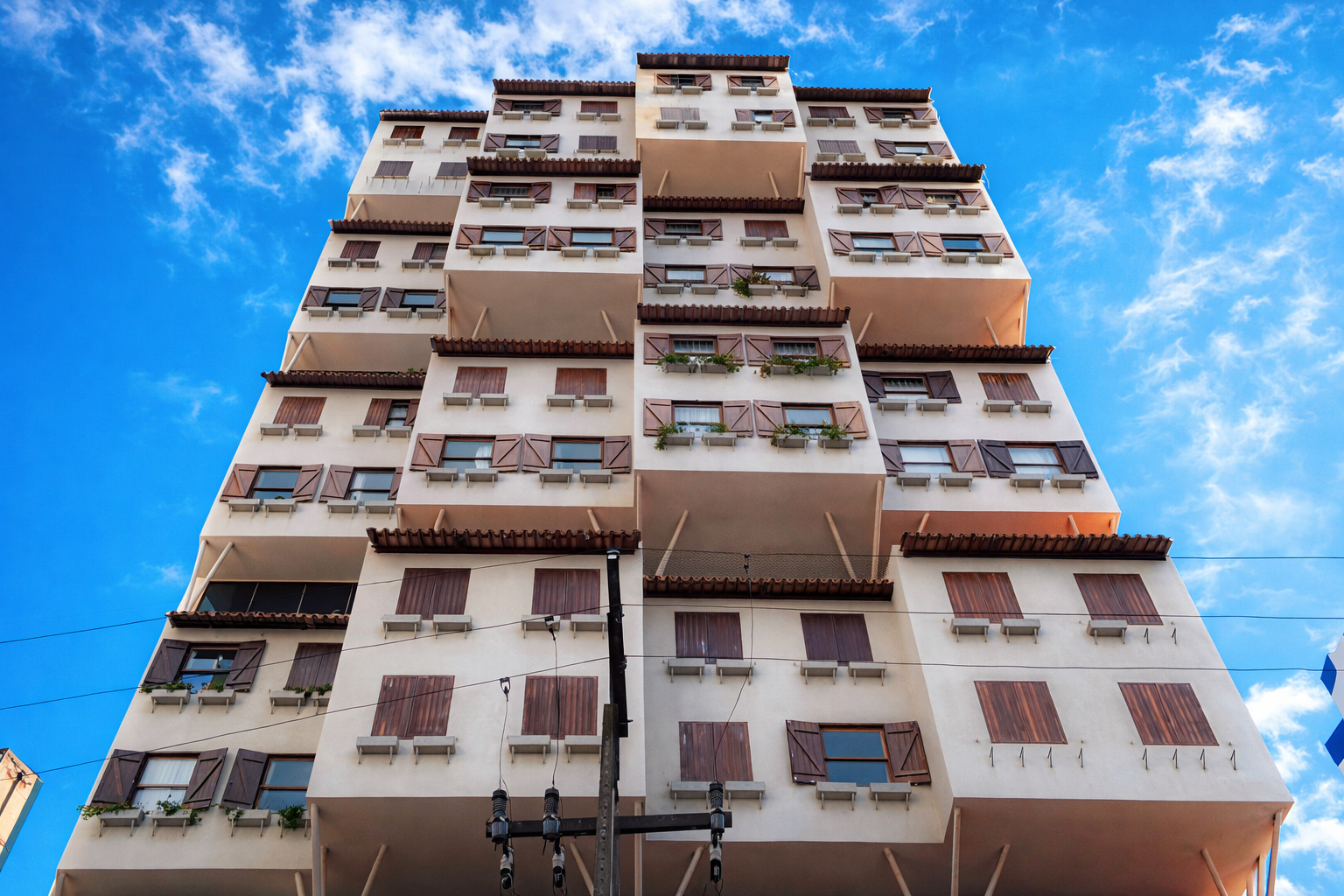
Designed by Jaime Lerner in 1979, the unusual building called Casario mixes overhanging volumes, exposed roofs, and cross-ventilation to create one of the most curious and functional facades in the city
Amidst the urban landscape of Curitiba, an unusual building has drawn attention for over four decades due to a detail hard to ignore: it looks like several houses stacked on top of each other. The Casario building, designed by architect and urban planner Jaime Lerner and completed in 1979, completely breaks away from the standard of traditional buildings by combining displaced volumes, exposed roofs, and typical elements of individual residences into a single vertical construction.
Urban architecture experts often highlight that works like this help to “break the visual rigidity of modern cities”, creating more welcoming and identifiable spaces for those who live and move through them. The result is a facade that mixes visual surprise with practical solutions for ventilation and lighting.
Unusual building in Curitiba that looks like stacked houses intrigues visitors to the region
The Casario building is an unusual structure in Curitiba that breaks with the logic of straight and repetitive facades. Instead of uniform lines, it features volumes that advance and recede, creating a dynamic visual effect.
-
Archaeologists opened a secret chamber that had been sealed by sand for 40,000 years inside a cave in Gibraltar and found what may be the last place where Neanderthals lived before disappearing from Europe forever.
-
The water that may have gone to the Moon with NASA during the Apollo 11 mission and been consumed by the astronauts springs in a Brazilian city at an altitude of 945 meters, famous for its thermal springs, above-average quality of life, and a natural radioactivity so unusual that it attracted Marie Curie.

-
In 200 days, a Finnish man builds with his own hands an 11-meter boat powered by solar energy with “infinite autonomy,” capable of dispensing with refueling and already used as a floating house.
-
Neurologist Richard Restak issues a severe warning to all people over 65: there is a daily habit he recommends completely eliminating from your life because it is destroying your neurons and accelerating memory loss.

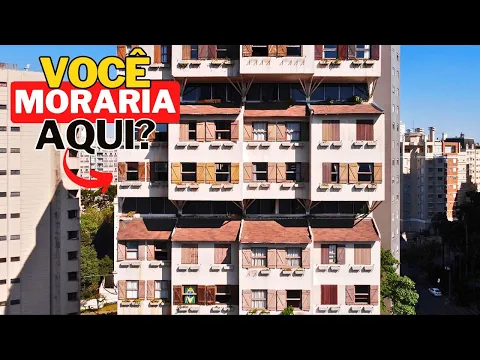

Each part of the facade seems to function as an “independent house.” This happens because the blocks are designed to overhang and are supported by cantilevered columns, a structural solution that supports the protruding volumes.
Those observing the building from a distance get the impression of seeing several overlapping residences, as if they were carefully and intentionally stacked.
Casario was made with volumes, roofs, and materials that create the effect
The unique aesthetic of the unusual building in Curitiba arises from a precise combination of architectural elements. The main one is the play of volumes with different setbacks, which breaks the linearity of the facade.
To reinforce the idea of suspended houses, Jaime Lerner included roofs with eaves on each volume. This detail is rare in vertical buildings and helps bring the construction closer to a more domestic scale.
Additionally, the project uses wooden doors that open outward, well-defined frames, and planters under the windows. These elements are common in houses, not in tall buildings, which is why they create a positive strangeness.
How ventilation, light, and mixed use work in the unusual building
Despite its unusual appearance, the building was designed to function well in everyday life. The play of volumes is not just aesthetic. It enhances the entry of natural light into the apartments.
Cross-ventilation is also a highlight. The internal corridors have windows, allowing for constant air circulation. This helps reduce the feeling of closed environments and improves thermal comfort.
The building has mixed use. The ground floor houses commercial spaces, while the upper floors are residential. In total, there are 15 floors with four apartments per level.
These units vary between duplexes, which maintain the exposed roof and wooden windows, and studios with large aluminum frames, which are more modern.
What makes this building different and valuable
The main differentiator of Casario lies in how it breaks urban monotony. Instead of repeating patterns, it creates visual identity. This choice also brings the building closer to people. The feeling of “stacked houses” makes the construction more welcoming, even though it is tall.
Moreover, the project demonstrates how architecture can unite aesthetics and functionality. The facade is not just beautiful. It directly contributes to lighting and ventilation.
The challenges and limitations of non-standard architecture
Creating an unusual building in Curitiba with overhanging volumes requires more complex structural solutions than a conventional building. The use of cantilevered columns, for example, demands precision in calculation and execution. Any error could compromise the stability of the blocks projected outward.

Additionally, maintenance can be more labor-intensive. Elements such as planters, wood, and roofs require ongoing care to preserve the original aesthetics.
Even so, the building has remained preserved after more than 40 years, which reinforces the quality of the reinforced concrete and masonry construction.
What this building reveals about architecture and the city
The Casario shows that buildings do not have to be merely functional or merely aesthetic. They can be both. It also reveals a more human urban vision. By bringing elements of houses into a tall building, the project creates an emotional connection with those who see it and those who live there.
This type of solution inspires architects to rethink how cities grow. Instead of repetitive blocks, it is possible to create buildings with identity and comfort.
More than an unusual building in Curitiba, Casario has become a symbol of creativity applied to urban life. It proves that architecture does not need to follow rigid formulas to work well. On the contrary, when it dares with purpose, it transforms the landscape and the experience of the people around.
And you, when looking at a building like this, prefer the boldness that draws attention or the safety of traditional models?






Seja o primeiro a reagir!