





 Portuguese
  English
  Spanish
  5 min of reading
  0 comments


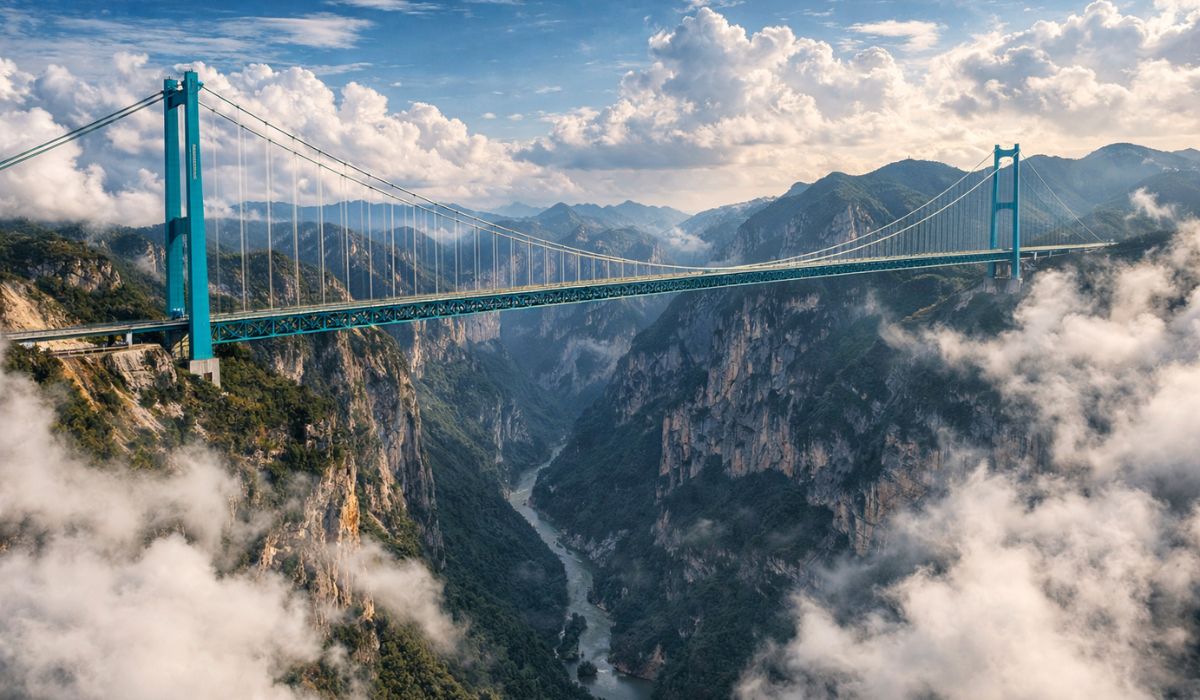
Inaugurated in 2025, the Huajiang Grand Canyon Bridge continues to stand out for its world record height and its impact on the mobility of a mountainous region in the Chinese province of Guizhou.
In China, a bridge inaugurated in 2025 continues to attract attention for a record: the Huajiang Grand Canyon Bridge is now the tallest in the world, with 625 meters between the deck and the Beipan River, in Guizhou province.
The structure came into operation on September 28, 2025 and took the global first place in this criterion, surpassing the Beipanjiang Bridge, which is 565 meters tall.
In addition to its height, the bridge features numbers that place it among the largest recent roadworks in China.
-
Son of a seamstress from the rural area of Ceará who did not speak English wins a scholarship of over 2 million reais at Williams College, one of the top 10 universities in the United States, covering everything including dormitory, meals, and annual trips to Brazil.

-
Bill Gates revealed that the true secret behind every great achievement is not a brilliant leap but rather small improvements repeated over the years, and the data from his own career and the fight against climate change prove that he is right.

-
With more than 635,000 doctors, Brazil sees competition increasing in large cities, and recent graduates are competing for shifts at an accelerated pace while the countryside still faces shortages.

-
The world’s first octopus farm wants to open in the Canary Islands and is already provoking an international reaction: the plan aims to produce 3,000 tons per year.


The structure was built with a total length of 2,890 meters and a main span of 1,420 meters, in an area of rugged terrain in the southwest of the country.
The Huajiang Grand Canyon Bridge also made history in Chinese engineering by establishing a new record in a province already known for having some of the tallest bridges in the world.
In March 2026, TIME magazine still referred to the structure as the bridge with the highest deck on the planet, reinforcing the relevance of this achievement.
The tallest bridge in the world has become a new landmark of Chinese engineering
One of the most important moments of the work occurred when the last metal segment was hoisted and connected to the main structure.
This stage marked the closure of the central part of the bridge and paved the way for finishing works, testing, and traffic release. The final piece installed weighed about 215 tons.
According to the state agency Xinhua, the system used in this phase was described by Wu Chaoming, senior engineer of the project, as the largest cable hoisting system for large spans ever used in this type of assembly.
In a statement reproduced by the agency, he stated that to complete the hoisting of the steel beams, the team used the largest cable hoisting system for large spans in the world.

According to the engineer, the system combined transportation, hoisting, and intelligent monitoring to handle challenges related to the weight of the pieces and the span’s amplitude.
This explanation was presented in the context of assembling the main metal structure, treated by Chinese authorities as one of the most sensitive phases of the schedule.
Structure in Guizhou reduced travel time from two hours to two minutes
Today, one of the main practical effects of the bridge is seen in travel time. Before the new connection, crossing the region required a journey through winding mountain roads and could take about two hours.
With the operation of the Huajiang Grand Canyon Bridge, this route now takes approximately two minutes, according to Xinhua and China Daily.
This gain has placed the structure at the center of discussions about mobility in areas with difficult terrain.
In practice, the bridge drastically shortened the travel time between important sections of the highway corridor linking Liuzhi and Anlong, as part of a broader effort to expand logistics in southwestern China.
Although the project was inaugurated in 2025, its impact remains current because the work permanently altered regional circulation.
Therefore, the topic continues to appear in recent reports not only as an engineering feat but also as a reference in transportation infrastructure in mountainous areas.
Height, length, and span place the bridge among the largest in China
The combination of height, total length, and main span explains why the Huajiang Grand Canyon Bridge has become such a closely followed project.
The deck at 625 meters above the Beipan River secured the world record for height, while the 2,890 meters of length and the main span of 1,420 meters enhanced the technical relevance of the project.
The supporting core of the work was assembled with 93 steel truss segments. Together, these components weigh about 22,000 tons, a mass described by Chinese sources as equivalent to three Eiffel Towers.

The investment reported by Chinese outlets was in the range of 2 billion yuan, approximately US$ 280 million based on the conversion used in some international reports.
Terrain and climate explain the challenges of the work over the canyon
The execution took place in an area identified by project suppliers and local reports as especially complex due to the canyon terrain, karst formation, and weather conditions.
According to these sources, the plateau environment intensifies temperature differences between day and night, while valley winds and episodes of strong convection can affect the hoisting and high work routine.
In this scenario, the assembly stage of the metal structure was treated by companies and Chinese authorities as one of the most delicate phases of the schedule.
Heavy pieces needed to be positioned over a void of hundreds of meters, in a region subject to climatic variations and high precision technical requirements.
When announcing the completion of the main structure and later the opening to traffic, Chinese authorities related the work to the advancement of the country’s engineering capacity in mountainous areas.
This framing frequently appears in official reports about the bridge from the final construction phase to the period after the inauguration.

Bridge in China also boosted tourism and regional circulation
The structure was also presented by authorities and engineers linked to the project as a connection with an effect on regional circulation.
According to these sources, the bridge is expected to strengthen integration between Guiyang, Anshun, and Qianxinan, as well as facilitate visitor access to tourist areas in the province.
China Daily highlighted among the possible impacts the faster travel to nearby attractions, such as the Huangguoshu waterfall region.
In Guizhou, where bridges and tunnels play a central role in the road network, this type of work is often treated as an instrument of economic and tourist connection.
The inauguration of the Huajiang Grand Canyon Bridge further reinforced Guizhou’s position as a showcase of extreme infrastructure in China.
The province already housed some of the tallest bridges in the world, and the surpassing of the Beipanjiang Bridge expanded this recent history with a new global record.









Seja o primeiro a reagir!