





 Portuguese
  English
  Spanish
  5 min of reading
  0 comments


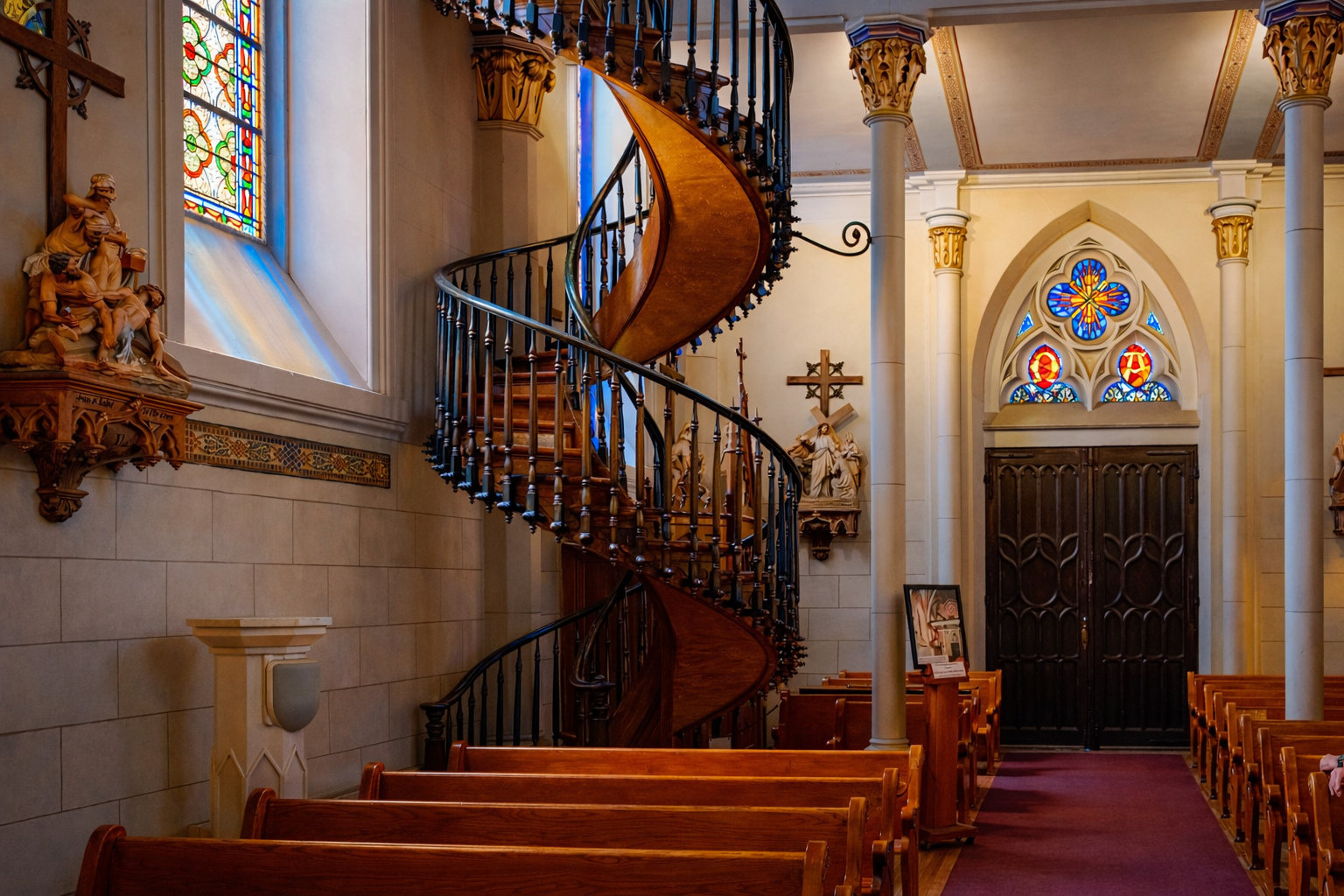
The famous spiral staircase of the Loretto Chapel combines unusual measurements, rare wood technique, and a story that still raises questions.
The Miraculous Staircase of the Loretto Chapel has become one of the most curious cases linked to historic staircases in the United States. With a height of 20 feet, two complete turns, and 33 steps, the structure gained fame for ascending to the choir without a visible central support.
The case became even more well-known because the solution emerged after architects claimed that a conventional staircase would not fit in the space without obstructing the seating. Santa Fe New Mexican, a newspaper cited in the original material, attributed the work to carpenter Frenchy Rochas.

A staircase made to conquer a very tight space
The Loretto Chapel was built between 1873 and 1878, in Gothic Revival style, and was left without access to the upper choir after its consecration. The most delicate point was precisely the interior space, too small to accommodate a common staircase.
-
With 30 meters in length, a house in England appears to float in the air and surprises engineers and architects around the world due to its visual effect and construction method suspended over sloped terrain.

-
Called El Inmortal, the building that survived earthquakes in Ecuador seems to balance, defies the laws of physics, and impresses with its bold construction structure.

-
A gigantic dam project in the Himalayas could solve one crisis but silently create another for millions of people.

-
Nikola Tesla said that intelligent people tend to have fewer friends, and now science partially confirms this: a study with over 15,000 people showed that for the more intelligent, socializing too much can even reduce life satisfaction.


It was in this scenario that the wooden spiral staircase was born, which today defines the interior of the chapel. Instead of occupying a wide area and blocking the view of the pews, the structure ascends in a compact and well-closed design.
The numbers of the Miraculous Staircase help explain its fame
The spiral staircase rises 20 feet, equivalent to 6.1 meters, and completes two full 360-degree turns to reach the choir. The set has 33 steps, a number that has gained symbolic value over time.
These measurements help to understand why the staircase draws so much attention. It is not just about beauty: the design managed to solve a real need within a limited space, using precise curves and an ascent that appears light to those observing from below.
Seen from the floor, the structure highlights the sequence of curves and the absence of a visible central post. This detail reinforces the feeling of delicacy, even in a staircase with enough height to connect the main hall to the upper level.
The detail that impresses the most is the way the staircase supports itself
The Miraculous Staircase was made of fir and uses only wooden pins, without nails, glue, or screws. What seems impossible at first glance received a more direct technical reading from engineers and carpenters.
The explanation lies in the internal and external stringers in a helical shape, which support the weight from the base. The internal stringer acts as a very sturdy support, capable of handling moisture and temperature variations.
Therefore, the staircase seems to defy gravity, but it is not without structural logic. The central piece of the charm is precisely the combination of curved design, well-crafted wood, and load distribution in an unusual form.
Handrail and reinforcement changed the reading of the structure over time
The staircase did not remain exactly as it was born. In 1887, iron handrails were added by Phillip August Hesch, and an iron support also reinforced the structure.
These changes altered the original appearance, but they help to understand how the staircase has been preserved. Even with reinforcements, the main design continued to be the great differential of the piece.
The technical fame grew because modern carpenters describe the work as an art difficult to replicate with hand tools. The combination of curves, height, and wooden joints still provokes admiration.
Who could have built the staircase that became a legend
The most popular version speaks of a stranger who appeared with simple tools, worked alone for months, and disappeared without receiving payment. The narrative linked to Saint Joseph transformed the spiral staircase into a religious and tourist symbol.

However, there is a line of research that points to Frenchy Rochas, a French carpenter who lived in New Mexico. Santa Fe New Mexican, a newspaper cited in the original material, published an obituary crediting him for the staircase, and a record from the Sisters mentions $150 paid to him for wood in 1881.
Even so, the legend continued to be greater than any isolated document. The Sisters’ archives do not confirm a miracle, but they also did not erase the fascination surrounding the authorship.
The staircase came out of daily use and became a historical attraction
The chapel operated daily until 1968, when the academy was closed. The campus was demolished, but the chapel was preserved, and the staircase began to occupy an even stronger place in the imagination of Santa Fe.
Today, the site receives about 250,000 visitors per year. The staircase has been closed to the public since the 1960s for safety reasons, but it continues to be observed as the centerpiece of the museum and also of the space used for weddings.
A photo from 1959 shows 20 choir members on the structure. This record helps to visualize that the staircase was not just decorative: it supported real use, even with its light and almost fragile appearance.
Why this staircase continues to arouse so much curiosity
The spiral staircase combines exact measurements, a compact solution, and a rare visual even for those who have seen other spiral staircases. The 6.1 meters, the two complete turns, and the 33 steps transformed the piece into something much more than access to the choir.
What keeps the story alive is the sum of technique and mystery. The staircase solved a practical problem within the chapel, but it did so in such an unusual way that it continues to be observed as a work of art, a carpentry challenge, and a historical attraction.
Did you already know this story? Want to see more content about curious constructions? Feel free to comment and share with someone who likes architecture, rare staircases, and historical facts.








Seja o primeiro a reagir!