





 Portuguese
  English
  Spanish
  5 min of reading
  0 comments


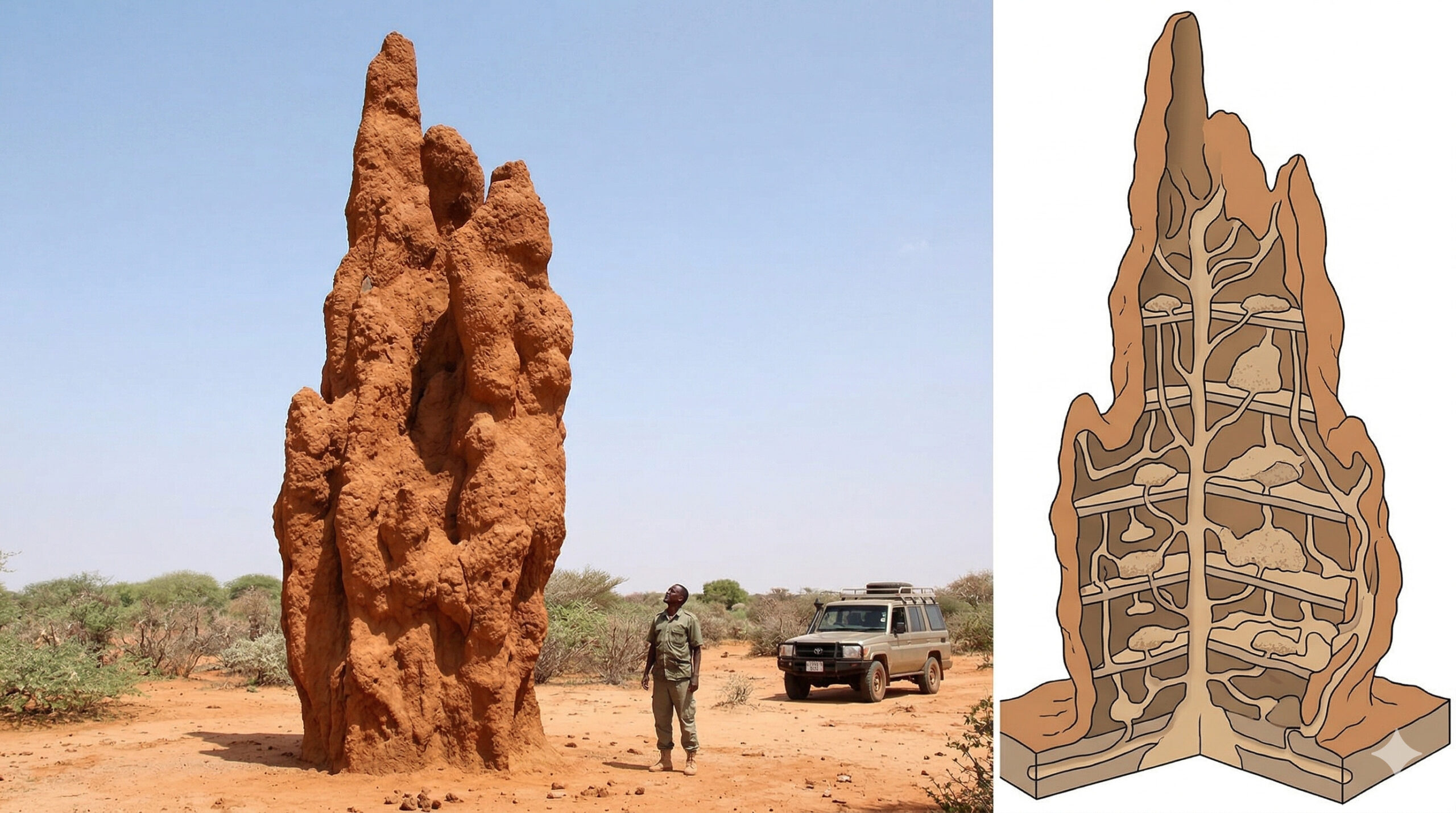
Termite mound of 8.7 meters in Somalia reveals how tiny insects build giant structures with highly efficient natural engineering.
In 1968, a record made in the region south of Hargeisa, in present-day Somalia, revealed to the world one of the most impressive natural constructions ever attributed to insects. According to the Guinness World Records, a termite mound photographed that year reached 8.7 meters in height, entering the organization’s records as an exceptional case among the largest structures ever built by termites.
The structure, built by colonies of termites over the years, draws attention not only for its height but also for the relative scale of the biological engineering involved. Guinness itself explains that termite mounds are among the largest structures built by animals, formed from soil, plant matter, saliva, and feces of the insects, and cites the case from Somalia as a particularly elevated example within this type of natural construction.
What is a termite mound and how does it work
The termite mound is the visible external structure of an extremely complex underground colony. Much more than a pile of dirt, it functions as an integrated survival system.
-
Measuring about 50 cm in wingspan, the merlin, the smallest bird of prey in the world, is at risk of extinction and could disappear by 2050, according to research published in Nature.
-
With 96 rooms, 37 bathrooms, and five kitchens, the mansion of the heir to Pernambucanas is worth R$ 50 million, has a pool, two terraces, and has become the target of a legal dispute after the owner fell into a coma in 2016.
-
In an isolated homestead in the mountains, a family builds a two-story tower with pallets, reclaimed wood, and scrap, transforming discarded materials into a functional off-grid home and proving that improvisation can also lead to surprising construction.
-
The government proposes a fee of R$ 625 for pet owners in 2026 in this region of Italy, but backtracks after a strong reaction and suspends the charge.

These structures are composed of: compacted soil, termite saliva, and organic matter.
This combination creates a kind of “natural cement” that is extremely resistant. The interior of the termite mound houses a network of tunnels, chambers, and channels that regulate temperature, humidity, and gas circulation, creating a stable environment even under adverse external conditions.
Inside the structure live:
- the queen
- the king
- workers
- soldiers
Each group performs specific functions that ensure the maintenance of the colony.
How millimeter insects build giant structures
One of the greatest scientific curiosities involving termites is the fact that there is no “leader” coordinating the construction.
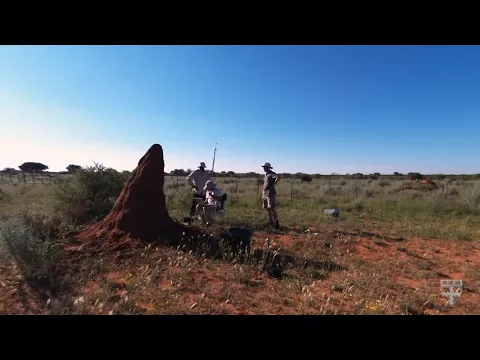

The process occurs through a mechanism called self-organization, where each individual follows simple rules based on chemical and environmental stimuli.
Termites deposit small amounts of material at specific points, guided by pheromones, and this collective behavior generates complex structures over time. This type of construction is known as:
- collective intelligence
- emergent behavior
The final result, like the 8.7-meter termite mound, is a highly sophisticated structure built without prior design.
Natural engineering that challenges modern architecture
Termite mounds are not only large, they are functionally advanced. One of the most impressive features is thermal control.
Even in regions with great temperature variation, the interior of the termite mound remains relatively stable. This occurs because the structure functions as a natural ventilation system.

Internal channels allow for continuous air circulation, removing carbon dioxide and regulating temperature, something comparable to modern passive climate control systems. This efficiency has already inspired human architectural projects, especially in buildings that seek to reduce energy consumption.
The time required to form a giant of 8.7 meters
Structures of this scale do not emerge quickly. A termite mound of this size can take:
- years
- decades
to reach its maximum height. Growth depends on factors such as:
- food availability
- climatic conditions
- soil stability
Construction occurs continuously, with constant maintenance, gradual expansion, and adaptation to the environment. This means that the termite mound recorded in Somalia represents the result of a prolonged and highly efficient process.
Why are such large structures rare
Despite the capabilities of termites, structures nearly 9 meters tall are extremely rare. This occurs because:
- they require specific environmental conditions
- they depend on stability for long periods
- they can be destroyed by external factors
Predators, climate changes, and human activities can interrupt the growth of these structures. Therefore, the record of the 8.7-meter termite mound is considered an exceptional event in natural history.

These structures also serve as shelter for other species. In many ecosystems, termites are considered environmental engineers, as they significantly modify the environment.
When compared to other structures built by animals, termite mounds stand out for their relative scale. While beavers build dams and birds build nests, termites can raise structures that, proportionally to their body size, are much larger.
If a human had the same construction proportion, they would be able to erect buildings kilometers high using only natural materials. This comparison helps to size the achievement of these insects.
What science learns from termites
The study of termite mounds goes beyond biology. Researchers use these systems to understand:
- collective intelligence
- decentralized systems
- energy efficiency
These concepts are applied in areas such as:
- robotics
- architecture
- engineering
The way termites build without central command has inspired algorithms and modern technological solutions.
An extreme example of natural organization
The 8.7-meter termite mound represents one of the most extreme examples of natural organization ever recorded. It demonstrates that simple systems can generate complex results, cooperation can replace centralized leadership, and natural processes can achieve high efficiency.
This type of structure reinforces the idea that nature operates with levels of complexity that often surpass human systems.
The termite mound recorded in Somalia in 1968 is not just a curiosity but a scientific landmark. A structure of 8.7 meters, built by insects a few millimeters long, shows how the combination of collective behavior, adaptation, and time can result in works of impressive scale.
More than a pile of dirt, it represents a living, dynamic, and highly efficient system, capable of rivaling human solutions in engineering and organization.
This type of discovery broadens the understanding of the potential of life on Earth and reveals that, even in seemingly simple forms, there are mechanisms capable of producing monumental structures.







Seja o primeiro a reagir!