





 English
  Francês
  Alemão
  Italiano
  Japonês
  Norueguês
  Portuguese
  Spanish
  5 min of reading
  0 comments


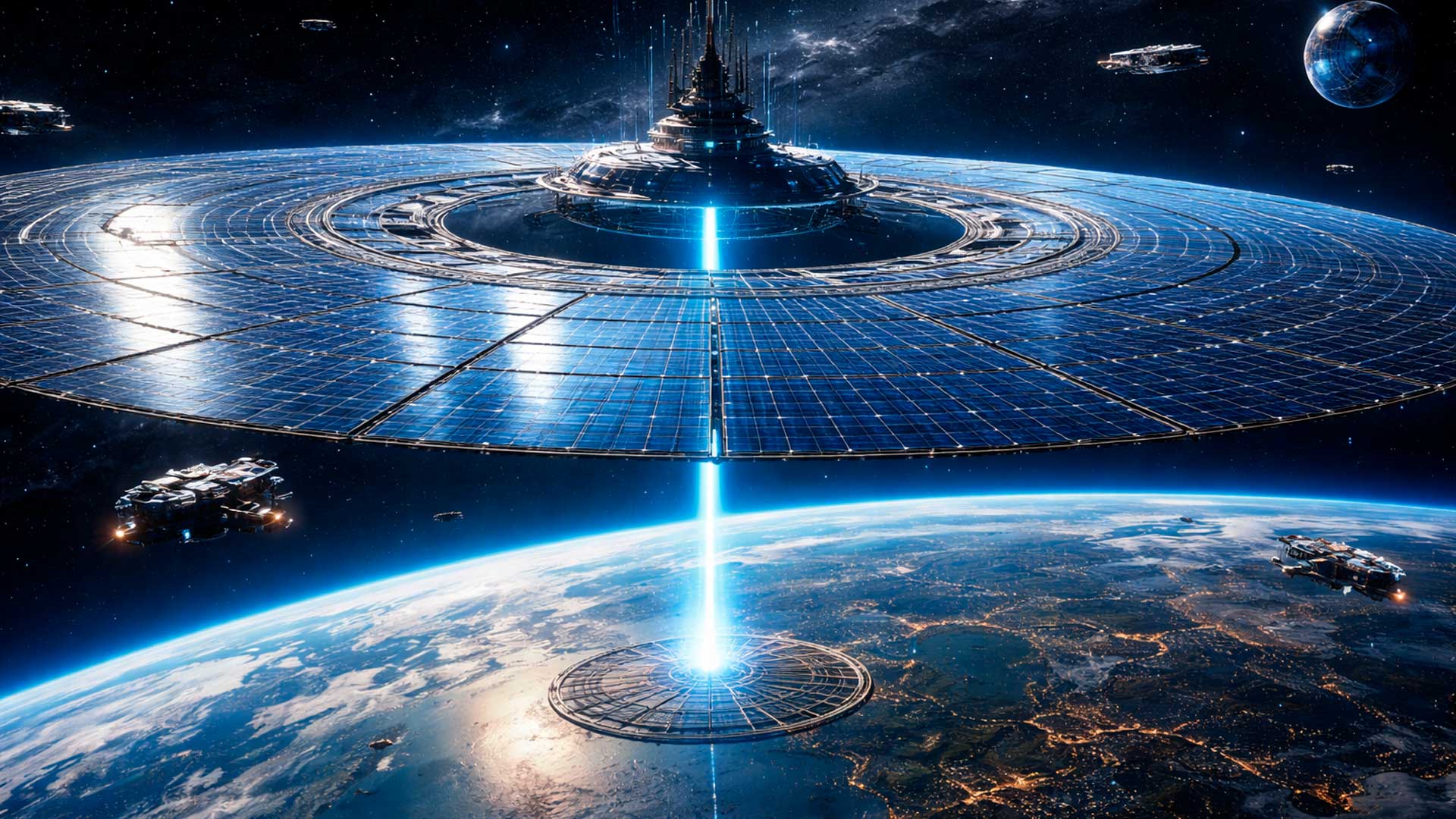
China wants to take solar power generation to geostationary orbit and transform continuous sunlight into electricity sent wirelessly to Earth. The proposal impresses with its size and ambition, but still depends on testing, heavy launches, and cost reduction to become a reality.
China has highlighted one of the boldest energy projects today by advocating for the construction of a solar power plant in space, capable of capturing sunlight continuously and transmitting that energy to Earth. The idea gained momentum after statements from rocket engineer Long Lehao, a member of the Chinese Academy of Engineering, published by the South China Morning Post on January 9, 2025.
According to this information, the plan aims for a structure about one kilometer wide in geostationary orbit, approximately 36,000 kilometers from the Earth’s surface. The proposal is to collect solar energy in a cloudless environment without the alternation between day and night, convert it into microwaves, and then send it to receivers on the ground.
The topic draws attention because it is not just a theoretical idea. In June 2024, China’s official scientific information platform reported that a team from Xidian University completed what it described as the first complete ground verification of chain and system for a space solar station, including light concentration, photoelectric conversion, transformation into microwaves, transmission, and reception.
-
350-year mystery may have been solved: remains of a soldier who inspired the hero of The Three Musketeers found beneath a church in the Netherlands.

-
NASA photographed a nearly perfect square with 3 km sides on Mars, 13 times larger than the Great Pyramid of Giza, but the official explanation is natural erosion; still, no one has explained why the four sides have almost identical lengths.

-
Starlink breaks the barrier of 10,000 satellites in orbit and takes its expansion to an unprecedented level, with a direct impact on global internet, technological competition, and the race for space.

-
Japan finds an alternative to oil amid rising prices by transforming ocean balance into electricity with a new technology that maintains efficiency even when the sea changes.

This places the project at an intermediate point between science fiction and applied engineering. There is currently no operational orbital power plant, but China is already gathering political discourse, ground validations, and mission proposals that indicate the country wants to lead the race for so-called space solar energy.
How the Chinese orbital solar plant would work

In practice, the logic is simple to understand and difficult to execute. Solar panels or arrays installed in space would capture solar radiation with intensity greater than the average observed on the surface, precisely because they do not suffer from atmospheric filtering, nor from losses caused by clouds and the daily cycle of darkness.
After that, the generated electricity would be converted into microwaves and sent to receiving antennas on Earth, known in the industry as rectennas, which would perform the reverse process and return that energy to the electrical grid. The ESA, the European Space Agency, summarizes this concept as a way to obtain clean and reliable energy 24 hours a day, provided that the transmission occurs safely and economically.
This is the point that explains the fascination surrounding the Chinese project. Instead of relying on batteries, favorable weather, or constant reinforcement from other sources to compensate for intermittency, the promise of the orbital plant is to offer a more stable source of electricity, something especially valuable for electrical systems increasingly pressured by demand, storage, and decarbonization.
What China has demonstrated so far
The most concrete advancement revealed so far came from Xidian University in Xi’an. According to the Chinese official platform NCSTI, the team led by Duan Baoyan completed tests in June 2024 that verified key technologies, such as microwave conversion, transmission over 55 meters, beam pointing control, and energy rectification reception.

This set of tests does not mean that energy is already being sent from space to Earth on a useful scale. What has been validated is the technical foundation of the system on the ground, which is important because the biggest bottleneck of the concept has always been in conversion losses, precise beam direction, and reception efficiency.
On another front, CGTN, based on information from Xinhua and the university itself, reported on June 22, 2022 that the Chinese goal included a first space solar station around 2028, expansion to about 10 megawatts by 2035, and a commercial target of 2 gigawatts by 2050, with an antenna approximately one kilometer long. Although this timeline is ambitious, it helps to show that China is working with gradual steps and not an immediate turnaround.
More recently, on June 23, 2025, pv magazine revealed a mission proposal linked to the program of the China Academy of Space Technology to demonstrate, before 2030, technologies such as ultralight solar arrays, microwave transmission, and even laser transmission. This reinforces that the project is still in the technological demonstration phase, not in commercial operation.
Why the proposal attracts so much attention in the energy sector
The main reason is the global search for a renewable source that does not depend so much on weather fluctuations. In space, the collection of sunlight can occur almost continuously, giving the orbital plant a significant theoretical advantage over solar parks installed on land.
Another factor is the geopolitical and technological symbolism. By comparing the project to a kind of “Three Gorges in space”, Long Lehao made it clear that the proposal is not just energy-related, but also industrial, spatial, and strategic for China, which aims to combine heavy launchers, orbital assembly, and wireless energy transmission into a single technological ecosystem.
The interest is not exclusive to the Chinese. NASA published a study in January 2024 showing that space solar energy is still being analyzed globally, with potential for future use, including applications beyond Earth, although it still faces significant gaps in capacity, cost, and technological integration.
The obstacles that still separate the idea from reality
The first major hurdle is cost. In the study released by NASA, the agency concluded that, considering a system that would start operating in 2050, space solar energy would still appear to be more expensive than sustainable alternatives on land, even if these costs could decrease with technological advancements.
The second obstacle is the engineering of scale. It is not enough to prove that microwaves can carry energy from one point to another in a controlled test. It is necessary to launch many components into space, assemble gigantic structures in orbit, maintain beam alignment safely, and ensure that energy reaches the ground without excessive losses.
There are also regulatory and environmental concerns. The ESA cites the need to study impacts on human health, flora and fauna, atmosphere, aviation, ground infrastructure, and also the environmental cost of the launch and the implementation of space infrastructure itself.
Therefore, the most realistic scenario today is that of a promising project, but still distant from the routine of the average consumer. The important news is not that China has already solved the energy problem with panels in space, but that the country has progressed enough to turn the idea into a program with a timeline, relevant tests, and long-term goals.
Does the proposal seem too visionary to become a reality in the coming decades, or can China indeed open a new era of clean energy with this orbital bet? Leave your comment and let us know if you see this space plant as an inevitable advance or as a megaproject too expensive to deliver on its promises.
With information from Terra!







Seja o primeiro a reagir!