





 Portuguese
  English
  Spanish
  5 min of reading
  0 comments


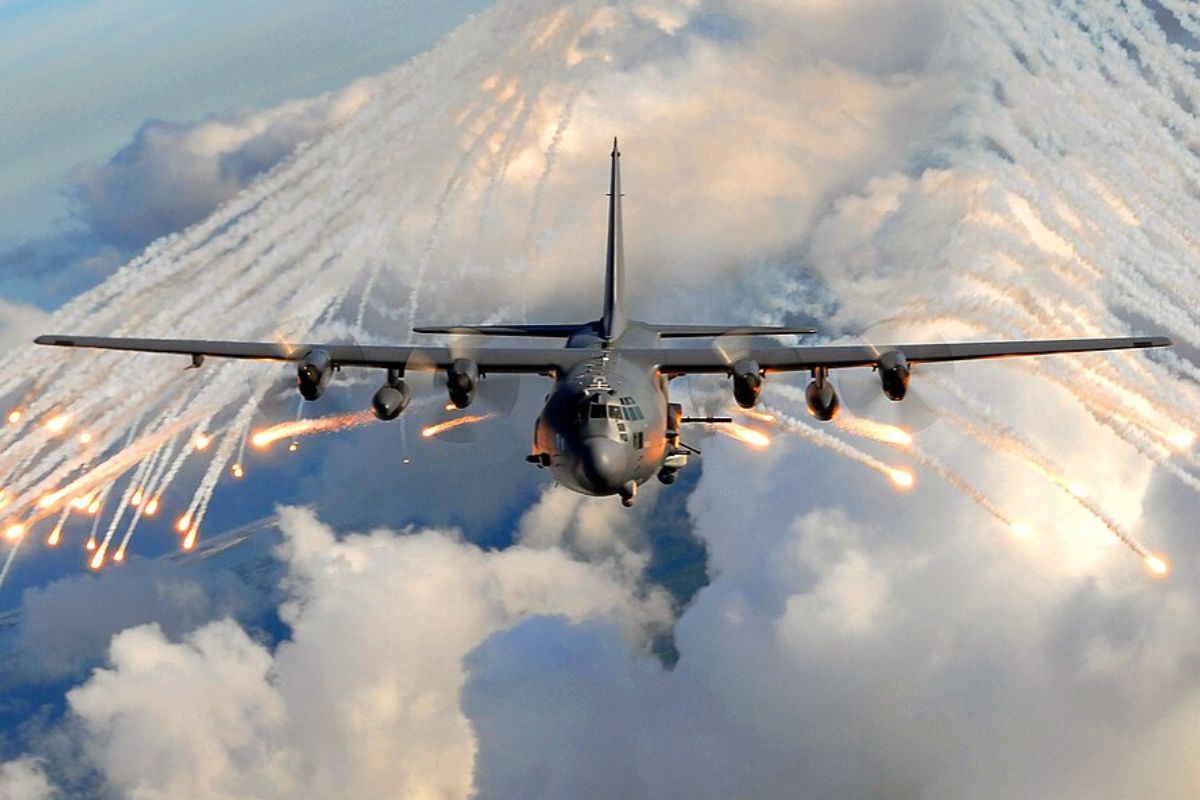
The AC-130J Combines Electro-Optical and Infrared Sensors, 30mm and 105mm Guns, Guided Missiles, and Extended Endurance to Support Troops, Monitor Critical Areas, and Strike with Precision. From Florida to the Middle East, Its Evolution Reflects Technological, Operational, and Budgetary Changes of Recent Decades in Complex Combat Scenarios.
The AC-130J was designed to remain airborne while the terrain changes in real time, with troops advancing, convoys moving, and targets of opportunity emerging in short windows. In this context, its operational logic is not just to attack: it’s to observe, prioritize, coordinate, and then apply force with precision, even in urban environments.
Throughout its evolution, the model has taken on a role as a persistent direct-fire expeditionary platform, focused on special operations and support to conventional forces. The central proposal is to combine persistence, situational awareness, and calibrated response, reducing the distance between detection and engagement in high-complexity missions.
What the AC-130J Does When the Mission Changes in Minutes

The main missions of the AC-130J are organized into three axes: close air support, air interdiction, and armed reconnaissance.
-
Motorola launched the Signature with a gold seal from DxOMark, tying with the iPhone 17 Pro in camera performance, Snapdragon 8 Gen 5 that surpassed 3 million in benchmarks, and a zoom that impresses even at night.

-
Satellites reveal beneath the Sahara a giant river buried for thousands of kilometers: study shows that the largest hot desert on the planet was once traversed by a river system comparable to the largest on Earth.

-
Scientists have captured something never seen in space: newly born stars are creating gigantic rings of light a thousand times larger than the distance between the Earth and the Sun, and this changes everything we knew about stellar birth.

-
Geologists find traces of a continent that disappeared 155 million years ago after separating from Australia and reveal that it did not sink, but broke into fragments scattered across Southeast Asia.
In close support, it operates in troop-on-troop scenarios, convoy escort, and point defense; in interdiction, it works against both pre-planned targets and targets of opportunity, coordinating attacks and maintaining continuous surveillance.
In practice, this means that the AC-130J functions as a prolonged presence platform over the area of interest, capable of maintaining tactical awareness of the field for hours. This persistence alters the rhythm of ground operations, as it allows for tracking changes in the terrain without swapping aircraft or disrupting the decision chain. Instead of a quick pass, there is continuous oversight of the mission from start to finish.
Another decisive factor is the expeditionary profile. The AC-130J has been described as providing persistent direct fire and the use of low-yield precision munitions against ground targets.
This design seeks to balance military effect and selectivity of attack, especially in urban areas, where target identification and collateral damage control are critical factors.
Sensors, Guns, and Missiles: How the Attack Package Functions
The AC-130J is a highly modified C-130J airframe with an advanced flight station for two pilots and fully integrated digital avionics. The extremely precise navigation results from this integration, which connects flying, mission, and weapon employment in a single operational flow. It is not just an armed aircraft; it is an integrated mission system.
At the heart of this architecture is the Precision Attack Package, with a mission management console, robust communications, two electro-optical/infrared sensors, and advanced fire control equipment. In terms of armament, it includes 30mm and 105mm guided weapons, as well as guided munitions such as GBU-39, GBU-69, AGM-114 Hellfire, and AGM-176 Griffin.
The combination of these elements addresses the “how” of the mission: detecting with sensors, confirming with fire control, deciding with mission coordination, and engaging with the most suitable munitions for the tactical objective. Efficiency comes from the sequence, not from a single isolated component. For this reason, the aircraft has been prepared to operate in adverse conditions, maintaining its capability for action when the environment is not permissive.
Where It Came From and Who Operates It: From the Vietnam Legacy to the Fifth Generation
The AC-130J is presented as the fifth generation of attack aircraft that replaced the AC-130U/W fleet. The AC-130 lineage carries a combat history dating back to Vietnam, with a record of over 10,000 trucks destroyed and participation in close support missions associated with saving lives in combat. This past has shaped the concept of armed persistence in the air.
In the last four decades, AC-130 variants have been employed in critical points across South America, Africa, Europe, and the Middle East, in support of special operations and conventional forces. This geographical distribution shows that the platform has been used in varied theaters, not limited to a single type of conflict or operational environment.
Regarding “who” is behind the operation, the records mentioned cite specific units and bases: the 4th Special Operations Squadron at Hurlburt (Florida), as well as Detachment 2 of the 27th Special Operations Group at Cannon (New Mexico). The first AC-130J squadron, the 73rd Special Operations Squadron, was activated at Hurlburt Field on February 23, 2018. The employment structure confirms a focus on special operations with global reach.
How Much It Costs to Maintain This Capability and What the Numbers Reveal
In numbers, the AC-130J has a reported unit cost of US$ 165 million and an active inventory of 37 aircraft as of fiscal year 2024.
The unit value helps to understand why its use tends to be linked to high tactical value missions, where persistence, coordination, and precision justify the investment.
The platform uses four Rolls-Royce AE 2100D3 turboprop engines, with 4,700 hp per engine at the shaft. The maximum takeoff weight is 74,480 kg, with a range of 4,828 km and crew service limitations associated with in-flight refueling.
This data shows an aircraft built to sustain presence, not just execute pinpoint attacks.
The dimensions also reveal the profile: a wingspan of 39.7 m, a length of 29.3 m, and a height of 11.9 m. The crew consists of 2 pilots, 2 combat systems officers, and 4 special mission aviators, totaling eight professionals per mission.
The “how much” here is not just financial: it also involves human scale, logistics, and ongoing employment doctrine.
Where the AC-130J Has Recently Appeared and Why It Has Gained New Strategic Weight
Records from 2020 and 2021 highlight operations and training at Hurlburt (Florida), Cannon (New Mexico), and a flyover in Wisconsin during the EAA AirVenture Oshkosh 2021, in a commemorative flight linked to the history of the Air Force Special Operations Command.
The public presence at these events also served to showcase the AC-130J as a new stage in the force’s attack capability.
On the program timeline, the name Ghostrider was officially adopted in May 2012; development tests and evaluations were completed in June 2015; initial operational capability was reached in 2017; full operational capability was projected for fiscal year 2025; and the last delivery occurred in November 2022. The sequence shows a long cycle of technical and operational maturation.
The “why” of the recent prominence stems from the very justification of force: competition among great powers, tighter budget constraints, and acceleration of technological changes.
In other words, the AC-130J gains relevance because it brings together three contemporary demands in a single platform: persistence, precision, and adaptability in multiple scenarios.
The AC-130J has established itself as a continuous mission platform: it observes, selects, coordinates, and engages with options for armament and sensors that operate in an integrated manner.
Its differential is not just “firepower,” but the ability to remain in the theater of operations with constant tactical awareness, connecting surveillance and attack in a linked manner.








-

-

-

-

-

-

50 pessoas reagiram a isso.