





 Portuguese
  English
  Spanish
  6 min of reading
  0 comments


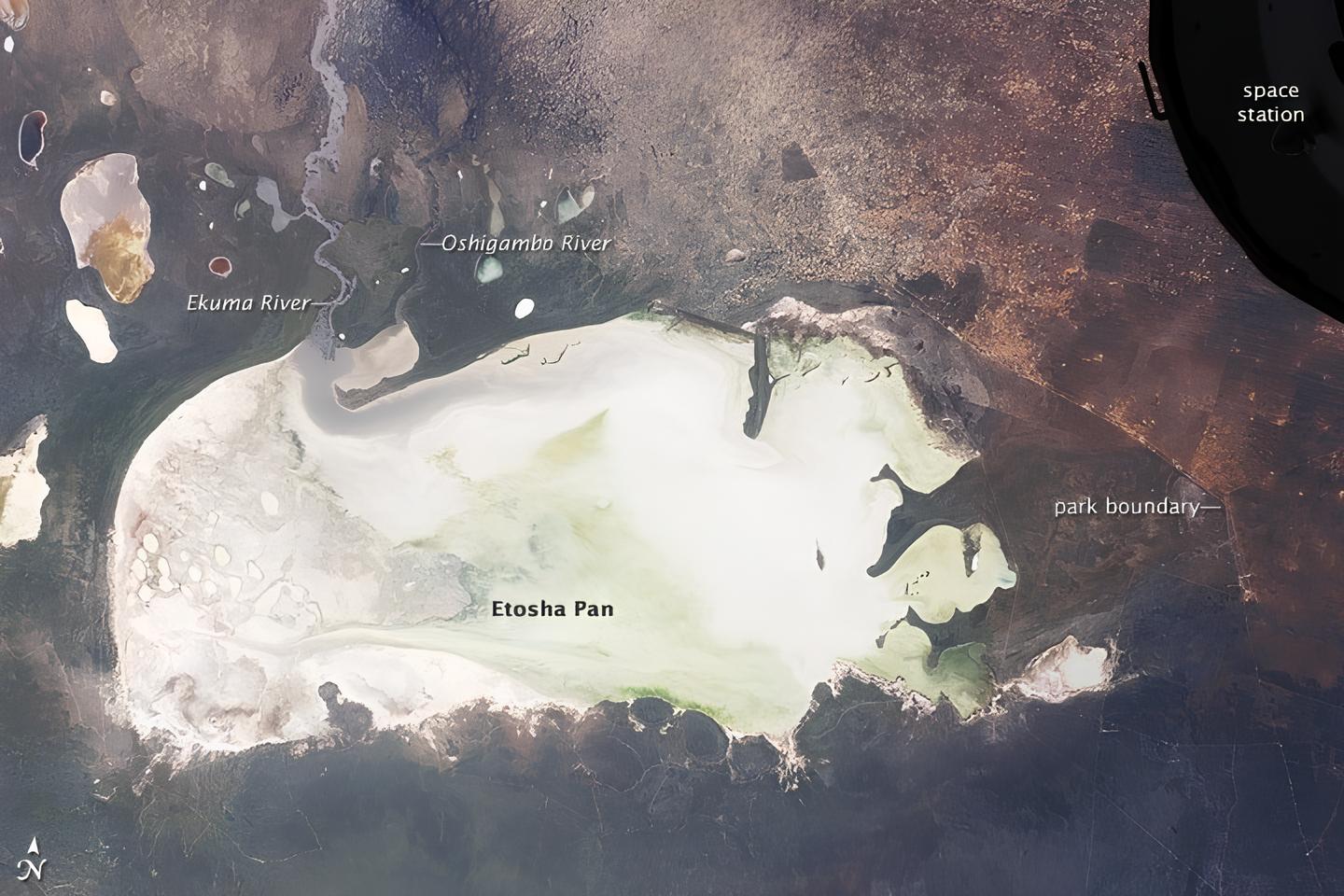
With up to 130 km in length, the Etosha Pan in Namibia alternates between a salt desert and a seasonal lake visible from space, creating a rare phenomenon that completely transforms the landscape.
In publications from the NASA Earth Observatory, the Etosha Pan, in the north of Namibia, has drawn attention again for displaying one of the most striking seasonal transitions in southern Africa. The vast salt basin, measuring about 130 kilometers in length, appears for most of the year as a white, dry, and cracked surface, but when the rainy season brings enough water to the rivers and channels that feed the depression, it can transform into a temporary water sheet visible by satellites and has even been recorded in images by astronauts in orbit released by NASA.
This cyclical behavior, alternating between an apparently inert saline environment and a highly active temporary ecosystem, helps explain why the Etosha Pan remains one of the most impressive examples of seasonal environmental dynamics on the planet. According to NASA, the basin remains dry for most of the year, but during periods of heavier rain, it functions again as a shallow and ephemeral oasis, attracting birds and large mammals and producing an extreme visual contrast between the “white void” and the sudden resurgence of life.
What is the Etosha Pan in Namibia and why does this giant salt flat impress scientists?
The Etosha Pan is an endorheic basin, meaning it is a closed system with no natural outlet to the sea. With an estimated area between 4,700 and 4,800 square kilometers, it occupies approximately a quarter of the entire Etosha National Park, one of the largest natural reserves in Africa.
-
Not in the refrigerator, much less near the stove: this is the correct way to store tomatoes.

-
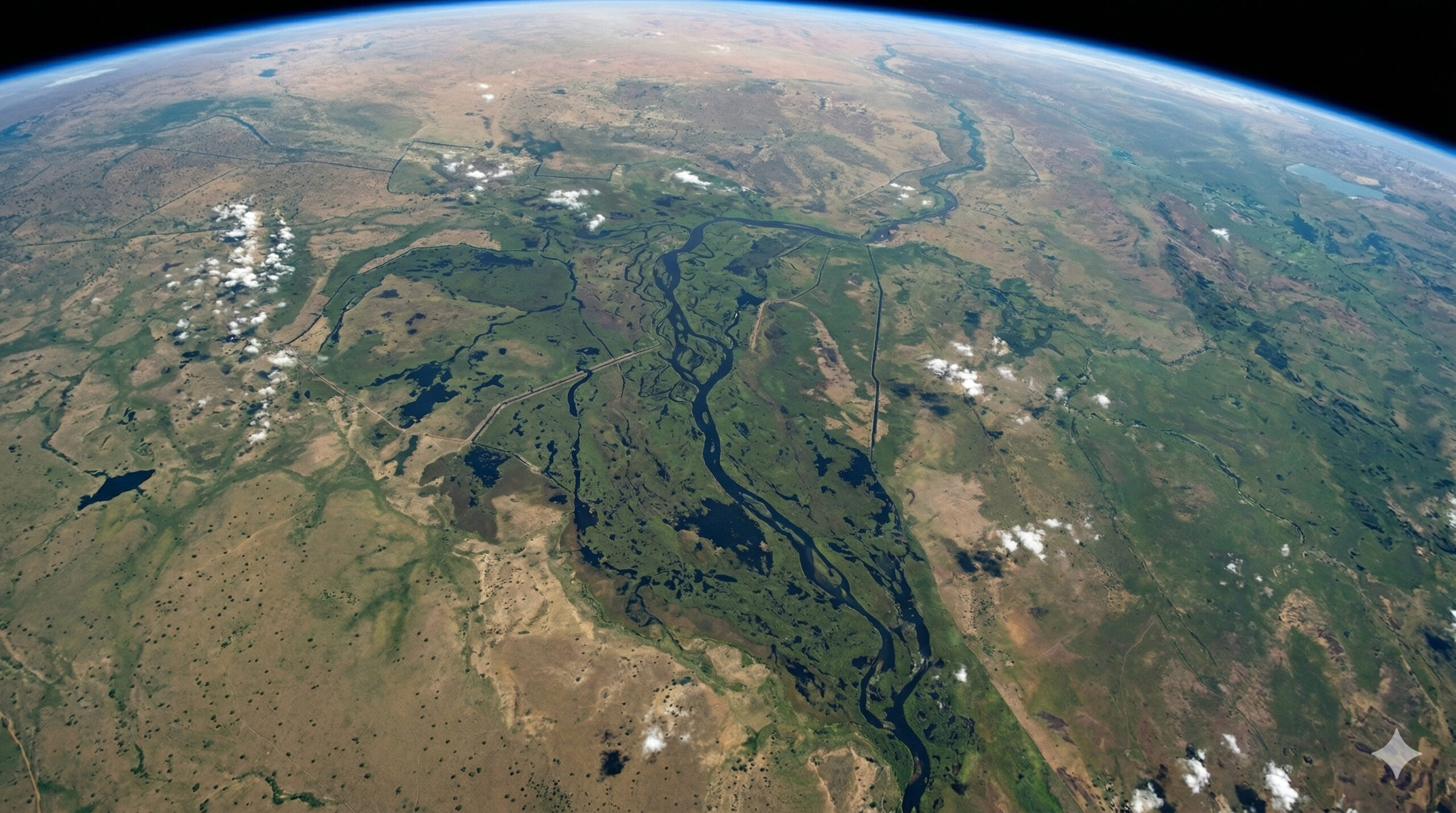
In South Sudan, the Sudd swamp, the size of England, causes the White Nile to lose more than half of its volume due to evaporation, forms floating islands of up to 30 km that move and block entire rivers, and for almost 2,000 years has prevented even armies and explorers from crossing this living labyrinth that changes shape every year.
-
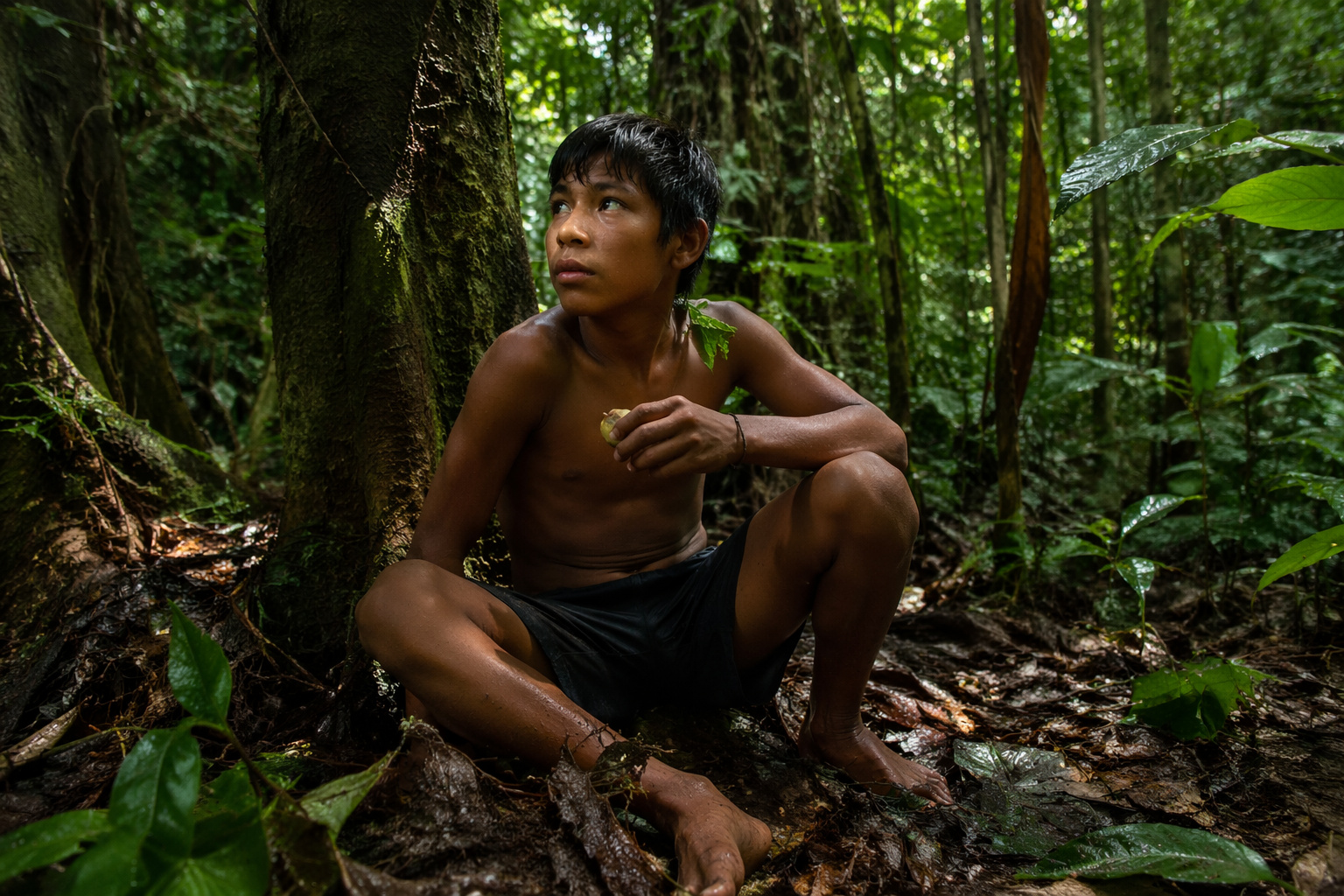
Alone in the forest for 11 days, an indigenous teenager from Acre recounts how he changed his path, got lost in the dense jungle, and survived on wild fruits, water, and calm until he found a way out and was rescued.
-
Psychology has discovered that adults who describe themselves as “non-creative” almost always trace this belief back to a single moment in childhood when someone evaluated what they did instead of asking what it meant, and the wound was so small that they confused it with a personality trait.


Its surface is predominantly composed of hardened clay and salt deposits, forming a white crust that intensely reflects sunlight. During dry periods, the soil fragments into geometric patterns of cracks, creating a landscape reminiscent of a mineralized desert.
This extreme visual characteristic is not just aesthetic, but a direct result of millions of years of geological transformation, which have completely altered the hydrological behavior of the region.
Geological formation of the Etosha Pan explains how an ancient lake turned into a salt desert in Africa
Geological studies indicate that the Etosha Pan began to form about 10 million years ago, when the region was still occupied by a large lake fed by river systems that were more active than those today.
At that time, rivers like the ancient Kunene system played a crucial role in supplying water to the area. However, tectonic changes and alterations in the terrain over millions of years diverted these water flows, isolating the basin.
With the progressive reduction of water input and the intensification of evaporation, the lake gradually dried up, leaving behind layers of salt and mineral sediments. This process transformed what was once a permanent body of water into one of the largest salt flats on the African continent.
Today, the Etosha Pan represents a living geological record of this transformation, preserving evidence of a hydrological past completely different from the current scenario.
How seasonal rains transform the Etosha Pan into a temporary lake in the Namibian desert
Although it remains dry for much of the year, the Etosha Pan still maintains hydrological connections with seasonal rivers, especially during the rainy season that occurs between November and May.
Rivers like Ekuma and Oshigambo, which form from rains in both Namibia and regions of southern Angola, can carry enough water to reach the basin. When this happens, the water slowly spreads across the flat surface of the pan.
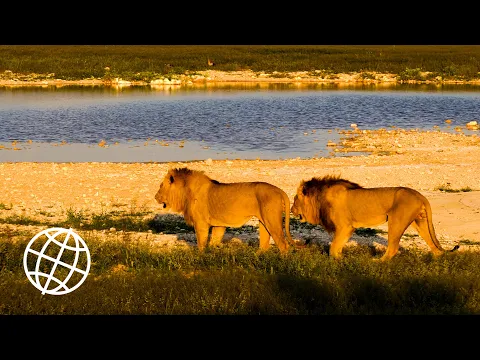
The depth of this flooding is usually shallow, often not exceeding 10 centimeters. However, due to the vast extent of the basin, even a shallow layer of water creates a gigantic visual effect.
This is a crucial point: it is not the depth, but the flooded area that transforms the Etosha Pan into a “temporary lake” of continental scale.
The process can last days or weeks, depending on the intensity of the rains and the evaporation rate, which is extremely high in the region.
Etosha Pan seen from space shows transformation between white desert and giant seasonal lake
One of the most impressive features of the Etosha Pan is its orbital visibility. During dry periods, the white salt surface is clearly identifiable by satellites. However, when flooding occurs, the contrast between water, sediments, and shores creates even more striking visual patterns.

Images captured by satellites and the International Space Station clearly show the transformation of the basin, with temporary rivers feeding the system and flooded areas rapidly expanding.
This phenomenon is so evident that it can be observed by astronauts in orbit, reinforcing the scale and geographical importance of the Etosha Pan.
Furthermore, the filling pattern is not uniform. Some areas accumulate more water than others, creating a dynamic landscape that continuously changes throughout the rainy season.
Explosion of life in the Etosha Pan attracts flamingos and migratory birds during rare floods
If for most of the year the Etosha Pan seems like a practically inhospitable environment, the scene changes radically when water arrives.
The temporary flooding creates ideal conditions for the development of algae and microorganisms, which serve as the base for an emerging food chain. Within days, the region begins to attract migratory birds in large numbers.
Among the most notable examples are flamingos, which use the pan as a breeding area in years of heavier rain. Colonies of tens or even hundreds of thousands of individuals can form, completely transforming the landscape.
In addition to flamingos, pelicans and other water birds also take advantage of the temporary environment for feeding and breeding.
This cycle of biological explosion followed by a return to the dry state is one of the most extreme examples of ecological adaptation in arid environments.
Dry period in the Etosha Pan reveals extreme salt desert and almost no visible life
When the rainy season ends, the process quickly reverses. The water evaporates under high temperatures, once again exposing the salt crust.
The landscape returns to the state of a white and cracked plain, with minimal visible biological activity. The absence of water drastically limits the presence of fauna, and only microorganisms adapted to extreme conditions can survive.

This contrast between temporary abundance and prolonged scarcity is one of the most striking characteristics of the Etosha Pan.
Few environments on the planet exhibit such a rapid and radical transition between two completely different ecological states.
Etosha Pan influences regional climate by releasing mineral dust and altering atmospheric dynamics
The behavior of the Etosha Pan also has important climatic implications. During dry periods, the exposed surface can release large amounts of mineral dust into the atmosphere.
These particles can influence regional atmospheric processes, affecting everything from air quality to cloud formation.
On the other hand, when the pan is flooded, the presence of water significantly reduces dust emissions, temporarily altering this balance.
This type of dynamics makes the Etosha Pan relevant not only as a visual phenomenon but also as an active component of the regional climate system.
The Etosha Pan in Namibia still holds secrets about extreme water and climate cycles
The Etosha Pan brings together a rare combination of factors: continental scale, extreme seasonal dynamics, deep geological origin, and significant ecological impact.
Its ability to alternate between an apparently dead arid environment and a vibrant temporary ecosystem in a matter of days makes it a natural laboratory for climatic, ecological, and geological studies.
Moreover, the visibility of the phenomenon on an orbital scale reinforces its importance as a global reference for the study of extreme environments.
It is a system that challenges intuitive perceptions of deserts and shows how even the most hostile environments can hide complex and highly dynamic cycles.
This type of temporary lake in the desert may exist in other regions of the planet
The Etosha Pan is a clear example of how nature can operate at extremes, alternating between total absence of water and temporary explosions of life in one of the driest regions of Africa.
In light of this, a question arises that continues to be explored by scientists and observers: how many other similar systems may exist on the planet, operating silently with cycles that only reveal themselves when conditions are just right?






Seja o primeiro a reagir!