





 English
  Francês
  Alemão
  Italiano
  Japonês
  Norueguês
  Portuguese
  Spanish
  6 min of reading
  0 comments


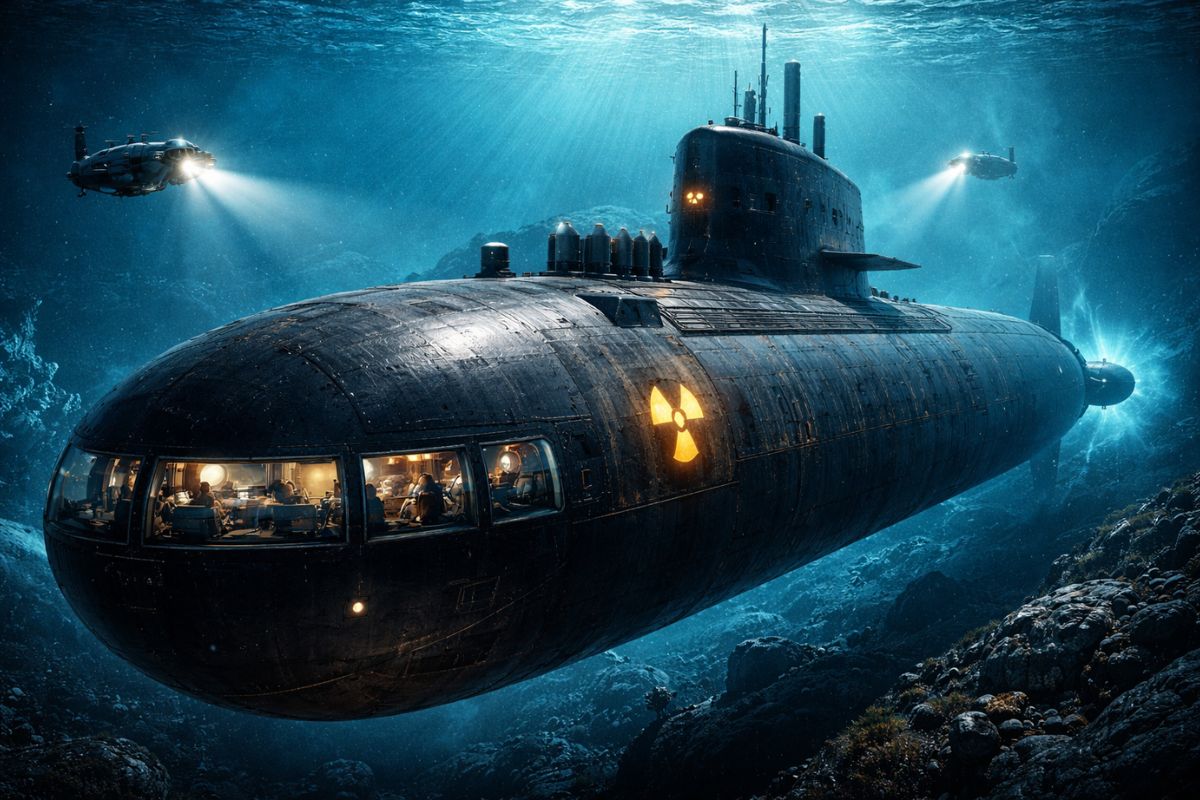
A submarine can stay submerged for months, carry an entire crew inside a steel cylinder, and still operate as one of the most powerful weapons ever placed in the sea
The nuclear submarine is one of the most impressive machines ever built by humankind. Capable of disappearing into the ocean for entire months, it carries over 130 people in a closed space, without sunlight, without contact with the surface, and with enough autonomy to cross great distances without returning to port.
Within this extreme environment, the routine mixes advanced technology, absolute discipline, and prolonged isolation. More than a military vessel, the submarine functions as an artificial ecosystem and as a platform for strategic power, capable of operating in the depths while carrying weaponry with devastating potential.
What makes the nuclear submarine so different

The main differentiator of the nuclear submarine lies in its propulsion system. While conventional models need to surface frequently, nuclear submarines are powered by reactors that allow for long periods of submerged operation.
-
350-year mystery may have been solved: remains of a soldier who inspired the hero of The Three Musketeers found beneath a church in the Netherlands.

-
NASA photographed a nearly perfect square with 3 km sides on Mars, 13 times larger than the Great Pyramid of Giza, but the official explanation is natural erosion; still, no one has explained why the four sides have almost identical lengths.

-
Starlink breaks the barrier of 10,000 satellites in orbit and takes its expansion to an unprecedented level, with a direct impact on global internet, technological competition, and the race for space.

-
Japan finds an alternative to oil amid rising prices by transforming ocean balance into electricity with a new technology that maintains efficiency even when the sea changes.

This means that the vessel can remain at the bottom of the ocean for months, navigating silently without relying on constant refueling.
This autonomy transforms the submarine into an almost invisible presence, difficult to locate and valuable from a military standpoint.
Today, there are over 500 active military submarines in the world, but only a portion of them belong to this more powerful category.
It is precisely these models that concentrate some of the most complex and expensive technologies ever applied in a war machine.
What is it like to live inside a steel cylinder
Life inside a submarine requires total adaptation. As soon as the vessel dives, the surface ceases to exist for the crew. There is no sky, no sun, and no space for common daily distractions.
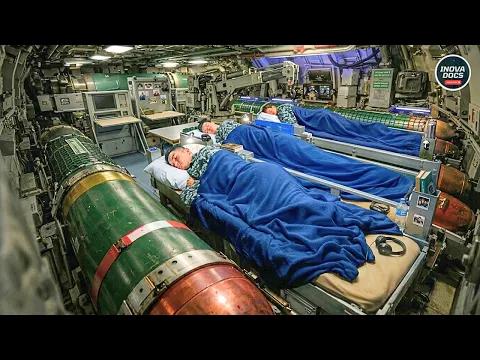
Every corridor, locker, and compartment must be used with precision. Space is limited, equipment occupies almost the entire interior, and privacy practically disappears.
In many cases, crew members share the same bed in different shifts, in a rotating system. It is a routine marked by confinement, discipline, and extreme use of every inch of the hull.
Even under these conditions, the crew must maintain normalcy. This includes working, studying, resting, and ensuring that all systems continue to operate without failures.
How the crew breathes inside the submarine
One of the most common questions about the nuclear submarine is how people manage to breathe for so long without access to outside air. The answer lies in the very structure of the vessel.
Oxygen is produced internally through the electrolysis of water, a process that separates hydrogen and oxygen using electricity.
The oxygen is gradually released into the internal environment, while chemical systems remove the carbon dioxide expelled by the crew.
In practice, the submarine functions as a small closed survival system. The air is recycled, filtered, and monitored all the time, because hundreds of meters deep, there simply is no option to open a window or renew the environment naturally.
Artificial routine and highly specialized functions

Living in a nuclear submarine also means accepting a completely different pace of life from the rest of the world.
The crew follows an artificial cycle of 18 hours a day, divided between work, maintenance, meals, study, and rest.
Each person has a specific role. Engineers monitor the nuclear reactor, technicians monitor the sonar, specialists calculate routes, and officers supervise the mission details. In an operation of this scale, any mistake can have serious consequences.
In addition to the technical pressure, there is also the mental strain of remaining isolated for so long. The repetitive routine and confinement are part of the challenge just as much as the technology of the vessel.
The role of sonar in the operation of the submarine
Inside a submarine, seeing is not a real possibility as it is on the surface. Therefore, one of the most important sectors of the entire vessel is the sonar.
This system captures sounds from the ocean and allows for the identification of engines, propellers, distant vessels, and even other submarines.
Operators spend hours listening to the environment through special headphones, trying to detect any signals out of the ordinary.
At the bottom of the sea, detecting first can determine who has the advantage. The sonar functions as if it were the submarine’s vision, allowing navigation, threat monitoring, and decision-making in a total darkness environment.
Food is also part of the mission

Food inside a submarine is much more important than just satisfying hunger. In an isolated environment, meals help sustain the crew’s morale for weeks or months.
In the first few days, it is still possible to consume fresh fruits, vegetables, and dairy products. After that, the kitchen relies on frozen, canned, and dehydrated foods.
Even so, the cooks need to maintain the quality of the meals and serve an entire crew in a limited space.
There are even snacks prepared for the night shifts, ensuring that no one goes without food during nighttime service. In such a closed environment, food also becomes emotional stability.
The military power hidden in the ocean
The nuclear submarine is not just a machine for survival and navigation. Its strategic function is directly linked to the military power it carries.
Some of the most advanced models can carry up to 20 intercontinental ballistic missiles. Each of these missiles can travel thousands of kilometers and carry multiple independent nuclear warheads. This means that a single vessel can strike several different targets at the same time.
In practical terms, a single submarine can concentrate enough power to destroy several cities in a matter of minutes. It is precisely this combination of invisibility and offensive capability that makes this machine so feared.
Why the submarine is a central piece of nuclear deterrence
The importance of the nuclear submarine goes beyond direct attack. It is also part of what experts call nuclear deterrence, a logic based on the capacity for response.
If a country knows that armed submarines are hidden somewhere in the ocean, any aggression could result in a devastating counterattack.
This factor creates a type of strategic balance because the uncertainty about the vessel’s location increases the weight of the threat.
For this reason, these submarines are treated as central pieces of global military security. They do not operate just as weapons, but as invisible guardians of a defense strategy based on the fear of retaliation.
An extreme machine, an extreme life
The nuclear submarine brings together some of the most extreme elements ever placed in the same structure. It is at once a means of transport, a survival system, an operational base, a technological platform, and a strategic weapon.
Inside it, more than 130 people live for months in a steel cylinder, surrounded by crushing pressure, total darkness, and a rigid routine.
Still, everything must function with absolute precision, from breathable air to sonar, from the kitchen to the nuclear reactor.
Few machines represent so well the combination of engineering, human resilience, and military power as the nuclear submarine.
And you, would you have the courage to spend months living inside a submarine at the bottom of the ocean?






Seja o primeiro a reagir!