





 Portuguese
  English
  Spanish
  4 min of reading
  0 comments


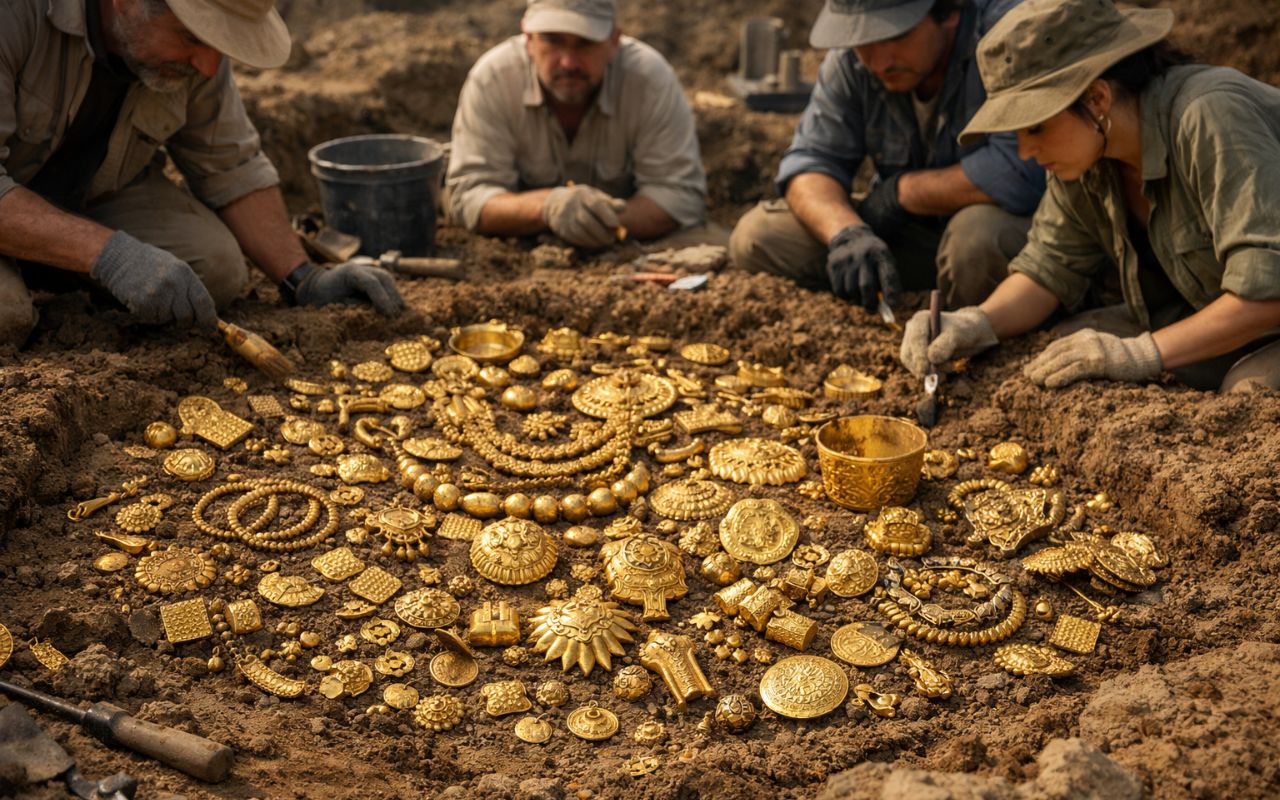
Discovery in Bulgaria reveals the oldest gold in the world, with more than 3 thousand pieces and evidence of social inequality 6 thousand years ago.
An accidental discovery made in 1972, in the city of Varna, revealed the oldest gold in the world, transforming the understanding of early European societies. The find was made by workers during construction when they uncovered an ancient necropolis with thousands of funerary artifacts. Since then, archaeologists have been investigating the site to understand who produced these pieces, how these people lived, and why gold held such value at that time.
The archaeological site, located in present-day Bulgaria, holds more than 3 thousand gold objects dated between 4600 and 4300 B.C. Furthermore, the collection totals about 6 kilograms of the precious metal. Therefore, it is not only the oldest gold in the world but also one of the largest prehistoric treasures ever found.
Prehistoric treasure impresses with quantity and sophistication
The discovered artifacts include a surprising variety of pieces, demonstrating an advanced technical level for the time. Among the items found are:
-
Axolotl challenges science with almost unbelievable abilities: an animal that never fully ages and can regenerate complex parts of its body intrigues researchers and may change the future of medicine.

-
He left a simple house to create a 5.3 billion euro empire: the unbelievable story of Federico Marchetti, the genius behind YOOX who revolutionized luxury e-commerce and rewarded his team with 50 million.

-
An explosive device was found on the Copacabana boardwalk this Monday, and the Bomb Squad had to be called in urgently to remove the object before something happened.

-
MDF furniture swollen from moisture doesn’t need to go to waste because two inexpensive techniques with sandpaper and waterproof varnish can restore its functionality without having to replace any parts.

- Necklaces and bracelets
- Earrings and pendants
- Decorative plates sewn into clothing
- Ceremonial ornaments
This collection reveals that the mastery of metallurgy was already sophisticated over 6 thousand years ago. Thus, the oldest gold in the world also serves as evidence that these societies mastered complex techniques of extraction, melting, and molding.

Additionally, the presence of non-local materials, such as seashells, indicates that there were trade networks. In other words, these communities did not live in isolation but maintained contact with distant regions of Europe and even the Mediterranean.
Tomb 43 concentrates wealth and raises hypotheses
Among the approximately 300 tombs found, one in particular stands out: the so-called Tomb 43. Alone, it contains about one-third of all the gold found at the site.
In this tomb, archaeologists identified the remains of a man over 60 years old — an age considered advanced for the period. He was buried with an impressive set of objects, including:
- An axe with a gold-covered handle
- Various body ornaments
- A golden artifact interpreted as a symbol of power
This level of wealth reinforces the idea that the individual held a prominent position. Therefore, the oldest gold in the world also helps identify leaders or prestigious figures in ancient societies.

Researchers raise hypotheses that he could have been a chief, priest, or even a craftsman specialized in metallurgy, given the sophistication of the objects around him.
Oldest gold in the world reveals social inequality
One of the most important aspects of the discovery is the clear evidence of social inequality. The distribution of objects among the tombs is not uniform.
While some burials contain a large amount of gold, others are extremely simple — or do not even present valuable objects. This indicates that there were already marked differences in social status over 6 thousand years ago.
Thus, the oldest gold in the world is not only an archaeological treasure but also a historical record of the formation of the first human elites. In other words, long before empires like Egypt or Mesopotamia, there were already well-defined hierarchies in Europe.
Varna culture and the advancement of metallurgy
The so-called Varna culture, responsible for these artifacts, flourished during the Copper Age, also known as the Chalcolithic period. This moment marks the transition between the Stone Age and the broader use of metals.
The level of specialization observed suggests an organized society with a division of labor. Furthermore, it indicates that there was sufficient technical knowledge to transform gold into symbolic and decorative objects.
Therefore, the oldest gold in the world also represents a milestone in the technological development of humanity. It shows that innovation did not arise suddenly but evolved gradually over the millennia.
Mysteries still surround the archaeological site
Even more than five decades after the discovery, the site of Varna has not yet been fully explored. A significant part of the necropolis remains intact, keeping new research possibilities open.
Archaeologists believe that future excavations may reveal even more details about this ancient society. Additionally, new technologies may help better understand the origin of the materials and the techniques used.
Meanwhile, the oldest gold in the world continues to fascinate scientists and the public. It not only impresses with its beauty and antiquity but also with its ability to tell stories about power, culture, and social organization in a distant past.
The importance of the Varna site goes beyond archaeology. It helps answer fundamental questions about the origins of social inequalities, technology, and power structures.
Moreover, the study of the oldest gold in the world contributes to understanding how human societies have evolved over time. This includes everything from economic organization to how prestige was represented.
With information from Adventures in History








Seja o primeiro a reagir!