





 English
  Francês
  Alemão
  Italiano
  Japonês
  Norueguês
  Portuguese
  Spanish
  4 min of reading
  0 comments


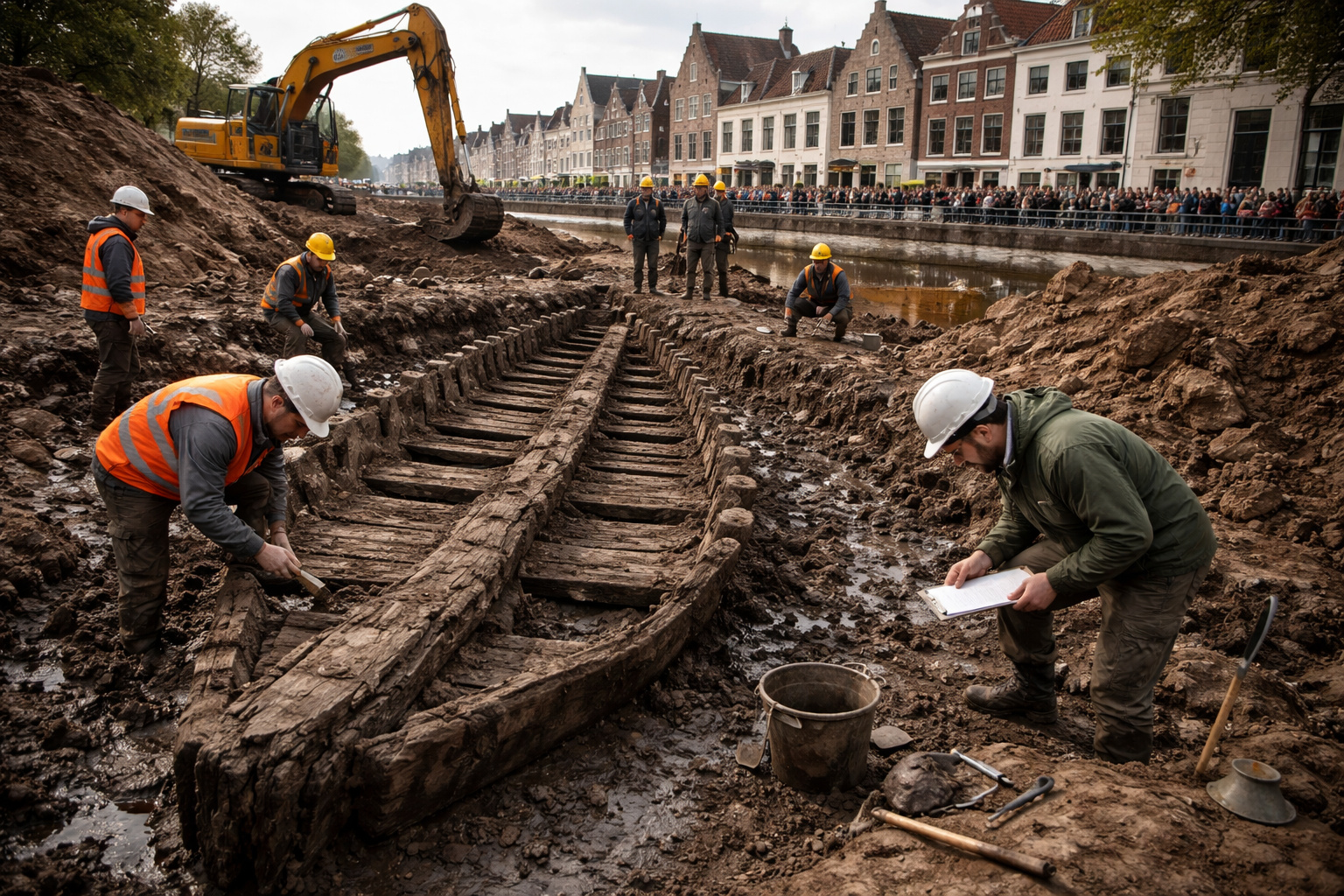
Unexpected find in urban excavation may clarify Viking presence in medieval Europe and reveal historical details still unknown
A historically significant archaeological discovery was recorded in early 2026, in the city of Wijk bij Duurstede, Netherlands, during a sewage construction project. During the excavations, workers found a wooden beam partially exposed in the ground, which immediately sparked technical and scientific interest. Thus, the material began to be analyzed as a possible fragment of a Viking ship up to 1,300 years old, according to a preliminary assessment conducted by specialists.
The initial identification was made by amateur archaeologist Danny van Basten, a member of ArcheoTeam Wijk bij Duurstede, who recognized the historical potential of the piece. Subsequently, teams from Stichting Beheer Vikingschip and Museum Dorestad were called in to conduct the first analyses, initiating a technical process that is now mobilizing researchers and local authorities.

Technical investigation indicates possible ancient naval structure
According to naval construction specialist Kees Sterrenburg, the shape of the beam exhibits characteristics compatible with structures of ancient vessels. Furthermore, notches, finishing, and construction patterns reinforce the hypothesis of naval use, supporting the possibility of a connection to a historical ship.
-
Seen from space, a colossal ‘Y’ cuts through the largest desert in China, blending a jade-filled river, red and white mountains, and revealing the absurd scale of the transformation of the Taklamakan surrounded by a green wall with billions of trees.

-
The Pacific Ocean reveals what the cliffs of Big Sur have hidden for millennia: Pfeiffer Beach, in California, features swirling purple sand formed by garnet crystals and displays a stone arch that is illuminated by the sun in winter for just a few days each year.

-
Aursjøvegen in Norway is a 100-kilometer gravel road that crosses chasms and dark tunnels carved into the rock at an altitude of 947 meters in the fjords and is only open for four months a year.

-
With about 4,000 m², the building constructed in a traditional neighborhood in France looks like a rainbow, has a colorful facade, mixes vibrant glass, and creates one of the most unusual visuals in Bordeaux.


The piece measures approximately 3.2 meters in length and 30 centimeters in thickness, although there are indications that it was originally larger. This detail increases the relevance of the find, as it suggests that the beam may have been part of a more complex structure.
Initial analyses indicate that the material may date back to the Carolingian period, between the 8th and 9th centuries, based on its location and fragments of pottery found nearby. Nevertheless, specialists also consider the possibility that the wood belongs to a cog ship, which would suggest a date closer to the year 1300.
Wood analysis may confirm origin and age
The municipal archaeologist Anne de Hoop, responsible for coordinating the investigation, classified the find as rare at both local and national levels, highlighting its importance for historical heritage. According to her, the piece will undergo a rigorous cleaning process before detailed analyses.
Subsequently, the technique of studying the growth rings of the wood will be applied, which allows for a more precise estimation of the material’s age. This procedure, known for its scientific accuracy, is expected to take several months to yield conclusive results.
In the meantime, to prevent structural damage caused by drying, the beam was carefully packaged and removed from the site, following preservation protocols. At the same time, researchers are evaluating the possibility that the fragment was transported by an ancient canal, a hypothesis that may explain its current location.
Authorities monitor the repercussions of the find
The discovery quickly gained regional attention, mobilizing local authorities. Mayor Petra Doornenbal and councilor Bert Lubbinge visited the site to closely follow the progress of the investigations.
Additionally, councilor Arne Schaddelee interrupted a provincial meeting upon being informed about the find, highlighting the impact of the discovery. At the same time, Museum Dorestad has already expressed interest in exhibiting the piece in the future, reinforcing its historical and cultural value.
Who were the Vikings and why does the discovery matter
The Vikings were peoples originating from the regions that today correspond to Denmark, Norway, and Sweden, with predominant activity between the years 700 and 1100 AD. This period was marked by intense maritime activity, with expeditions that had military, commercial, and exploratory objectives.
The term “viking,” derived from Old Norse, is directly associated with these expeditions. However, beyond their reputation as raiders, these peoples also stood out as traders, farmers, and craftsmen, playing a significant role in the economic integration of various regions.
They established trade routes that connected different parts of Europe and other continents. Additionally, attacks on Christian monasteries marked the beginning of their expansion, resulting in the occupation of territories in the United Kingdom and the founding of settlements in Ireland.
Discovery may expand knowledge about Viking routes
In this context, the beam found in the Netherlands may represent a new piece of evidence regarding Viking presence in medieval Europe, directly contributing to the understanding of their routes and movements.
With the advancement of analyses throughout 2026, specialists await results that may confirm the origin of the piece and expand historical knowledge about this period.
In light of this, the central question remains: does this fragment really belong to a Viking ship or could it reveal a new interpretation of medieval navigation in Europe?









Seja o primeiro a reagir!