





 Portuguese
  English
  Spanish
  4 min of reading
  0 comments


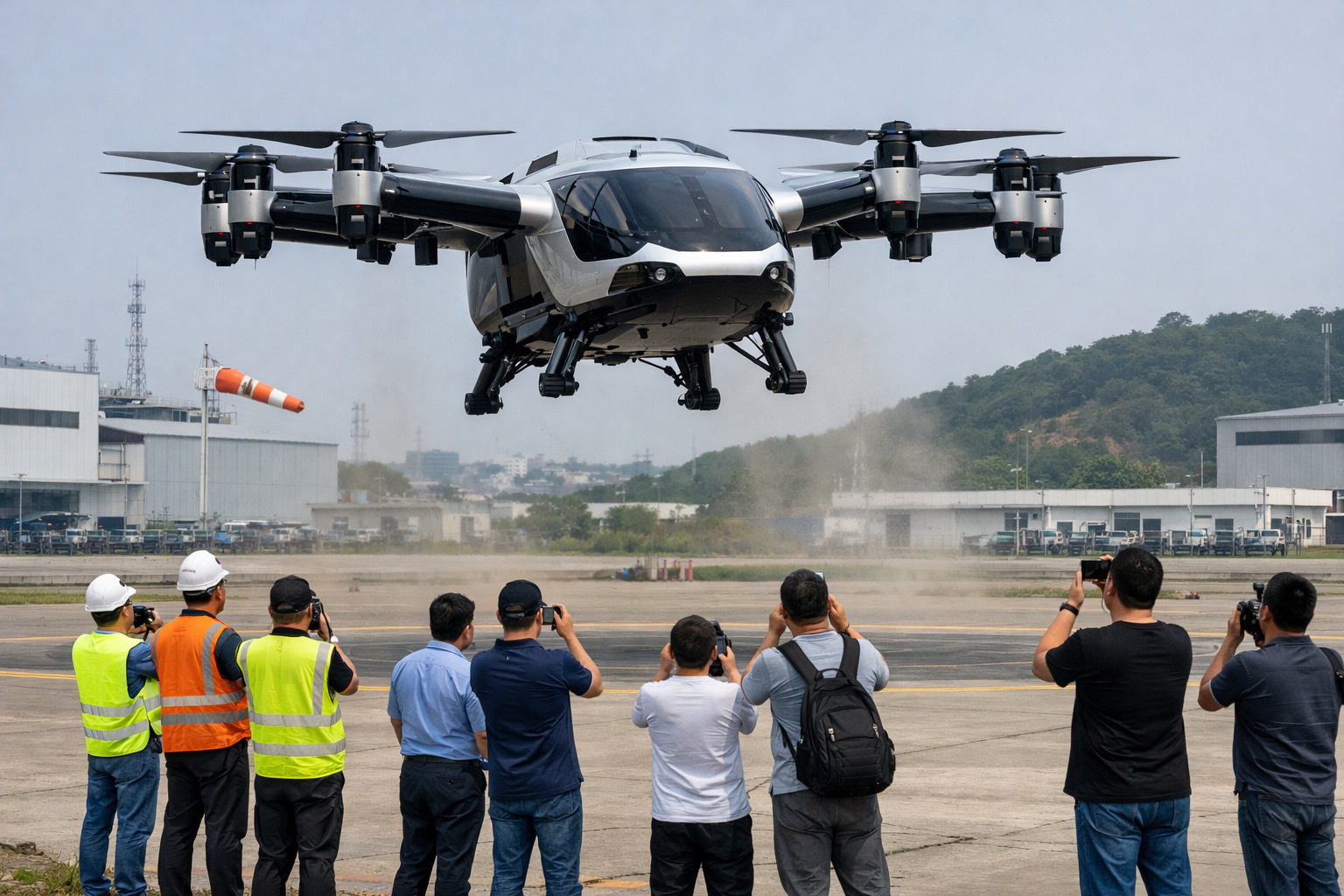
Electric Aircraft Matrix Completes Full Transition Flight in China, Features 20 Motors, Range of Up to 1,500 Kilometers and Capacity for Ten Passengers or 1,500 kg of Cargo
The electric aviation industry has just crossed a historic frontier. The Chinese company AutoFlight has introduced to the world the largest flying car on the planet in real operation. Named Matrix, the five-ton eVTOL successfully completed a full transition flight, which is considered one of the biggest challenges of modern aeronautical engineering.
This information was reported by “Olhar Digital”, based on technical data from the manufacturer and also on reports from “Interesting Engineering” and “New Atlas”, which highlighted the global impact of the test.
Unlike most so-called “flying cars,” which are designed for short urban trips, the Matrix was born with a different ambition. It was developed for longer regional routes, heavy cargo transport, and even large-scale emergency missions. Therefore, its performance could redefine the concept of electric air mobility.
-
While lunar missions are deploying increasingly larger robots, Japan has bet on a small SORA-Q the size of a palm, which transformed on the Moon and photographed the SLIM landing.

-
Genetic study shows that Europe after Rome was not born from a lightning invasion, but from families, migrations, and a lot of mixing.

-
China wants to install a giant power bank in space to harvest solar energy continuously, day and night, and has already tested on the ground, in a 75-meter tower, the wireless transmission of energy over a distance of 100 meters to various moving targets.
-
The brute force of the waves turns into clean energy with almost no waste, as promised by a gyroscopic converter created in Japan that, in simulations, couples with the sea’s sway and reaches the maximum limit of 50% efficiency, leaving old marine generators behind.


What Makes the Full Transition Flight a Milestone in Electric Aviation
First, it’s essential to understand why the test was deemed historic. A full transition flight is the most complex phase in the development of an eVTOL. This is because the aircraft must switch between three distinct modes of operation in a single sequence.
Initially, the Matrix performed a vertical takeoff, ascending like a helicopter. Then, already in the air, it accelerated and entered the cruise flight mode, beginning to use its wings for lift, just like a conventional airplane. Finally, it reduced speed and executed a vertical landing, descending smoothly to the ground.
This combination requires absolute precision among propulsion, aerodynamics, and control software. Therefore, by successfully completing the entire cycle, AutoFlight demonstrated that its systems work even in large eVTOLs.
Additionally, the test took place at the Kunshan Civil UAV Flight Test Center in China. Consequently, the company solidified its position as a strong competitor in the global advanced air mobility market.
Five Tons, 20 Motors, and Range of Up to 1,500 Kilometers
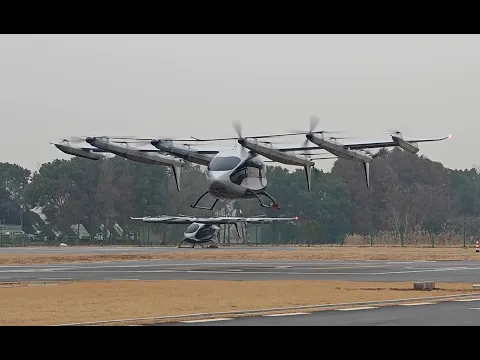

While many flying cars still operate with compact dimensions, the Matrix impresses with its numbers. Its weight is around five tons, and the maximum takeoff weight reaches almost six tons (5,700 kg).
Regarding its dimensions, the aircraft has a wingspan of 20 meters, which is the distance between the wingtips, and a length of 17 meters. Therefore, it is a considerably sized aircraft, well above the industry average.
In terms of capacity, the Matrix can carry up to ten passengers in business class. Alternatively, it can be configured to carry 1,500 kg of cargo, significantly expanding its logistical applications.
Another technical differentiator is the design called composite wing, which integrates 20 propulsion motors. This high number of motors is not an exaggeration. On the contrary, it represents a safety reinforcement. In case one or even two motors fail, the others ensure stable flight continuation.
As for range, there are two versions. The fully electric version can cover up to 250 kilometers. Meanwhile, the hybrid version, which combines electricity and fuel, can reach 1,500 kilometers. Thus, the Matrix breaks the perception that electric aircraft are only suitable for very short trips.
How the Matrix Can Transform the Global Air Transportation Market

Until recently, the industry believed that eVTOLs were limited to short-distance urban travels and reduced cargo capacity. However, the Matrix challenges this logic. It demonstrates that it is possible to use electricity for regional transportation between cities, heavy logistics, and strategic operations.
Moreover, the hybrid range of 1,500 kilometers opens up new commercial routes. Consequently, electric aviation can advance beyond urban transport and reach regional and even interstate markets.
At the same time, the success of the test strengthens China’s position in the global race for advanced air mobility. AutoFlight, in turn, starts to compete directly with companies from the United States and Europe that develop similar solutions.
Therefore, the Matrix represents not only a technological advancement but also signals a potential structural change in the aviation of the future.
Would you trust getting on a five-ton electric flying car to travel between cities?








-

-

-

-

-

19 people reacted to this.