






 Portuguese


Yamaha ZR Hybrid Connected arrives in Brazil for R$ 13,990 with a 125 cc engine, Power Assist electric assistance, just 98 kg, Stop & Start, and Bluetooth connectivity.
Yamaha has introduced a new contender in the entry-level urban motorcycle segment in Brazil. Officially launched on April 23, 2026 for R$ 13,990, plus shipping, the ZR Hybrid Connected combines a 125 cc gasoline engine with temporary electric assistance, weighs only 98 kg in running order, and includes Stop & Start, a digital dashboard connected to smartphones, and four years of warranty. Production takes place in Manaus, Amazonas, and sales began in May.
According to Yamaha Motor do Brasil, the ZR is their new entry-level scooter that utilizes the Blue Core Hybrid with Power Assist system. It’s important to note that this is not an electric motorcycle that can operate solely on battery power; the small electric motor aids the combustion engine for approximately three seconds in high-demand situations such as take-offs, climbs, accelerations, overtaking, or carrying a passenger and cargo.
Yamaha ZR Hybrid Connected priced at R$ 13,990 targets urban use
The price was one of Yamaha’s primary arguments at launch. The brand announced the ZR Hybrid Connected at R$ 13,990, excluding shipping, placing electric assist technology in a model designed specifically for daily commuting.
-
Electric Pickup Rivian R1T in Rear-End Collision: $1,600 Estimate Becomes $42,000 Repair, CEO Says This Shouldn’t Happen

-
Volvo EX30 Arrives with Minimal Buttons and Centralized Controls, But Display Failures, Charging Issues, and Unexpected Brakes Prompt Returns for Full Refund in the UK
-
CFMOTO Confirms 450NK for Brazil with 47 hp Twin-Cylinder Engine, TFT Display, and Expected Arrival in 2027

-
BYD Debuts New Electric Car Smaller Than Dolphin Mini Priced at R$ 69,000 in Japan; No Brazil Launch Announced


The strategy becomes clear when examining the package. This is not a scooter designed for sports performance or long journeys.
The focus is on lightweight design, automatic transmission, maneuverability, connectivity, and features that can help reduce fuel waste in urban traffic.
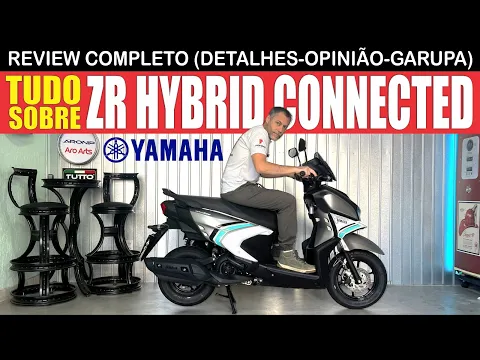

Yamaha offers the ZR in colors Moon Silver, Magma Red, and Midnight Black, respectively a matte silver, metallic red, and metallic black. The manufacturer itself classifies the model as its entry-level scooter in the Brazilian market.
125 cc engine delivers 8.2 hp and receives electric assistance during take-offs
At the heart of the ZR is a 125 cc Blue Core Hybrid single-cylinder engine, with a claimed maximum power of 8.2 hp at 6,500 rpm and torque of 1.0 kgf.m at 5,000 rpm.
The figures clearly indicate that the electric assistance is not designed to turn the ZR into a high-performance scooter. The goal is to relieve the combustion engine’s workload precisely when demand increases.
Yamaha claims that the Blue Core project utilizes solutions aimed at enhancing combustion efficiency, reducing internal friction, and managing thermal control. It is on this set of technologies that the Power Assist system operates.
Power Assist engages for three seconds when the scooter requires more power
When the system detects an increase in load on the gasoline engine, the auxiliary electric motor is activated for three seconds, providing additional assistance to the main powertrain.
According to the manufacturer, this can occur when departing from a traffic light, going uphill, accelerating harder, resuming speed, overtaking, or transporting passengers and cargo.

The dashboard even has an indicator that shows the rider when the Power Assist is in operation.
Yamaha claims that the electric assist reduces the momentary overload on the combustion engine and helps lower fuel consumption. The company also positions itself as a pioneer in Brazil in applying this lightweight hybrid technology to the two-wheeler market.
ZR is not an electric scooter
The ZR still relies on the 125 cc combustion engine for propulsion. The electric assist is complementary and temporary. Therefore, it does not function like certain hybrid cars that can move the vehicle for certain periods using only an electric motor.
In the ZR, electrification primarily serves as Power Assist. The electric motor assists the conventional powertrain when load increases, but it does not turn the scooter into a zero-emission vehicle during normal use.
Stop & Start turns off the engine at traffic lights and in congestion
Another city-focused feature is the intelligent Stop & Start. When it detects a stop, such as at a traffic light or in traffic, the system can automatically shut off the engine. When the rider accelerates again, the engine is restarted without the need for a conventional restart.
The purpose is to prevent the engine from running unnecessarily when the scooter is stopped.
According to Yamaha, this feature helps reduce both fuel consumption and pollutant emissions.
The system works with an intelligent generator that also enables silent starts and assists with the electric assist system.
In practice, Power Assist and Stop & Start address two extremely common situations in urban traffic: repeatedly starting from a standstill and remaining stationary at intersections or in congestion.
At only 98 kg, the ZR is one of the top choices for beginners
The ZR weighs 98 kg ready-to-ride. Yamaha presents it as the lightest scooter in its category and argues that the low weight facilitates maneuverability, parking, and navigating through heavy traffic.
This weight also helps contextualize the modest 8.2 hp of the engine. In an urban scooter, the relationship between power, weight, and intended use is more relevant than looking at maximum power in isolation.
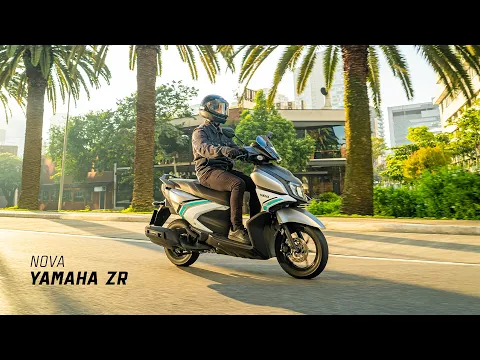
The ZR measures 1,880 mm in length, 685 mm in width, and 1,190 mm in height, with a wheelbase of 1,280 mm. The seat height is 785 mm from the ground, and the minimum ground clearance is 145 mm.
The design clearly emphasizes compactness and ease of use in urban settings.
Digital dashboard brings calls and messages directly to the scooter
The low launch price did not prevent Yamaha from adding connectivity features. The ZR features a 100% digital dashboard that can be paired with a smartphone via Bluetooth using the Yamaha Motor On app. With this connection active, the rider can view on the dashboard information related to received calls and messages, as well as the phone’s battery status.
The display also shows speedometer, clock, fuel level, average consumption, instant consumption, Power Assist indicator, and ECO function.
The ECO function indicates when driving is being carried out in a manner considered more economical by the system.
This is an unusual package for those who still associate small scooters only with simple mechanical solutions and basic dashboards.
App tracks fuel consumption, trips, maintenance, and last location
Some functions are concentrated on the smartphone. Through Yamaha Motor On, the owner can check average consumption, trip history, and maintenance schedule.
The app also records the last location where the smartphone was paired with the scooter.

There is also an ECO ranking that compares driving efficiency with that of other users of the system, according to Yamaha.
Route history can be shared, enhancing the integration between the scooter and smartphone beyond simple notification displays.
21-liter storage space accommodates a small closed helmet under the seat
Urban scooters depend heavily on practicality, and Yamaha utilized the space under the seat as another selling point of the model.
It has 21 liters of capacity, sufficient, according to the company, to accommodate certain small full-face helmets, depending on their size and shape.
The ZR also features a retractable front hook for carrying small items. The seat is designed in two levels, with a designated area for the passenger and a rear handle. The handlebar position and foot space have also been defined with a focus on everyday use.
These are simple solutions, but they are directly related to the aim of replacing or complementing the car for short trips.
Brakes use UBS system, but the ZR does not come with ABS
Here, there is an important distinction in the technical specifications. The Yamaha ZR Hybrid Connected features a 190 mm disc brake in the front and drum brake in the rear, utilizing the combined UBS system, which stands for Unified Brake System. It is not equipped with ABS.
The UBS distributes part of the braking force between the wheels. When the rear control is activated, the system also applies a portion of the braking force to the front; when both levers are used simultaneously, the UBS manages the force distribution.
In the front, the ZR uses a 12-inch wheel with a 90/90 tire. In the rear, the wheel is 10 inches and fitted with a 110/90 tire. Both tires are tubeless.
The front suspension is telescopic with 90 mm of travel, while the rear has 81 mm.
LED lighting and sporty design aim to steer clear of basic scooter image
Despite being the entry-level model, Yamaha aimed to give the ZR a more sophisticated look. The front has an LED position light shaped like the letter “Y,” while the headlight and rear light also use LEDs. The design includes a smoke-colored windshield and angled mirrors.
This approach clearly demonstrates an attempt to combine efficiency with a sporty appearance, preventing the model from being perceived solely as a rational transport alternative.
The manufacturer itself describes the ZR as a scooter developed for urban agility and highlights the front design inspired by motorcycles.
Production in Manaus integrates new lightweight hybrid into Yamaha’s Brazilian strategy
The ZR Hybrid Connected is produced in Manaus, rather than simply imported fully assembled for the Brazilian market. Yamaha announced its arrival at dealerships starting in May 2026, shortly after the official presentation in April.
The model was launched with a four-year warranty and a Fixed Price Review program.
The presence of local production is significant because it incorporates lightweight hybrid technology into an entry-level product manufactured in the country, rather than restricting it to a niche motorcycle or a high price range.
Yamaha is also applying the Power Assist logic to another product in its line, the Fluo ABS Hybrid Connected, indicating that light electrification is gaining traction among its urban scooters.


