





 Portuguese
  English
  Spanish
  5 min of reading
  0 comments


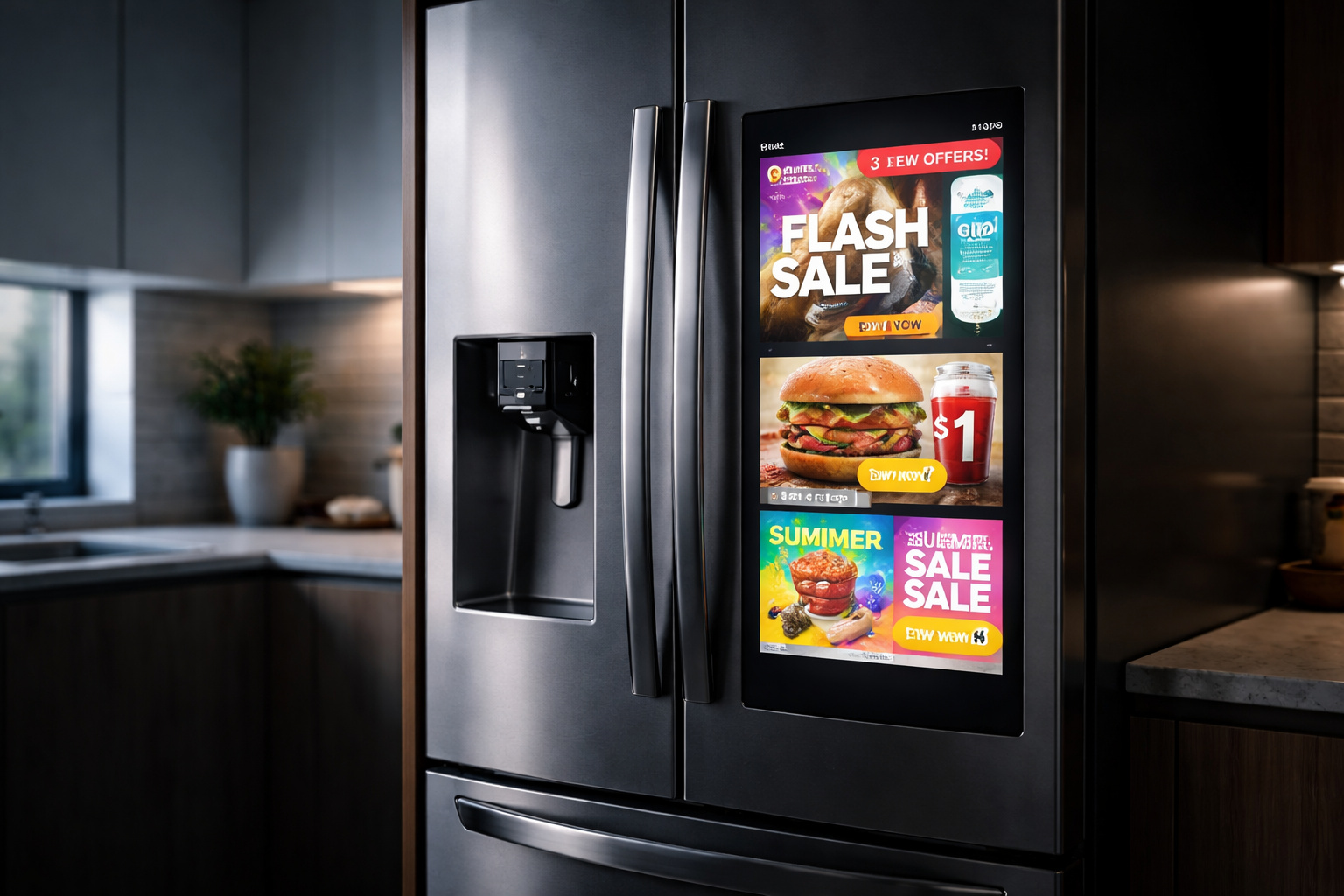
Samsung starts showing ads on smart refrigerators and draws criticism for turning appliances into advertising platforms.
In 2025, Samsung Electronics initiated a movement that caught global attention by introducing ads in its Family Hub smart refrigerators, primarily in the United States. According to a report from the technology-focused site The Verge, the company began displaying “promotions and curated advertisements” on models of the line through a remotely distributed software update. The feature was implemented via over-the-network updates, reaching refrigerators with integrated screens — typically found in premium models of the Family Hub line. According to the outlet itself, the ads appear on the so-called “Cover Screen” when the display is idle, integrated with weather, calendar, and news widgets.
This change represents a significant shift in how appliances are used within the home. The most sensitive point is that devices already paid for by consumers have started to incorporate advertising via software, something traditionally associated with free or ad-subsidized digital services.
This new scenario provoked immediate reactions, raising discussions about privacy, business models, and the limits of advertising within the home environment, especially with the expansion of connected devices within households.
-
Archaeologists find an intact tomb over 2,500 years old, with more than 100 preserved objects, weapons, jewelry, and human remains never touched.

-
Volcanic lava transforms into threads as fine as human hair that travel over 30 kilometers by wind and fall like cutting rain on roofs and backyards in Hawaii and Iceland.

-
NASA issues a warning for the feared Godzilla El Niño that could change the planet’s climate in 2026 with extreme warming of the Pacific capable of causing devastating droughts in some regions and historic floods in others simultaneously.

-
Archaeologists discover a 100-meter ship graveyard in a submerged Greek city, and what has appeared on the seabed of Libya could change what was known about this ancient port.


How ads work on Samsung refrigerators
The affected refrigerators are part of the Family Hub line, which features screens of 21.5 or 32 inches attached to the door. These displays function as smart hubs, allowing:
- control of home devices
- display of recipes
- access to calendar and weather
- video playback
With the update, these screens began to include a new element: advertising. According to official information, the ads appear on the so-called “Cover Screen,” a home screen that displays widgets like weather and agenda.


The ads are displayed as banners or rotating blocks alongside this information, potentially appearing whenever the screen is in idle mode.
In some cases, users reported more visible formats, which increased the perception of invasion.
Software update changes the functionality of an already purchased product
One of the most sensitive points of this change is the fact that the ads were not present at the time of purchase of the product. They were introduced later, through a remote update.
This means that consumers who purchased a premium appliance began to receive advertising without necessarily expecting it, altering the original experience of the product.
This practice raises important questions about:
- consumer rights
- post-purchase changes
- limits of updates on connected devices
According to Samsung itself, the initiative started as a “pilot program” to assess user acceptance.
Negative consumer reaction and criticism of the model
The introduction of ads in refrigerators generated strong repercussions, especially because it involves a high-value product.
Recent reports indicate that many consumers found the practice inappropriate, especially since there was no reduction in the price of the product in exchange for the display of advertising.

The main criticism is that a traditionally neutral household appliance has started to function as a new advertising screen within the home.
Some users reported frustration with the fact that ads appear in a space considered private, like the kitchen. Others raised concerns about the future of consumer experience with smart products.
Is it possible to disable the ads?
After the negative repercussions, Samsung began to offer a way to disable the ads.
However, there is an important limitation.

According to technical information, by disabling advertising, the user also loses access to the main widget of the interface, which includes useful functionalities such as:
- weather forecast
- calendar
- daily information
This creates a scenario in which the consumer must choose between maintaining functionalities or eliminating ads, which reinforces the criticism about the indirect imposition of advertising.
“Screens everywhere” strategy expands ad presence
Samsung’s decision does not occur in isolation. It is part of a broader company strategy known as “screens everywhere.” The proposal is to integrate displays into various appliances, including:
- refrigerators
- washing machines
- ovens
- other household devices
With more screens inside the home, the possibility of monetization through advertising also arises. This movement brings appliances closer to other digital devices, such as smart TVs and smartphones, which already use ads as a revenue source.
The impact of advertising in the home environment
The introduction of ads in refrigerators raises a broader debate about the limits of advertising. Traditionally, the home environment was considered a space free from direct commercial interruptions on physical objects. With digitalization, this barrier begins to disappear.

The presence of ads on a basic appliance represents an important symbolic change, indicating that virtually any connected device can become an advertising platform.
This scenario raises questions about:
- privacy
- data collection
- user experience
- consent
Comparison with other connected devices
The strategy adopted by Samsung follows a pattern already observed in other segments. Smart TVs, for example, have begun to display:
- sponsored recommendations
- promotional banners
- suggested content
However, there is an important difference. While televisions are traditionally associated with content consumption, refrigerators were not seen as media platforms, which intensifies the perception of invasion.
This difference explains part of the negative consumer reaction.
What does this indicate about the future of appliances
The introduction of ads in refrigerators may represent the beginning of a new phase in the appliance industry. Manufacturers may seek new sources of revenue beyond the sale of the physical product, including:
- advertising
- digital services
- subscriptions
This model is already common in technology but is still relatively new in appliances. The trend suggests that connected devices within the home may become increasingly integrated into digital ecosystems and continuous monetization models.
Samsung’s decision to introduce ads in smart refrigerators represents a significant change in the relationship between consumers and home technology. By transforming an appliance into an advertising platform, the company expands the concept of connected devices but also raises questions about limits and user expectations.
The episode reveals a turning point in the market: products that were once merely utilitarian are now integrating broader digital strategies, where the consumer experience can be constantly updated and monetized.
This movement indicates that the future of appliances will not be defined solely by performance or efficiency but also by how they integrate into the digital ecosystem and new forms of revenue generation.








Seja o primeiro a reagir!