





 Portuguese
  English
  Spanish
  5 min of reading
  0 comments


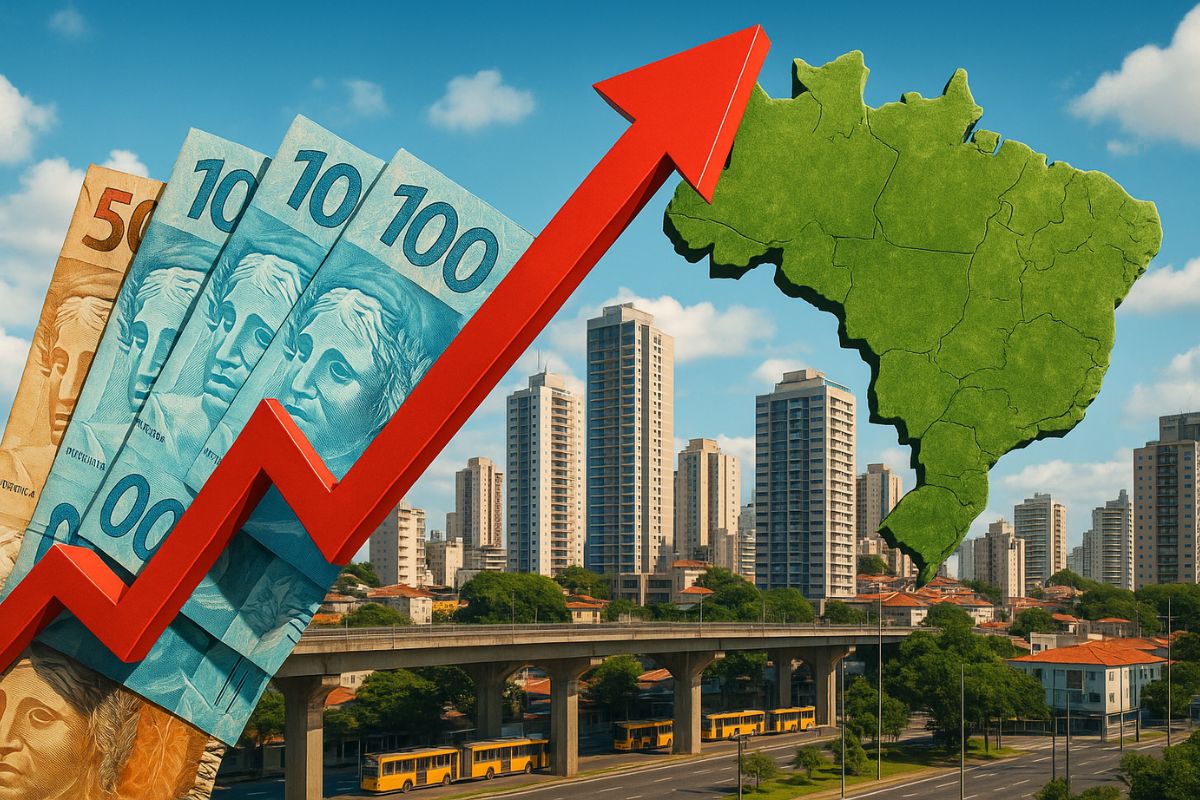
Report Highlights 10 Brazilian Cities With Hyper-Growth in Formal Employment Between 2019 and 2025, Now Competing for Capital With Major Centers and Redrawing the Map of Opportunities.
The Brazilian cities analyzed show a movement of economic decentralization that is already altering the geography of formal work. In five years, these municipalities doubled the stock of formal jobs or exhibit an unequivocal trajectory in that direction, creating space for new poles of services, industry, logistics, and energy outside the capitals.
The trend arises from the combination of natural resources, logistics chains, corporate services, and modernized agribusiness. The multiplier effect is immediate: more income, more consumption, and new local investment fronts, with impacts on housing, mobility, and professional qualification.
How We Mapped Brazilian Cities in Hyper-Growth
The selection considers the period from December 2019 to 2025, focusing on the stock of formal jobs as a comparable metric.
-
Brazilian city bets on the business environment to generate jobs and attract investments in the energy sector — secretary reveals strategy at Macaé Energy 2026.

-
50 viaducts, 4 tunnels, 28 bridges, and 40 kilometers of bike paths: BR-262 in Espírito Santo will receive 8.6 billion reais for the largest engineering project in the state’s history, inspired by the Immigrant Highway in São Paulo.

-
Brazil produces too much clean energy and doesn’t know what to do with it: over 20% of solar and wind capacity was wasted in 2025 while investors flee and 509 renewable generation projects were abandoned in the last year.

-
Piauí will produce a new fuel that replaces diesel without needing to change anything in the truck’s engine and reduces pollutant gas emissions by half: truck drivers from all over the Northeast are already celebrating the news that will arrive later this decade.


The methodological transition to the New Caged in 2020 makes the stock the most stable indicator for measuring net growth.
Comparing stocks eliminates temporal noise from admissions and dismissals and allows for observing the effective expansion of the local labor market.
Municipalities with direct evidence of growth above 100% in the stock of job links were prioritized or robust inferential evidence when the detailed series was not fully available.
In the latter case, the execution of investments, clear sectoral jumps, and consistent signals of rapid formalization were taken into account. The goal was to capture structural dynamics, not seasonal peaks.
Who Is Leading the New Cycle
The highlighted group gathers different profiles that converge in the outcome: Maricá and Saquarema benefit from the oil cycle; Parauapebas continues to be driven by Carajás mining; Presidente Kennedy stands out with high per capita income linked to oil. Itajaí accelerates with the port complex and logistics services; Barueri consolidates corporate services and distribution.
São Caetano do Sul, São José, and Balneário Camboriú combine high-value services with quality of life. Borá reflects the strength of agro-industrial formalization on a micro scale.
The contrast with the metropolises is instructive. Capitals remain leaders in absolute volume, but the percentage growth of these emerging Brazilian cities is much higher in the 2019–2025 horizon.
It is the snapshot of a more polycentric country, where medium and small poles start to compete for projects, plants, and service centers with state capitals.
Drivers of Growth: From Pre-Salt to the Port, From Agribusiness to Technology
The first force is the supercycle of commodities. Oil and gas royalties fuel public and private investment in Maricá, Saquarema, and Presidente Kennedy, with direct repercussions in civil construction, services, and formal employment.
Parauapebas exemplifies the dynamism of mining, with a construction and trade chain orbiting large projects.
The second force is logistics. Itajaí operates as a foreign trade hub with multiplier effects on transportation, storage, customs services, and the construction of logistical assets.
Barueri occupies a strategic position for e-commerce and financial services, increasing the number of jobs in operations, technology, and back office. When the logistics corridor functions, employment radiates throughout the urban fabric.
High-Value Satellites and the Role of Quality of Life
In the third vector, São Caetano do Sul, São José, and Balneário Camboriú combine specialized services, construction, and commerce with desirable urban attributes.
A predictable business environment, good social indicators, and an offer of qualified labor create a virtuous cycle that attracts companies and talent, sustaining the rise in formal employment.
This model shows that there is not just one way to grow. While some municipalities depend on capital-intensive chains, others monetize knowledge, services, and urbanity.
In all cases, local governance and the ability to execute projects make a difference in the pace and quality of growth.
The Case of Borá and the Power of Formalization in the Interior
Borá illustrates the proportional impact of the employment boom in tiny cities. Agricultural industrialization completely transforms the local economic base, increasing revenues, access to credit, and trade dynamism.
On a micro scale, each new formal link affects the income of entire families, boosting consumption and activating services.
The message is clear: the interiorization of formal employment is a powerful vector of social cohesion.
As formal job opportunities expand, the local economy gains predictability, and small municipalities start planning infrastructure and services based on a more stable foundation.
Risks and Dilemmas of Such Accelerated Growth
There are two key areas of concern. Dependence on a single sector exposes cities to price shocks and global volatility.
Diversifying immediately is imperative, transforming the current bonanza into a springboard for new productive chains.
The pressure on infrastructure and public services is also significant, with rising housing costs, the need to expand health care, education, sanitation, and mobility.
The third risk is the mismatch of skills. Jobs in logistics, IT, engineering, and foreign trade require specific competencies that are not always available locally.
Without rapid and continuous qualification, job openings may shift to professionals from outside, reducing the impact of the cycle on the resident population.
Strategies to Sustain the Wave and Attract Capital
The recipe that repeats in winning cases includes clear urban planning, a simple regulatory environment, and investment in critical infrastructure.
Well-structured public-private partnerships unlock logistical and social assets. In the people front, technical training aligned with local vocations prevents bottlenecks and raises average income.
For investors and companies, the map indicates opportunities in housing, retail, education, health care, and B2B services that follow employment.
Where the formal stock doubles, the demand for housing and services accelerates, creating space for projects with returns sustained by real growth in the consumer base.
The 10 Highlighted Brazilian Cities and What Unites Them
The group formed by Maricá, Saquarema, Parauapebas, Presidente Kennedy, Itajaí, Barueri, São Caetano do Sul, São José, Balneário Camboriú, and Borá shows distinct routes converging to the same destination: formal employment on the rise, increasing revenues, and new attractiveness for capital.
In common, governance capable of anchoring projects and a clear economic driver, whether it is a port, oil, mining, corporate services, or agribusiness.
The next leap depends on transforming growth into development, reducing exposure to sectoral cycles and spreading gains throughout the city.
When diversification goes hand in hand with qualification and infrastructure, the boom does not become a bubble, it becomes a foundation for the next decade.
Which of these Brazilian cities do you believe is best prepared to sustain the pace and diversify the economy in the next five years, and why?









Seja o primeiro a reagir!