





 Portuguese
  English
  Spanish
  4 min of reading
  0 comments


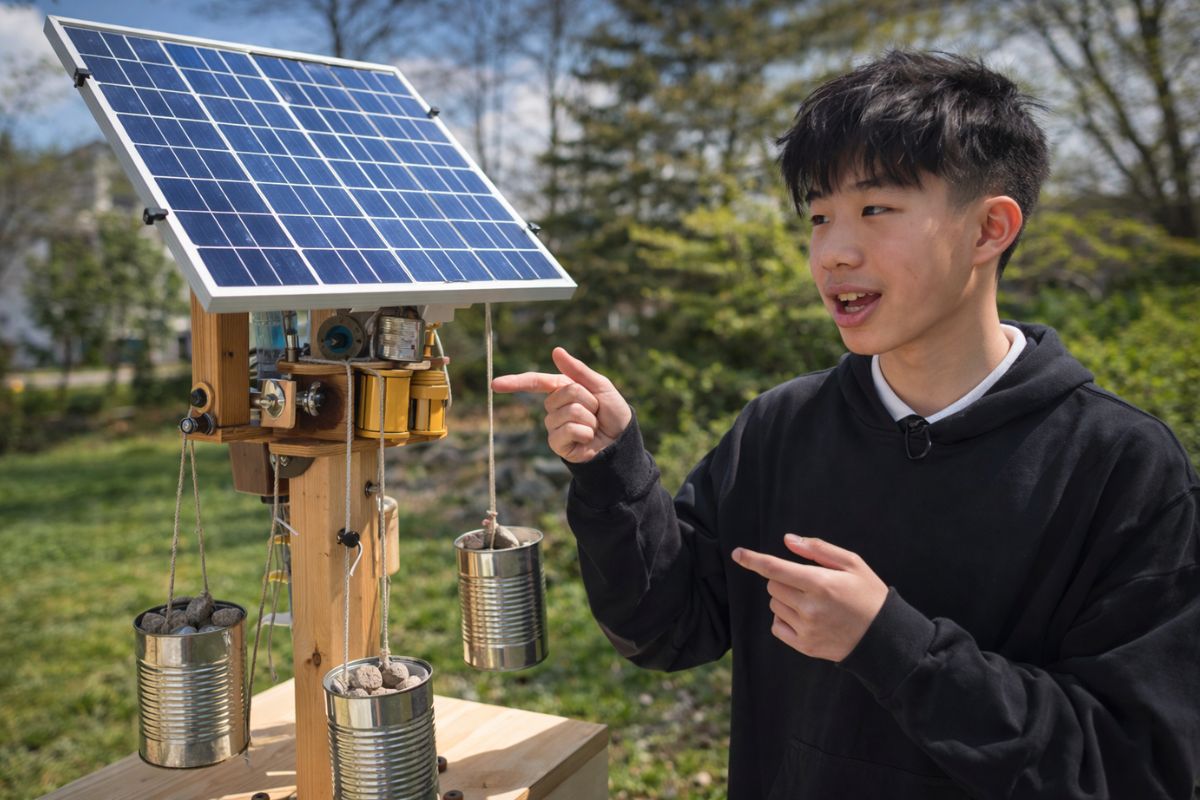
Jason Chang, seventh grader in Worcester, developed a solar tracker that dispenses motors and electricity by using gravity and a seesaw design to increase solar energy efficiency. The invention with recycled parts cost less than 25 dollars and earned the student the title of national STEM champion.
A 12-year-old student from Worcester, Massachusetts, built a solar tracker that works without motors, without electricity, and without expensive components using only water, gravity, and recycled parts. Jason Chang, a seventh grader, developed the device as a school project and managed to increase the efficiency of solar panels by 20% with equipment that cost less than 25 dollars to assemble.
What started as an attempt to solve a household problem of manually adjusting the family’s solar-powered Christmas decorations turned into a nationally recognized invention. Jason was named national STEM champion and will present his solar tracker in Washington, D.C., as one of 55 young people selected nationwide by the program that celebrates scientific projects from elementary education students.
How the gravity-powered solar tracker works

The principle behind Jason Chang’s solar tracker is ingeniously simple. Instead of using electric motors or electronic sensors to track the sun’s position throughout the day as commercial systems do, the device uses water and a seesaw mechanism to gradually tilt the panel, harnessing the force of gravity itself.
-
Brazil puts into play its first supersonic fighter F-39 Gripen E assembled in the country.

-
Haiti’s capital is experiencing a crisis of energy and construction, facing blackouts, has a blocked port, and buildings at risk after years of instability and a significant earthquake.

-
From a devastated quarry to an oasis of biodiversity with over 200 species: the incredible transformation of an old mine in Portugal that proves the power of nature to heal when given a chance.

-
Neither Brazil nor the USA: China produces over 60% of the world’s farmed fish and accounts for about 40% of all global seafood, using industrial-scale aquaculture megafarms to influence the international market and supply billions of people.

The operation is based on a system of interconnected buckets. Water is slowly added to one side of the structure, causing the weight to shift and the panel to tilt progressively toward the sun.
The solar tracker follows the solar movement throughout the day without consuming any electricity, eliminating the need for batteries, wiring, or digital programming. It is a purely analog mechanism that simply solves a problem that conventional systems tackle with complexity and high cost.
Recycled parts and cost below 25 dollars

One of the most notable aspects of Jason’s solar tracker is the cost. While commercial solar tracking systems can cost hundreds or thousands of dollars, the student’s prototype was assembled entirely with recycled parts and accessible materials, totaling less than 25 dollars.

This low-cost approach is particularly relevant for communities with limited resources. The solar tracker developed by Jason demonstrates that real energy efficiency gains do not necessarily depend on expensive or sophisticated technology.
In rural areas or developing countries, where static solar panels are the norm due to cost issues, a simple and inexpensive device capable of increasing energy capture by 20% could make a concrete difference in electricity generation for homes and small businesses.
The result: 20% more efficiency in solar capture
In tests conducted by Jason, the gravity-powered solar tracker managed to raise the efficiency of solar panels by approximately 20% compared to fixed panels positioned at a static angle.
The gain is explained by the basic principle of solar energy: the more perpendicular the incidence of sunlight on the surface of the panel, the greater the energy capture.
Static panels are only in the ideal position for a fraction of the day. In the morning and late afternoon, the light hits the panel at oblique angles that significantly reduce energy generation.
Tracking systems solve this problem by keeping the panel always oriented toward the sun, and Jason’s device does this without adding energy consumption to the process, meaning that the entire 20% gain is net.
From school project to national STEM champion
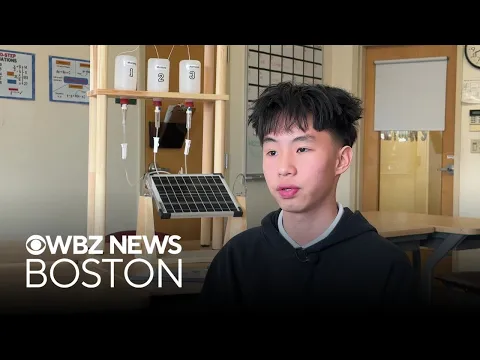

Jason Chang’s solar tracker caught the attention of the evaluators of the national STEM program, which annually selects the most promising scientific projects presented by elementary education students in the United States.
Jason was named one of the 55 national champions and will present his invention in Washington, D.C.
The surprise was communicated to the student by a team from WBZ, CBS’s station in Boston, who visited him in Worcester for a report.
The moment Jason discovers that he will represent his state in the federal capital was recorded on video, showing the genuine reaction of the 12-year-old boy to a recognition he did not expect.
Jason himself stated that his motivation was to solve a practical everyday problem, and that the idea that his solution could have broader applications only arose after the test results were ready.
A simple idea with potential for real impact
The case of Jason Chang illustrates something that engineers and renewable energy researchers know well: not every innovation needs to be complex to be transformative.
The gravity-powered solar tracker does not use artificial intelligence, does not depend on internet connectivity, and does not require specialized maintenance. It works with water and basic physics.
If the concept is refined and adapted for use at scale in off-grid communities, in solar agriculture projects, or in low-cost residential installations, the 25-dollar solar tracker could represent a real contribution to the democratization of clean energy.
Meanwhile, the project already serves another important role: showing that elementary education students are capable of thinking of solutions to real problems when given encouragement and freedom to experiment.
What did you think of Jason’s invention? Do you believe that simple ideas like this can have a real impact on solar energy, or is the path always high technology? Leave your opinion in the comments.







Seja o primeiro a reagir!