





 Portuguese
  English
  Spanish
  5 min of reading
  2 comments


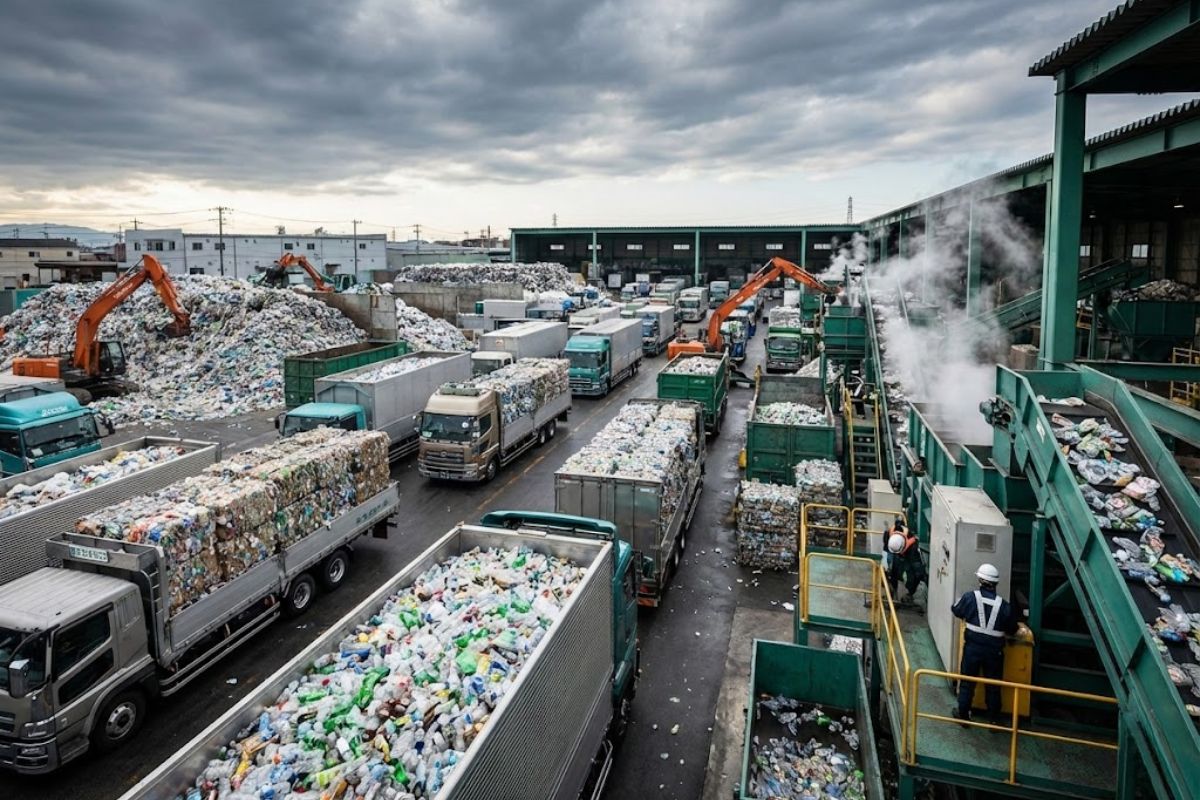


With a capacity of 24,000 tons per year, the Japanese recycling plant in Kanto transforms post-consumption PET bottles into new transparent packaging through automated and manual sorting, infrared separation, shredding, washing, extrusion at 270°C, sensor inspection, and continuous return to supermarket shelves in the Japanese retail sector daily.
The Japanese factory FPCO Kanto, in the northern part of the Kanto region, operates an industrial mechanism that receives used PET bottles on a large scale and returns the material to the market as new transparent packaging. With an annual production of approximately 24,000 tons, the system demonstrates how volume, technique, and routine can work together.
The process starts far from the production line and ends close to the consumer: in supermarkets. Between these two points, each stage exists to meet a practical requirement: to separate correctly, reduce contamination, maintain quality standards, and ensure that the final container regularly returns to the shelves without supply disruption.
Where The Cycle Begins: Broad Collection and Controlled Mixing

The dynamics of the Japanese factory begin with the flow of incoming material. PET bottles arrive in 10-ton trucks, coming from three main routes: collection in supermarkets, collection in stores, and materials from municipal systems.
-
A rare storm transformed part of the Gulf into an unlikely scene of hail, extreme rain, and tornado risk in the middle of the desert, with volumes that exceeded the annual average in a single day.

-
Brazil catches the world’s attention with ships powered by ethanol and biodiesel that have lower emissions, an unprecedented certification with advantages in chartering, and a revolution in cabotage.

-
A couple who only has Sundays free has built a hand-dug pool, a hamburger joint, a dance hall, and a playground in their own home without hiring a mason, and even with breaks due to accidents and the pandemic, the work has never truly stopped.

-
Furniture made with aluminum and glass does not warp and has become an alternative to replace MDF in Brazil.

This logistical design increases the raw material reach and avoids reliance on a single supply channel.
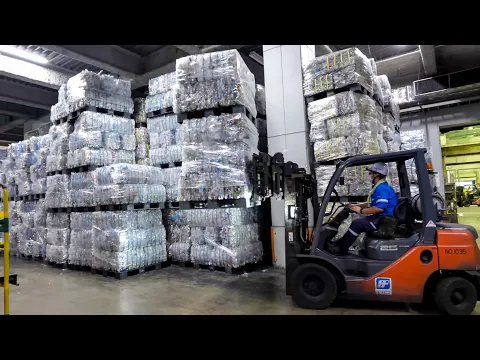
Upon reception, the bales are untied, and the pulled wires are reused as valuable resources. Then, the three types of raw materials are mixed right at the entry point, with the help of a forklift and a discharge plate.
The initial mixture is not an operational detail; it is the foundation of regularity, as it reduces sudden variations in the material that will proceed to sorting and processing.
Layered Sorting: From Automation to Human Insight

After feeding the line through conveyors and screws, the material goes through automatic screening, sorting systems, and label removal. The goal is to quickly separate what is relevant from what compromises yield. At this stage, automation accelerates the flow and prevents impurities from advancing to the thermal and transformation steps.

One of the most relevant technical points is the use of infrared rays to identify items with inappropriate labels or materials that are not PET. When something out of the standard is detected, jets of air expel the item from the line, accompanied by the characteristic “psh” sound that follows this selective rejection. This optical combination and air rejection function as a precision filter, before the final manual sorting, which corrects residual deviations with human intervention.

From Bottle to Flake: Shredding, Water, and Density Separation

With the material already cleaned of major contaminants, shredding begins. The bottles are finely cut and sent to a silo, then proceed through stages that use air and water to separate different fractions of plastic. It is not just about reducing size: this phase reorganizes the material so that each component has the appropriate technical destination.

In the water separation, neck plastics are segregated by physical behavior. What sinks goes on to the next stages of recycled PET; what floats is also treated as a valuable resource. Nothing in this stage is accidental: density becomes an industrial criterion, and each correctly directed fraction increases process efficiency and reduces internal waste.
270°C: When The Waste Becomes Raw Material Again

After the cleaning and separation stages, the material is extruded and goes through a critical thermal transformation. The temperature around 270°C marks the point at which the processed plastic gains new form and stability to become pellets. At this stage, the chain stops dealing with “used bottle” and begins dealing with standardized industrial input.

The resulting pellets, after being cooled, have a diameter of about 3 mm. This standard matters because it facilitates the feeding of the next stages and the predictability of performance. Standardization is what enables quality scaling, especially when the goal is to continuously produce to supply a high-turnover market, such as food packaging and supermarket items.
From Pellets to Packaging: Quality Control Before The Store

In the conversion phase, the pellets are transformed into thin sheets, stacked into rolls. During the rolling, sensors check for defects along the surface. Each roll can reach approximately 1 ton, highlighting the industrial pace of the operation and the need for constant inspection to avoid batch loss.


Then, the sheet is sucked and molded to form transparent containers. Before shipping, a metal detector acts on the classification of the finished product. Only then are the packaging boxed and sent for distribution.

The return to the shelves does not happen just by speed, but by a rigorous sequence of checks, which protects the performance, appearance, and reliability of the final product.
Why This Model Gained Traction in the Japanese Retail Sector

The logic of the Japanese factory resonates with a behavior already integrated into daily life: many supermarkets have collection points where consumers separate materials by category. This arrangement shortens the distance between disposal and reuse, reduces operational friction, and creates a more predictable supply chain for those who depend on transparent packaging in large volumes.
There is also an important systemic effect: when recycling stops being a peripheral step and begins to operate as continuous production, the recycled material becomes a regular part of the supply. This changes the perception of recycling: from a sporadic action to a permanent infrastructure.
The result is a cycle in which collection, processing, and consumption feed back into each other daily, with technical standards and scale.
The case shows that large-scale recycling does not depend on a single technology, but on the integration of several: peripheral logistics, optical sorting, physical separation, thermal control, and final inspection.
The operation of 24,000 tons per year, in northern Kanto, demonstrates how used PET can consistently return to the market and have a daily presence in retail.
Considering your reality, which step do you consider most decisive for the cycle to work genuinely: collection at supermarkets, infrared sorting, transformation at 270°C, or final inspection before the store? And would you participate more in waste separation if you saw this return happening so directly in local commerce?






Maravilhoso.
Reciclar para reuso: menos plásticos contaminando nossos mares.
Coleta nos Supermercados.