





 Portuguese
  English
  Spanish
  3 min of reading
  3 comments


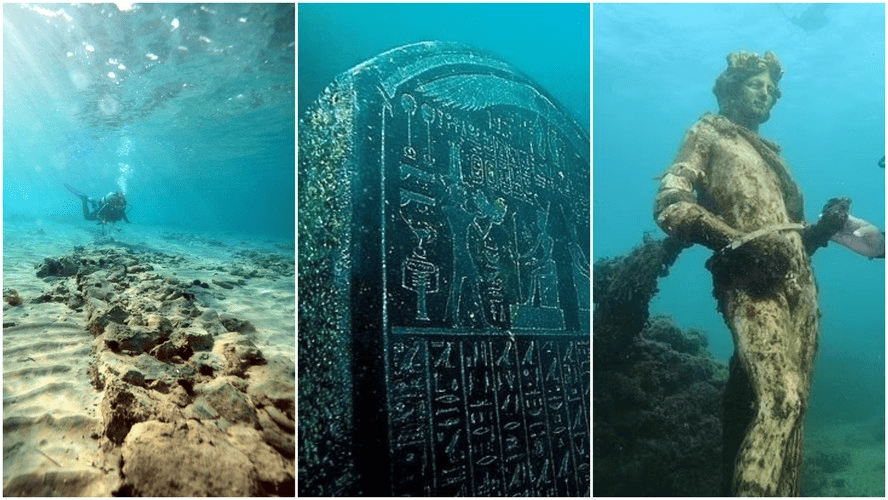


Researchers Identified a Mysterious Submerged Structure of 25 Meters That May Be a Pyramid Built More Than 10 Thousand Years Ago. The Discovery Raises Hypotheses About Ancient Civilizations That Are Still Little Known and Challenges the Traditional Chronology of History
A submerged stone structure in the Sea of Japan has reignited an old debate among researchers. Discovered in 1986, the so-called “Pyramid” of Yonaguni may be older than the pyramids of Egypt and even than Stonehenge, according to some scientists.
Structure Surprises With Shape and Estimated Age
Located 25 meters deep, near the Ryukyu Islands, the formation known as the Monument of Yonaguni features steps and flat terraces, similar to those of a temple.
According to estimates, the structure would be over 10 thousand years old, which would place it before the advent of agriculture.
-
With over 14 million baskets of earth moved, an ancient North American metropolis built a monumental pyramid of 30 meters and established a city with 20,000 inhabitants nearly a thousand years ago.

-
A 1,900-year-old treasure emerges from a Roman house destroyed by fire and sealed since antiquity in Romania, with coins and metals fused among the ashes.

-
The Brazilian colonial city that stopped in time and shares territory with a rocket launch base.

-
79-year-old woman challenges limits, visits 193 countries in the world after 56 years of planning and reveals the behind-the-scenes of a global journey that few have managed to accomplish.


Experts who support this hypothesis suggest that Yonaguni could have been built by a yet-unknown civilization. If confirmed, the history of humanity may need to be revised.
The site has earned the nickname “Atlantis of Japan” and has already attracted divers, geologists, and archaeologists. The unusual shape of the rock continues to fuel theories and hypotheses about its origin.

Liangtai Lin
Recent Debate Reignites Controversy
On the podcast “Joe Rogan Experience”, the topic gained prominence again with opposing opinions. Archaeologist Flint Dibble stated that the structure does not appear to have a human origin. “I’ve seen many crazy natural things, and I don’t see anything here that reminds me of human architecture,” he said.
In response, writer Graham Hancock, known for his theories on lost ancient civilizations, disagreed. For him, the formation shows clear signs of design, such as steps, arches, and even a carved face.
Hancock compared Yonaguni to Göbekli Tepe in Turkey, another archaeological site that challenges the conventional chronology of human history. Göbekli Tepe is dated to 9500 B.C., being one of the oldest known structures made by humans.


Other Opinions Divide the Scientific Community
Japanese geologist Masaaki Kimura also believes that the formation was made by humans. He suggested that Yonaguni could be part of a lost continent called Lemuria. For Kimura, the construction would be between 2,000 and 3,000 years old, a time when sea levels were lower.
On the other hand, Professor Robert Schoch from Boston University sees the formation as a natural phenomenon. In a previous interview with National Geographic, he explained that sandstones often break into straight shapes, especially in regions with high tectonic activity.
“These very straight edges are a result of the classic stratigraphy of the sandstones,” he stated.
Nearly four decades after its discovery, the Monument of Yonaguni still raises questions. The formation remains submerged and is studied by different experts. And, for now, no one has reached a definitive conclusion about its origin.







Acho intrigante o professor Robert Schoch, da Universidade de Bosto, fala que isso foi feito pela natureza, está muito sincronizador, parecer que alguém usou uma ferramenta diferenciada.
Uma matéria interessante sobre descoberta arqueologicas
Dez mil anos??… que é isso, rapaz, vai com calma. O modo de vida, ou melhor, o estilo de vida das pessoas teem nos mostrado que, se alguém veste uma camisa da Nike no Brasil, não demora nem um ano para outra pessoa vestir uma igual no Japão. Então, acho um equívoco dizer as piramides do Egito teem diferença de oito mil anos destas apresentadas na reportagem. Isto é impossivel.