






 Portuguese
  Spanish


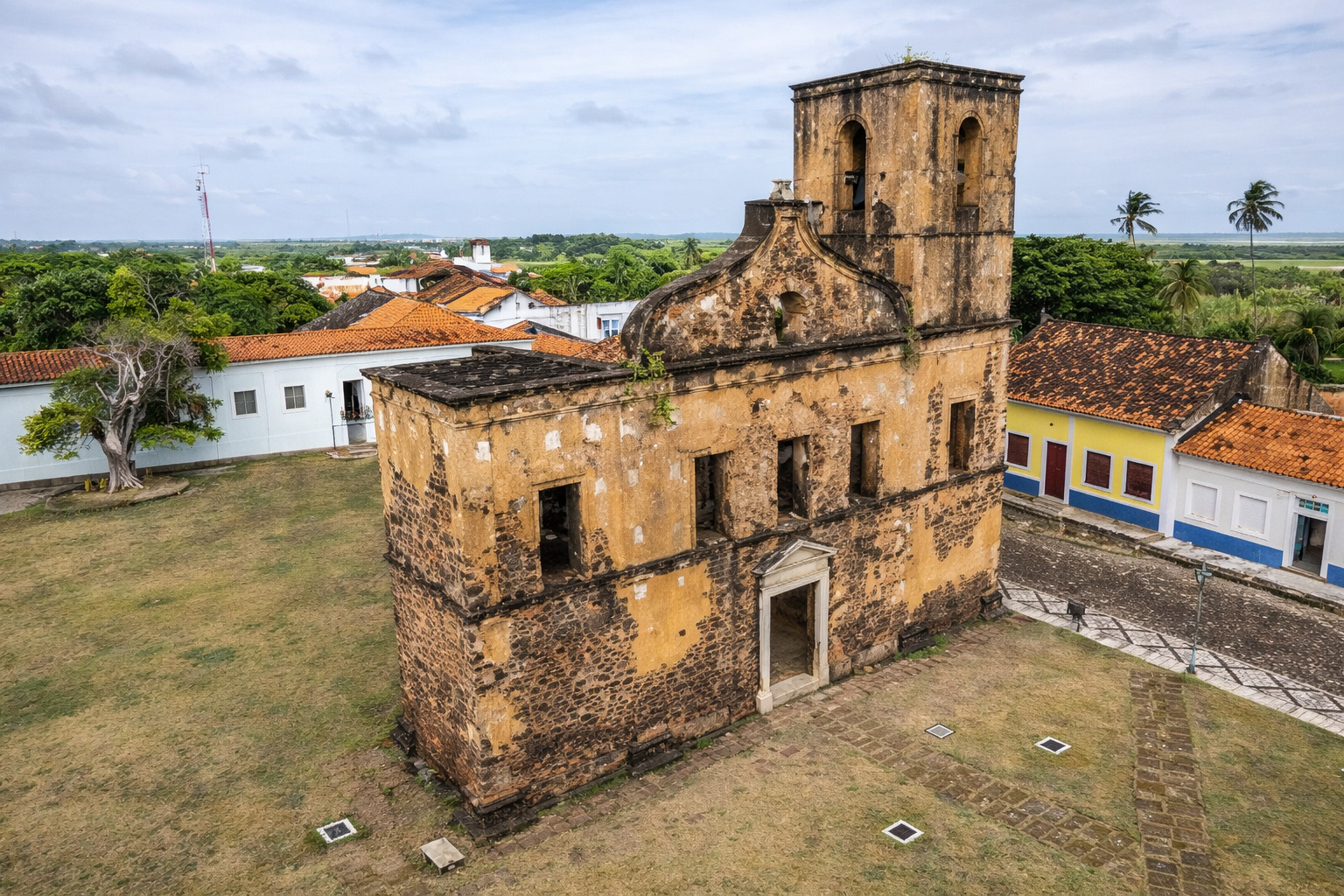

Historical city combines 17th-century heritage, economic legacy, and space technology in operation since the 1980s
A colonial city of great historical relevance remains preserved in Maranhão, gathering ancient ruins and space technology in the same territory.
Located just 32 km from São Luís, across the Bay of São Marcos, Alcântara preserves structures from the imperial period while also housing the Alcântara Launch Center.
This combination creates a unique setting where roofless mansions and stone streets coexist with modern rocket launch operations.
The territory also includes more than 150 quilombola communities certified by the Palmares Cultural Foundation, further enhancing its cultural and historical significance.
Strategic space base boosts launches in Brazil
The Alcântara Launch Center operates at 2°18′ south latitude, being considered one of the closest points to the equator among global bases.
This strategic location allows for savings of up to 30% in fuel for orbital launches, according to data from the Brazilian Space Agency and the Brazilian Air Force.
The base was inaugurated in 1983 and became operational in 1989, establishing itself as one of the main assets of the Brazilian space program.
While rockets are launched, the ruins of the Church of São Matias, begun in the 17th century, remain open to the sky, symbolizing the coexistence of past and innovation.
Historical city reaches economic peak and enters decline in the 19th century
Alcântara was founded in 1648 on the site of the ancient Tupinambá village of Tapuitapera, beginning a trajectory of growth based on the colonial economy.
During its period of greatest prosperity, the city stood out for sugar production, salt extraction, and cotton cultivation exported to Europe.
Wealthy families sent their children to study in Coimbra, Portugal, directly influencing local architecture.
In 1836, Alcântara was elevated to the status of a city, consolidating its economic and social peak.
However, in the second half of the 19th century, the decline of cotton and the abolition of slavery led to the region’s downturn.
With the departure of the elites, many buildings were abandoned, although they were preserved due to geographical isolation.
In 1948, the National Historical and Artistic Heritage Institute recognized the city as a National Monument, listing around 400 historical properties.
-
Workers renovating a playground in northern England uncover 176 World War II bombs buried underground; training artifacts still contained explosives.

-
Brazilian Architect Transforms Waste into Sustainable Homes with Solar Power and Rainwater Systems for 40 Years

-
Security Guard Becomes Doctor at Louisiana Hospital Where He Once Worked, Studied Chemistry Between Shifts

-
Woman Rescued from Luxury Complex in Brazil Worked Without Pay for 55 Years, May Be Entitled to Over $300,000





Historical center concentrates heritage and cultural attractions
The historical center of Alcântara can be explored on foot, starting from Ladeira do Jacaré with direct access to the main attractions.
Among the highlights are the ruins of the Church of São Matias, a symbol of the city and the unfinished construction from the 17th century.
The Church of Our Lady of Mount Carmel, begun in 1660, preserves artistic elements such as tiles and gilded carvings in the rococo style.
The Historical House Museum of Alcântara houses over 900 pieces from the colonial period, including furniture and utensils.
The House of the Divine maintains traditions linked to the Feast of the Divine Holy Spirit, a celebration originating in the 19th century.
Additionally, Livramento Island stands out as one of the most well-known beaches in the region, accessible by boat.
Access and climatic conditions influence visit planning
Access to the city is via catamaran or speedboat, with a crossing of approximately 1h20 from São Luís.
The vessels depart from the Praia Grande Hydroviary Terminal, with schedules defined according to the tide table.
The Jacaré Port operates only at high tide, which requires prior planning by visitors.
Moreover, the city has no airport and presents limited road access.
The equatorial climate features two well-defined seasons, with rains concentrated in the first half of the year, which directly influences the visitor experience.
Coexistence between historical heritage and technology defines local identity
Alcântara brings together, in one space, colonial ruins, traditional communities, and a strategically recognized space base.
This coexistence highlights the uniqueness of the city within the Brazilian context, emphasizing its historical, cultural, and technological value.
The proximity to São Luís facilitates access and reinforces its regional importance.
The preserved setting demonstrates how different historical periods can coexist in an integrated manner, keeping alive the memory of a significant past.
How does a single territory manage to gather colonial heritage, cultural diversity, and technological advancements without losing its historical identity?


