





 Portuguese
  English
  Spanish
  7 min of reading
  0 comments


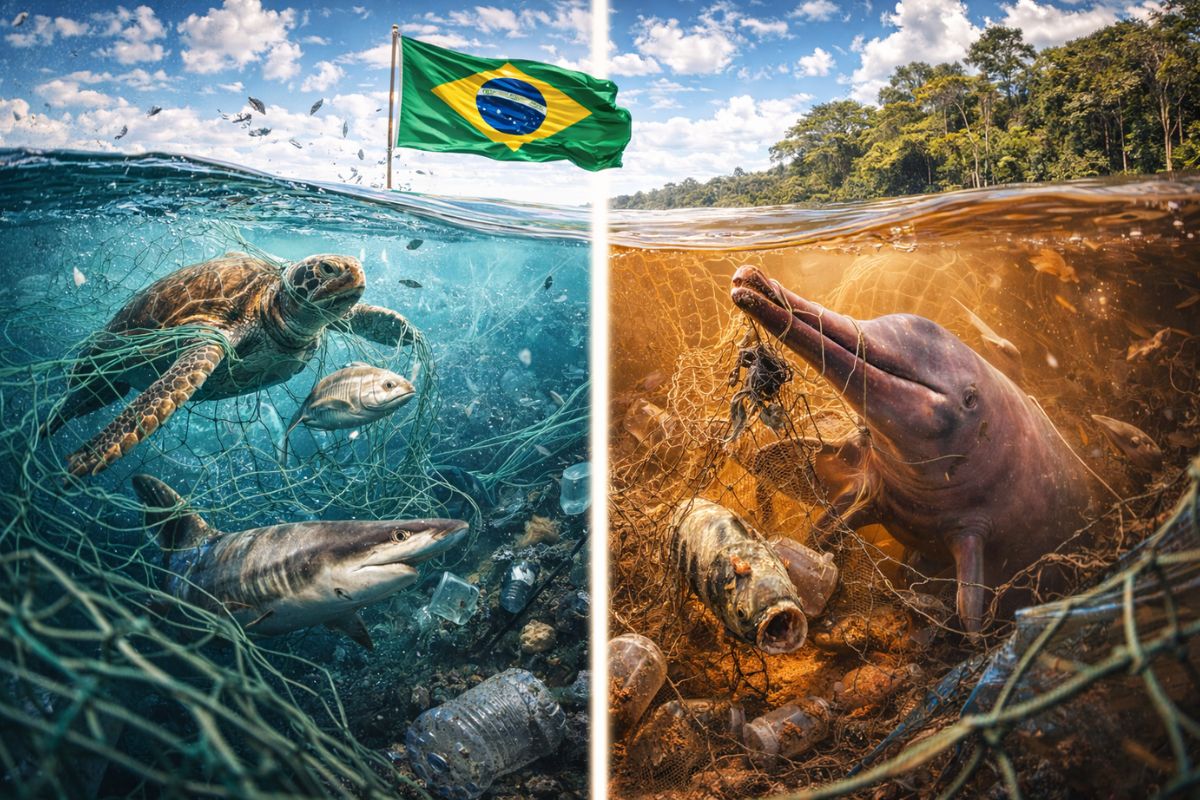
New Report on Ghost Fishing Estimates 25 Million Marine Animals Affected Per Year, Shows Fishing Gear Turning into Marine Litter and Warns of Pressure on Amazon River Dolphins.
Ghost fishing, the name given to abandoned, lost, or discarded fishing gear in the sea, has become a silent trap for Brazilian marine wildlife. According to the Ghost Tide report, ghost fishing may impact up to 25 million marine animals per year along our coastline, causing death, mutilation, injury, and entrapment. These are nets, lines, hooks, and traps that continue to fish on their own long after leaving the hands of fishermen.
Produced by World Animal Protection, the study compiles scattered data, field reports, and estimates to size the problem in a country with over 7,000 kilometers of coastline. The numbers indicate that, every day, around 69,000 marine animals may encounter ghost fishing gear in Brazil, while approximately 580 kilograms of nets are lost along the coast daily. The report also raises a warning: the impact is not restricted to the ocean and has already reached Amazonian rivers and emblematic species, such as the pink river dolphin and the tucuxi.
What is Ghost Fishing and Why Does It Continue to Kill On Its Own

Ghost fishing refers to the effect of fishing gear that drifts or gets trapped on the seabed without any human control.
-
He started running at 66 years old, broke records at 82, and is now a subject of study for having a metabolic age comparable to that of a 20-year-old, in a case that is intriguing scientists and inspiring the world.

-
Oldest tree on the planet reappears after 130 years of searches: Wattieza, 385 million years old, was 10 meters tall and had no leaves or seeds; Gilboa fossils in New York solved the mystery in 2007.

-
A 48-square-meter house assembled in hours with 4,000 bricks made of recycled plastic that does not absorb moisture, has natural thermal insulation, and costs less than 90,000 reais in a complete kit.

-
Luciano Hang revealed that Havan’s air fleet has already accumulated more than 20,000 landings, 10,000 flight hours, and 6 million kilometers traveled, and he says that without the planes, the company would never have grown so quickly.


These are gillnets and trawl nets, lines, hooks, gill nets, pots, and other traps that have been abandoned, lost, or discarded in the sea.
Even far from boats, these gears continue to capture fish, crustaceans, turtles, whales, sharks, and other animals as if they were still in operation.
The problem is that these gears don’t have a “power off” button. Ghost fishing continues to operate day and night, in any season, as long as there is plastic material and structures capable of trapping or injuring animals.
A piece of net caught on a reef, for example, can continue to capture animals that pass by accidentally for years, adding silent deaths that rarely enter the official fishing statistics.
Ghost Nets, Plastic, and Microplastic That Remain for Centuries
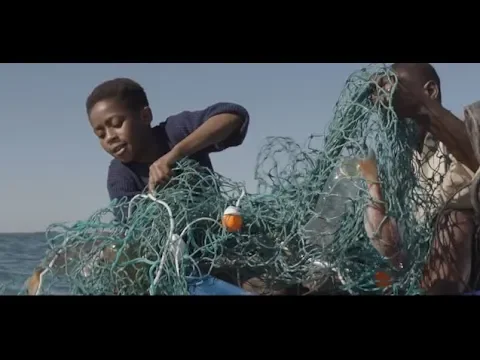

The majority of the gear that fuels ghost fishing is made of plastic. This means that the same net that gets tangled around a turtle or a shark today will not just disappear in the coming decades.
The report indicates that a plastic net can take up to 600 years to degrade in nature, prolonging the ghost fishing effect far beyond the lifespan of the boat that used it.
As long as it remains whole or partially intact, this net continues to capture animals. When it starts to fragment, it creates another problem: microplastic.
Small pieces of plastic spread throughout the oceans are ingested by fish, birds, and marine mammals and enter the base of the food chain.
In other words, ghost fishing does not end when the gear stops capturing visible animals because its legacy in the form of microplastic remains in the seas for centuries.
Globally, it is estimated that at least 640,000 tons of fishing gear are abandoned, lost, or discarded in the ocean every year. This equipment represents around 10 percent of all marine debris.
In Brazil, the Ghost Tide report estimates that about 6,600 tons of new fishing nets are produced or imported each year, helping to understand the scale of the challenge to prevent a portion of that volume from turning into ghost fishing.
25 Million Marine Animals Under Pressure on the Brazilian Coast

Based on the combination of available data and projections, the study estimates that 25 million marine animals along the Brazilian coast may have been impacted by ghost fishing in just one year.
This means that, on average, at least 69,000 marine animals per day cross paths with ghost nets, lines, and other ghost gear along our coastline.
This impact affects nearly all groups of marine fauna: fish, crustaceans, whales, dolphins, turtles, sharks, and diving birds that feed.
When an animal becomes trapped in ghost fishing gear, the outcome can be drowning, mutilation, serious injuries, intense stress, or long entrapment.
Even when they manage to escape, they often carry pieces of line or net attached to their bodies, compromising their feeding and locomotion abilities.
According to João Almeida, Wildlife Campaign Manager at World Animal Protection, the degree of suffering and scale of mortality are significant.
Ghost fishing does not choose species, size, or life stage: it captures everything from juveniles to adults, often belonging to populations already stressed by other human activities.
Ghost Fishing Reaches the Amazon Rivers and Threatens Dolphins
The report makes it clear that ghost fishing is not a problem exclusive to coastal areas. The intensification of gillnet use in Amazonian rivers is already identified as the biggest pressure factor for the two dolphin species in the region: the pink river dolphin and the tucuxi.
In these waters, lost or poorly managed nets function as invisible barriers to the movement and feeding of these animals.
Even without systematic data as robust as those from the coast, the study indicates that ghost fishing likely plays a central role in the drastic reduction of these populations.
In Amazon rivers and lakes, a single stretch of net can trap commercially valuable fish while simultaneously accidentally capturing dolphins, which become collateral victims of this invisible mechanism.
The difficulty of monitoring vast areas, with low enforcement and a wide range of fishing activities, makes ghost fishing even more challenging in the Amazon. Many deaths are never recorded and disappear without leaving evidence, reinforcing the “ghostly” nature of the problem.
Lack of Data, Huge Coastline, and Spread Out Gear

One of the strongest conclusions of the Ghost Tide report is that Brazil knows little about its own ghost fishing.
Despite the immense coastline, only three states – São Paulo, Santa Catarina, and Rio de Janeiro – have consistent scientific studies with structured records on the removal of ghost gear.
To fill these gaps, World Animal Protection relied on reports from diving agencies, beach cleanup initiatives, and local groups.
The sum of this information indicates that at least 70 percent of the Brazilian coastline has reports of abandoned or lost fishing gear spread across reefs, cliffs, sandy bottoms, and diving areas.
The lack of official data on fishing activity in general, such as fishing effort, types of nets used, most critical areas, and disposal practices, makes it more challenging to accurately gauge the problem.
The study itself acknowledges that, given the current gaps, the real situation of marine fauna may be even more severe than the estimates suggest.
Global Initiatives Against Ghost Fishing and Brazil’s Role
To tackle ghost fishing on an international scale, World Animal Protection initiated, in 2015, an intersectoral alliance known as the Global Ghost Gear Initiative, or GGGI, in English.
This effort brings together governments, the fishing industry, supermarket chains, fishing communities, universities, research centers, NGOs, and international organizations around the same problem.
The proposal is twofold: to better map where and how ghost fishing occurs and, at the same time, to establish more sustainable commitments to reduce the loss and disposal of gear.
The initiative already has 13 signatory countries, but the Brazilian government has not yet joined. The involvement of more actors, including Brazil, is seen as essential to transform good isolated practices into scalable policies.
During the report launch in Brazil, in São Paulo, the second Brazilian institution was announced to represent the country in the GGGI: the Jubarte Whale Institute. This means that the institution commits to providing data and can access funding for projects aimed at mapping and reducing ghost fishing in Brazilian waters.
An Invisible Problem That Calls for Visible Responsibility
The picture drawn by the Ghost Tide report shows that ghost fishing is not a detail of marine litter but an important cog in the crisis affecting the wildlife of oceans and rivers.
Gear abandoned by a boat today can continue capturing animals and releasing plastic for decades, crossing borders, reaching new regions, and affecting species that were never the original target of fishing.
At the same time, the data indicate paths. Better monitoring of fishing activity, creating net collection programs, establishing clear disposal rules, encouraging tracking technology, and increasing participation in international initiatives are pieces of the same solution.
The more we understand where ghost fishing occurs and which gear causes the most damage, the easier it becomes to act directly and efficiently.
Ghost fishing, by definition, happens outside the view of most people. The fight to reduce its consequences, however, needs to be taken transparently by governments, businesses, fishermen, and consumers.
And you, have you ever encountered abandoned nets, lines, or other signs of ghost fishing on the beaches or rivers you frequent, and how do you think it should be tackled in Brazil?








-

-

-

-

7 pessoas reagiram a isso.