





 Portuguese
  English
  Spanish
  5 min of reading
  0 comments



Archeologists Find In Mongolia A Wall System With 4 Thousand Kilometers, Older Than The Great Wall Of China, And Reveal New Functions For This Impressive Medieval Structure.
An archaeological discovery in Mongolia is changing the historical perspective on ancient Asian walls. Researchers have found a wall system measuring about 4,000 kilometers long, which, although not older than the famous Great Wall Of China, offers a different perspective on the use of these structures in medieval Asia.
The research was conducted by archeologists from the Hebrew University of Jerusalem and the National University of Mongolia, bringing surprising revelations.
The Medieval Wall System
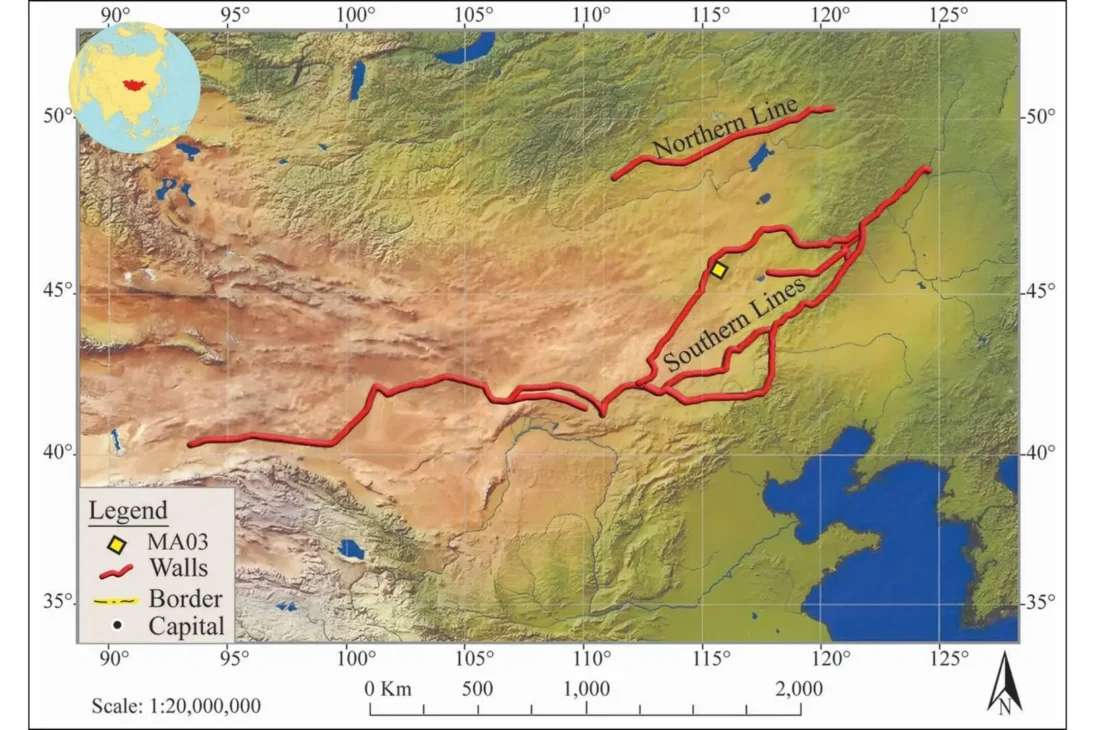
The newly studied structure has been named Medieval Wall System (MWS). It spans territories of Mongolia, China, and Russia, extending for an impressive 4,000 kilometers.
-
These living root bridges and ladders are over 700 years old and help indigenous people survive in one of the rainiest regions in the world.

-
From sertanejo star to international investor: Ana Castela invests millions in a mansion in the USA, creates a themed accommodation in Orlando, and shows that the “boiadeira” also wants to grow away from the stage.

-
The 10 most stunning motorhomes in the world: a $3 million trailer with a rooftop nightclub and garage for a Ferrari, “palaces on wheels” with Italian marble, private cinema, and five-star hotel luxury for billionaires.

-
Trump wanted to spend $400 million on the White House, but the courts prohibited the million-dollar construction.

One of the most analyzed sections is the so-called Mongol Arch, which has been intensively excavated since 2018. The new discoveries challenge what was previously believed about the purpose of this construction.
Contrary to the common idea of a military fortification, like the Great Wall Of China, the MWS seems to have served another purpose.
The excavations showed that, in many sections, what exists are simple ditches a few meters wide and deep, flanked by earth mounds. In some places, there are not even visible remnants of a wall.
A Symbolic And Functional Boundary
The evidence found led archaeologists to reconsider the purpose of the MWS. Instead of an impassable barrier defending territories from enemy armies, the system functioned as a form of territorial marker. The structure served to control the movement of people, animals, and goods.
Its design allowed for transit at certain strategic points, the so-called gates. At these locations, control and surveillance could be exercised more effectively.
Thus, the wall operated as a tool for economic and territorial organization, rather than as a classic military fortress.
The discoveries also include fortresses and enclosures associated with the system, such as the archaeological site MA03, which helped reinforce this interpretation.
The Routine On The Fringes Of The Empire
The site called MA03 revealed even more details about the daily life of people who lived near the wall. The rectangular structure, made of rammed earth and stone, was surrounded by internal and external ditches. There, researchers found clear evidence of habitation.
Heating systems made of stone, typical of environments prepared to withstand the harsh winters of the steppes, were identified.
Fragments of ceramics, iron tools, animal remains, and even an iron plow were also discovered. These remnants indicate that the local population engaged in various activities such as livestock, hunting, and agriculture.
This way of life contrasts with the traditional view of steppe peoples as exclusively nomadic herders.
The presence of kang type heating systems, used in China and Korea, also indicates contact and adoption of external technologies, showing a broader cultural integration.
Adapted And Permanent Communities
Life in MA03 seems to have been that of a small community that adapted to the demands of the climate, soil, and central government. The constant presence of people in these areas shows a more complex social dynamic than previously thought.
The discoveries give special value to the archaeological remains, as they reveal everyday aspects of life in the region, which were previously silent and little known by traditional historical records.
Burials Reveal The Symbolic Value Of The Wall
During the excavations, archaeologists also found a grave within the MA03 enclosure. The burial occurred around 1440, more than two centuries after the original occupation of the site.
The fact that someone was buried there long after the structure was abandoned suggests that the place held a special significance for local populations.
The body, that of an adult man, was carefully buried alongside personal items, textiles, and a birch bark basket. These elements indicate the performance of complex funeral rites, possibly related to ancient cultural traditions.
This phenomenon of repurposing spaces has been observed in other parts of the Medieval Wall System.
This shows that the structure did not only remain on the ground but also in the cultural memory of the nomadic peoples of the region.
The Relationship With The Power Of The Jin Dynasty
The period of construction of the MWS coincides with the rule of the Jin dynasty, which governed parts of northern China and Mongolia between the 12th and 13th centuries. The Jin, originating from the Jurchen peoples, established a model of governance that blended nomadic and sedentary elements.
The Medieval Wall System may have been a strategy of the Jin to assert their presence and exert control over the peripheral regions of their empire.
The structure allowed monitoring of movements and regulating economic exchanges in remote borders.
Despite this organization, Jin’s dominance was not lasting. In the early 13th century, the advance of the Mongol Empire resulted in the defeat of the Jin and the loss of control over these areas. The wall, over the centuries, ended up being forgotten.
A New Perspective On Asian History
The recent discoveries in Mongolia shed new light on underexplored aspects of Asian medieval history.
Unlike the traditional idea of walls as rigid military barriers, the Medieval Wall System reveals a more flexible function adapted to local needs.
It was not merely about dividing territories, but about organizing space, controlling flows, and marking the presence of a distant central power.
The existence of fixed communities, culturally and technologically integrated with other peoples, also broadens the understanding of life in the steppes of medieval Asia.
Just like the Great Wall Of China, centuries after its construction, the Medieval Wall System reemerges as an important piece for understanding the complex strategies of power, organization, and survival in one of the vastest regions of the ancient world.
Reference: Shelach-Lavi G, Amartuvshin C, Heimberg D, et al. Life Along The Medieval Frontier: Archaeological Investigations Of The Southeastern Long Wall Of Mongolia.
Antiquity








-

-

2 pessoas reagiram a isso.