





 Portuguese
  English
  Spanish
  3 min of reading
  0 comments


Archeologists Found Intriguing Structures Near The Great Pyramid Of Giza, Bringing New Mysteries About Ancient Egypt And Its Monumental Constructions
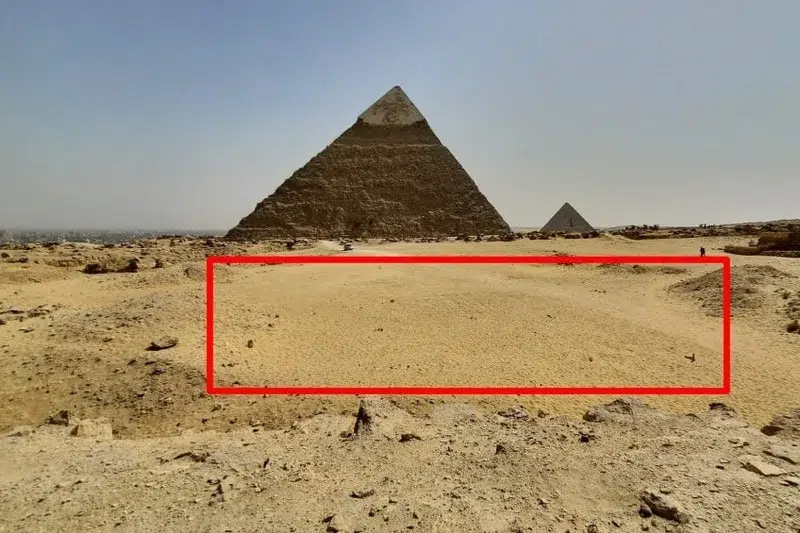
The Great Pyramid of Giza, an imposing symbol of ancient Egypt, continues to guard mysteries beneath its sands. Recently, archeologists discovered a structure in L-shape buried next to the iconic monument, dated to about 4,500 years ago. This discovery could open new perspectives on the history and engineering behind the royal tombs.
The structure, found by an international team of researchers from Japan and Egypt, was identified using advanced technology. Utilizing methods such as electrical resistivity tomography (ERT) and ground-penetrating radar (GPR), scientists mapped the terrain of the Western Cemetery of Giza. This site is known for housing the tombs of the royal family of King Khufu and high officials of the period.
An Empty Space Surrounded By Tombs

The Western Cemetery is marked by mastabas, flat-roofed rectangular tombs. However, a central area caught the researchers’ attention for appearing strangely empty. This investigation led to the use of technologies to examine what might be hidden beneath the surface.
-
He started running at 66 years old, broke records at 82, and is now a subject of study for having a metabolic age comparable to that of a 20-year-old, in a case that is intriguing scientists and inspiring the world.

-
Oldest tree on the planet reappears after 130 years of searches: Wattieza, 385 million years old, was 10 meters tall and had no leaves or seeds; Gilboa fossils in New York solved the mystery in 2007.

-
A 48-square-meter house assembled in hours with 4,000 bricks made of recycled plastic that does not absorb moisture, has natural thermal insulation, and costs less than 90,000 reais in a complete kit.

-
Luciano Hang revealed that Havan’s air fleet has already accumulated more than 20,000 landings, 10,000 flight hours, and 6 million kilometers traveled, and he says that without the planes, the company would never have grown so quickly.


The ERT, which measures soil resistance to electric currents, revealed an initial anomaly two meters deep: an L-shaped structure measuring 10 meters long. According to researchers, this formation seems to have been filled with sand after its construction, raising questions about its original purpose.
A Deeper Enigma
Even more intriguing was the discovery of a second anomaly beneath the L-shaped structure. This showed high resistance, reducing the likelihood of containing rubble, sand, or even an empty space.
Scientists suggest that this layer may be connected to the upper structure and potentially lead to a chamber or tomb.
“It could be a system of vertical limestone walls or shafts leading to a larger structure,” state the authors of the study, published in the journal A Archeological Prospection. Despite the initial evidence, experts confirm that more research is needed to validate these hypotheses.
Excavations In Progress Next To The Pyramid Of Giza

Motoyuki Sato, the lead author of the study and a researcher at Tohoku University, stated that the structure exhibits very defined characteristics for it to be a natural feature. According to him, the different shape reinforces the possibility that the formation was built by human hands.
Peter Der Manuelian, an Egyptologist from Harvard, pointed out that the discovery was hampered by the lack of visible structures above ground in the scientific area.
He noted that L-shaped offering chapels are already known in Giza, but are typically found above the surface, making this underground finding even more unique.

What Follows – Updates In November 2024
Although archeologists are just beginning to explore this mysterious structure, the discovery is already sparking debates about the historical significance of the find. “The continuity between the shallow and deeper structure suggests something of great importance,” declared the team.
For now, what is known is that an apparently unoccupied area of the Western Cemetery may hide a new chapter of Egyptian history. However, only further studies and excavations can reveal what really lies beneath the sands of Giza. As of now, in November 2024, there have been no new updates on the discovery.

With each new discovery, ancient Egypt reaffirms its inexhaustible fascination. And even with all modern technologies, the land of the pyramids continues to challenge our understanding.








Seja o primeiro a reagir!