





 Portuguese
  English
  Spanish
  5 min of reading
  0 comments


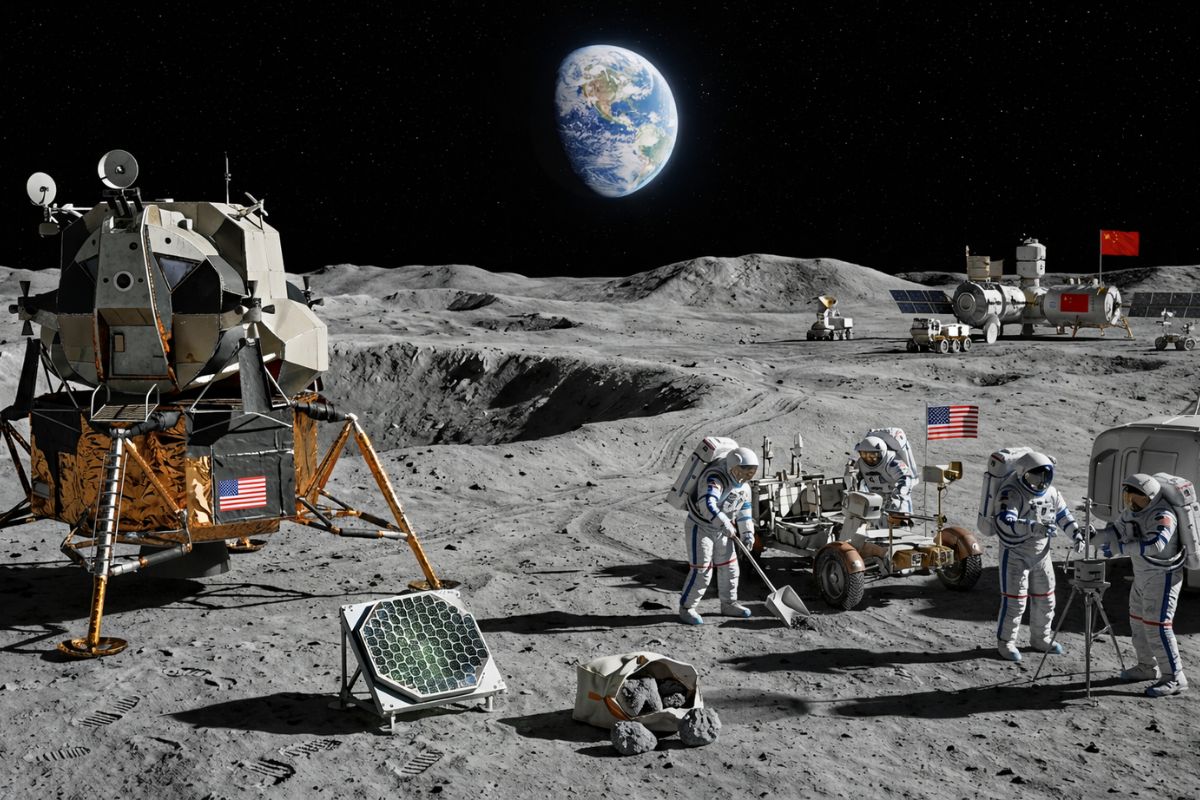
Amid doubts about “fraud,” verifiable physical evidence, and a new mission push, the Moon emerges from the past to become a stage for geopolitics and technology once again
The Moon still divides opinions: a significant portion of the public continues to call the landing a “hoax,” while scientists and observatories point to evidence spanning decades, from rocks analyzed worldwide to mirrors left on the lunar surface.
At the same time, the Moon is becoming a priority again. In 2026, four astronauts will return to lunar orbit after more than 50 years without human missions so close, and the space race gains a new central adversary, with China now playing the role of main rival.
Why the Moon still becomes “fraud” for so many people
The discussion persists because the theory is simple to understand and easy to spread: “we didn’t go to the Moon, it was a studio.” The very debate is strengthened by the feeling that governments can lie and that the “official truth” does not always convince.
-
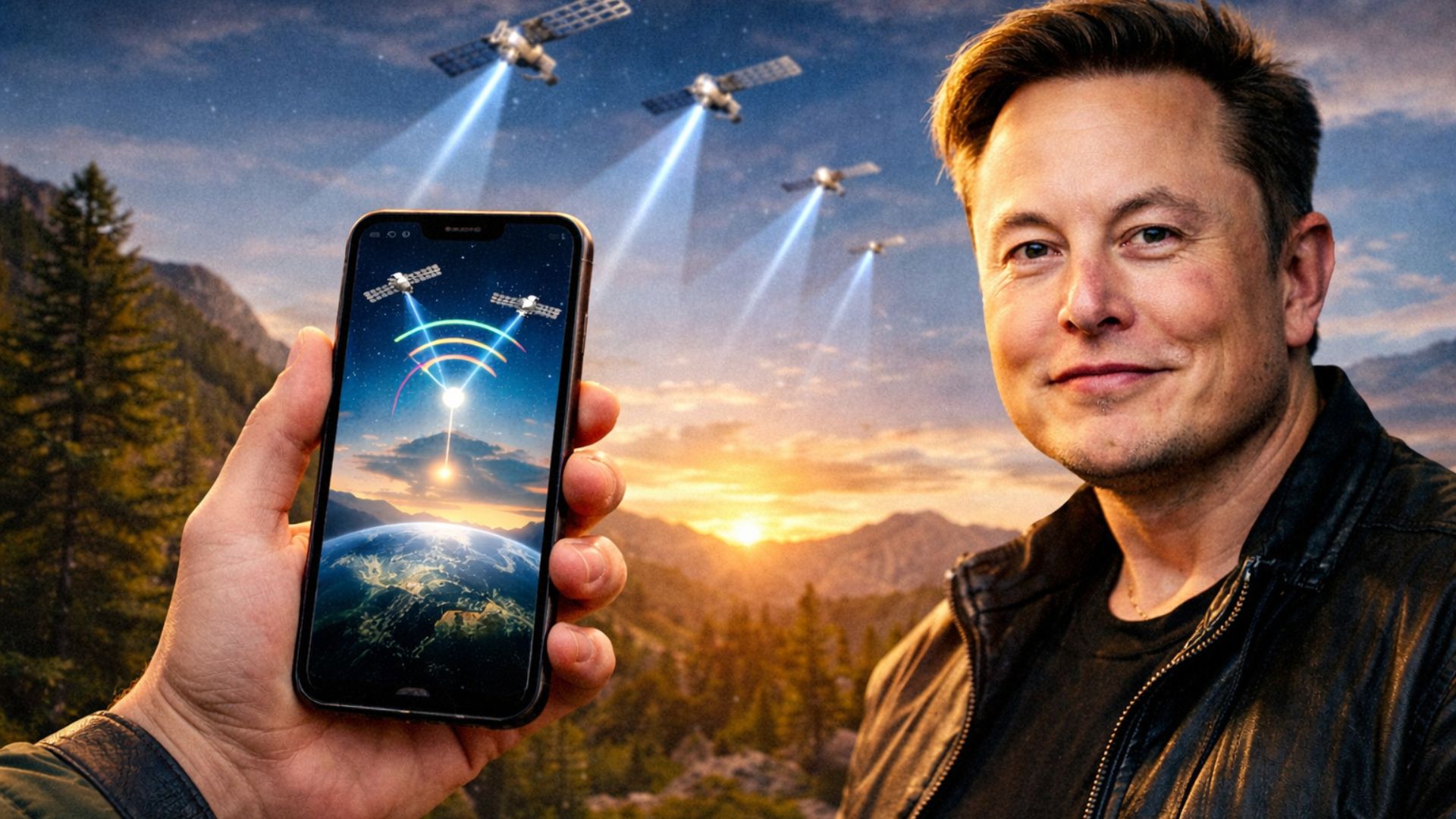
New list shows over 50 cell phones compatible with Starlink without an antenna: direct connection to satellites in low orbit, coverage in areas without signal, initial support for SMS and emergencies, and forecast for global mobile internet.
-
Not even Starlink, Elon Musk’s internet, has succeeded: Iran enters the 37th day of a digital blackout with over 864 hours without internet, surpassing all previously recorded blockades and forcing millions to use the isolated national network after military attacks.

-
China arms a solar panel shield against the advance of the desert: a 1 GW project in Ningxia creates shade for shrubs and goji, and the official plan aims for 253 GW by 2030 to recover 7,000 km².

-
MetSul issues alert for 72 hours of severe weather in the South of Brazil with an extratropical cyclone, a line of instability, and a cold front that will hit Rio Grande do Sul from Monday to Wednesday with strong winds and heavy rain.

However, when it comes to the Moon, the story does not rely solely on old images. It involves independent tracking, physical evidence, and technical details that help separate legitimate doubt from repeated narrative.
When going to the Moon became the way to win a war without gunfire
The space race was born at the height of a dispute where direct attack was unthinkable. The Soviet Union launched Sputnik in 1957 and then put Laika into orbit. In the United States, the shock is immediate because the same type of rocket that carries a satellite can also carry a warhead.
The response is structural: NASA is created in 1958, and the competition accelerates. The Moon becomes a public objective when Kennedy sets the deadline of “by the end of the decade,” with the logic of winning a technological war without needing to fire a shot.
Technology fails, lives are lost, and Apollo 11 almost goes wrong
Before victory, there is a sequence of failures and risks. The text mentions rockets exploding, repeated attempts, and the 1967 accident that killed three astronauts. Still, the program continues, learns, and advances.
When Apollo 11 arrives, the journey to the Moon takes three days. Nearing landing, the computer emits overload alarms and errors. In the control center, the decision is quick: continue.
Armstrong takes manual control to avoid a rocky area, with fuel at the limit. The tension of the landing is part of the real story, not a decorative detail.
The most repeated theories about the Moon and the answers that do not depend on “faith”

Some doubts always resurface, and the text itself presents physical and technical answers.
“Waving” flag
The flag has a horizontal rod to stay open. The movement comes from handling, and without air to slow it down, it lasts longer. After that, it stops. The point is simple: no wind is needed for initial movement.
Absence of stars in photos
The missions land on the sunlit side of the Moon, with intense light reflecting off the ground and suits. To capture astronauts and the surface, the camera adjusts aperture and speed, which “washes out” faint stars, as happens with the daytime sky on Earth. The text mentions an ultraviolet camera positioned in the shadow during one mission, where stars appear and positions are confirmed.
“Crooked” shadows
A single light source, the Sun, can create shadows in different directions when the terrain is uneven. The argument is that the surface of the Moon is not flat, and slopes and craters change the geometry of the shadow.
Van Allen radiation belt
The text states that the trajectory was calculated to cross the least radioactive part in less than 30 minutes, with a dose comparable to that of a CT scan. The passage is planned, not random.
The most uncomfortable proof for the fraud thesis: Soviets monitored everything
Here is the point that changes the conversation: in the midst of the Cold War, the Soviet Union would have a huge interest in discrediting the United States. The text states that the Soviets had radars, a tracking network, and scientific capability to monitor the missions.
They tracked Apollo missions in real-time and captured radio transmissions directly from the Moon, independently. Still, they did not use “fraud” as a propaganda weapon. If there were a simple shortcut to undermine American credibility, this would be the perfect moment to exploit it.
Active physical evidence: mirrors on the Moon and rocks analyzed worldwide
The text cites three pieces of material evidence that do not depend on “believing” in an institution.
Mirrors on the Moon’s surface
Observatories can point lasers and receive the reflection back. It is a repeatable verification based on measurement.
Lunar rocks
The missions brought back 382 kg of rocks, analyzed by scientists from various countries, including Soviets. The lunar origin of these samples has been treated as consistent over the decades.
Marks of modules and footprints
A satellite in 2009 photographed the surface of the Moon in high resolution and shows landing modules and marks. Without wind and rain, the tendency is for these marks to persist for a long time.
Why no one returned for more than 50 years and why the Moon is back now
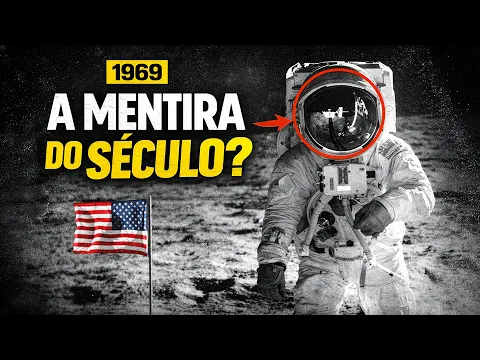

The text responds with a human and political factor: the space race was also geopolitical. After the objective was achieved, the budget fell, and the country’s priority changed with Vietnam, crises, and instability.
The cycle repeats: presidents announce plans, programs change, and the Moon is left waiting. Until China enters the game consistently, with a rover landing in 2013, a landing on the far side in 2019, and a return of samples from the far side in 2024, in addition to a goal of sending an astronaut to the Moon by 2030.
The Moon as a base and not as a trophy: ice, water, and fuel
The major shift in utility appears at the south pole: permanently shadowed craters with ice, according to the text. Water changes everything in a space mission: it serves for drinking, producing oxygen, and, by separating hydrogen and oxygen, becomes rocket fuel.
This repositions the Moon as an advanced base to test technology, train, and refuel before more distant missions. The logic is operational: if something goes wrong on the Moon, the return occurs in days; on Mars, the return interval can be years.
2026 reignites the race and puts the Moon back at the center
In 2026, four astronauts will return to lunar orbit, marking the resumption of a phase that has not occurred in over 50 years. The text presents this return not as “planting a flag,” but as the beginning of a new chapter, with long-term motivation and renewed competition.
In the end, the discussion about the Moon ceases to be just about “did or did not” and becomes another question: who will lead the next step when exploration once again involves power, technology, and strategy.
Do you believe that man went to the Moon or do you think it was all a hoax?






Seja o primeiro a reagir!