





 Portuguese
  English
  Spanish
  7 min of reading
  5 comments


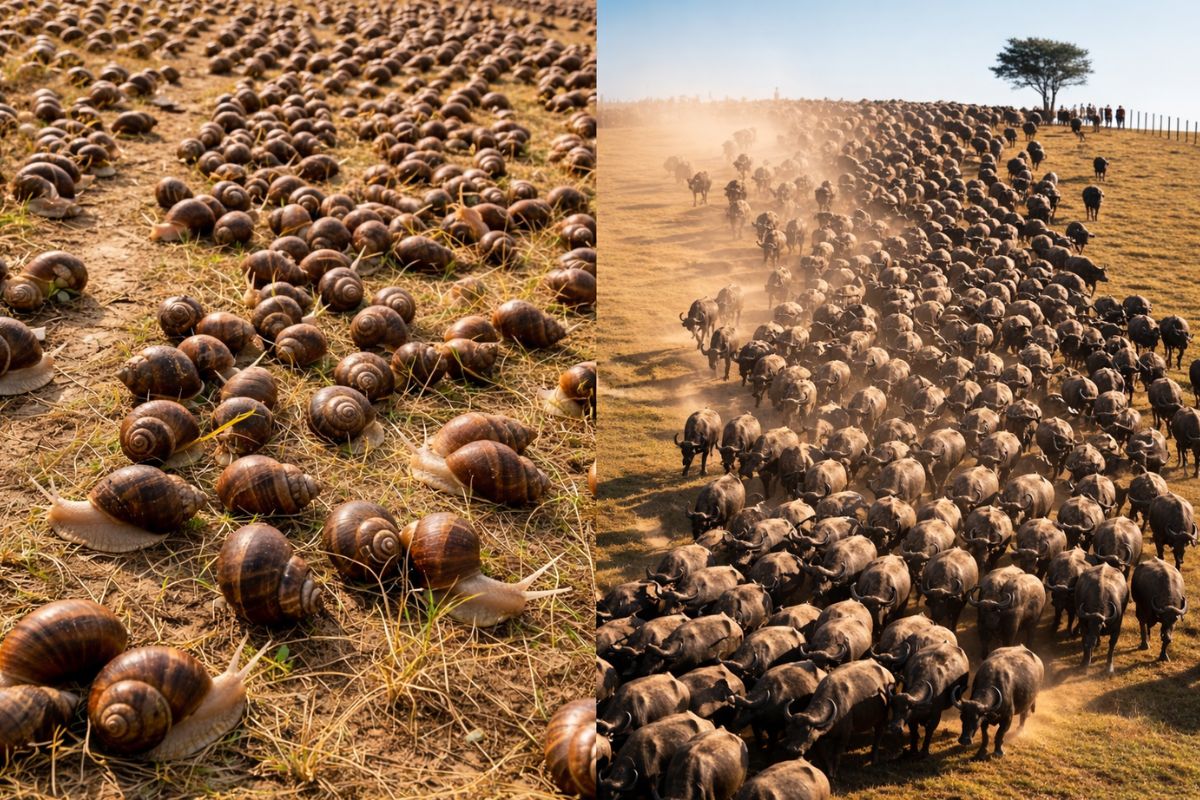


Axis Deer That Breaks Fences And Competes For Pasture With Cattle, Wild Buffaloes Weighing Up To 700 Kg, African Snail That Spreads Pests And Parasites, African Catfish That Devours Native Species And Devastating Wild Boar Form A Team Of Invasive Animals That Threaten Crops, Livestock And Forests In Brazil.
The invasive animals are already part of the routine of many Brazilian farmers. When the subject comes up, almost everyone remembers the wild boar, now considered a national pest. But the list of problems is larger than it seems. There are other animals introduced by humans that escaped control and now cause daily damage on farms, flooded areas, rivers, and natural reserves.
More silent than an insect plague, but much more destructive over the years, these invasive animals trample pastures, compete with cattle, break fences, attack crops, spread diseases, and upset entire ecosystems. What started as ornamental, productive, or “opportunistic” breeding has turned into an expensive challenge, difficult to control, and poses risks to the safety of people and herds.
Axis Deer: The “Beautiful” Intruder That Breaks Fences And Competes With Cattle

The axis deer, also known as chital deer, is the typical case where appearance deceives. Beautiful, elegant, and silent, it seems harmless at first glance, but today it is seen as one of the most problematic invasive animals in rural areas of Brazil.
-
The eggshell that almost everyone throws away is made up of about 95% calcium carbonate and can help enrich the soil when crushed, slowly releasing nutrients and being reused in home gardens and vegetable patches.

-
This farm in the United States does not use sunlight, does not use soil, and produces 500 times more food per square meter than traditional agriculture: the secret lies in 42,000 LEDs, hydroponics, and a system that recycles even the heat from the lamps.

-
The water that almost everyone throws away after cooking potatoes carries nutrients released during the preparation and can be reused to help in the development of plants when used correctly at the base of gardens and pots, at no additional cost and without changing the routine.

-
The sea water temperature rose from 28 to 34 degrees in Santa Catarina and killed up to 90% of the oysters: producers who planted over 1 million seeds lost practically everything and say that if it happens again, production is doomed to end.


Originating from India and southern Asia regions, the axis deer was primarily brought for ornamental purposes and for breeding in private properties aimed at sport hunting.
For years, these animals were confined to fenced areas. The problem started when fences were broken, properties were abandoned, and in some cases, there were deliberate releases, paving the way for the animals’ escape.
From there on, the axis deer found in Brazil a perfect setting: favorable climate, abundant food, and practically no natural predators capable of controlling its population.
It competes directly for food with cattle, consuming the same grass from pastures on extensive grazing farms. This means less food available for the herd and higher costs for supplementation, especially during dry periods.
In addition to competition for pasture, the axis deer invades crops, tramples planting areas, and causes damage that often goes unnoticed at first but accumulates over time.
Another serious point is the impact on infrastructure: the axis deer breaks fences easily, crosses neighboring properties, and circulates near rural roads, increasing the risk of accidents, especially at night.
With rapid reproduction and little control, the herds grow year after year, turning this deer into a discreet yet constant invader.
Wild Buffaloes: 700 Kg of Brute Force in Flooded Areas and Pastures

The buffaloes arrived in Brazil with a clear objective: meat and milk production in areas where traditional cattle have more difficulties, especially in the north of the country.
Adapted to flooded terrains and challenging regions, they seemed the perfect solution for certain environments.
The problem began when part of these animals escaped from human management or were simply abandoned.
Over time, populations of wild buffaloes emerged, i.e., buffaloes that returned to live ferally, uncontrolled, in areas like Marajó Island and other rural regions. An adult buffalo can easily exceed 700 kg, making any close encounter potentially dangerous.
In the field, the damage caused by this type of invasive animal is significant and visible. Wild buffaloes trample pastures, compact the soil, destroy fences, and harm rural roads.
In flooded areas, they affect springs, riverbanks, and preservation zones, causing erosion and environmental degradation that impacts not only the farm where they are but also neighboring properties and entire ecosystems.
For rural producers, the loss goes beyond pasture and infrastructure. There is a direct risk to safety: unlike managed buffaloes, wild ones are unpredictable and can attack people, horses, tractors, and vehicles.
In many communities, residents avoid moving in certain areas because of these animals. Capturing, removing, or controlling wild buffaloes requires heavy equipment, specialized labor, and significant investment, making the problem linger for decades.
African Snail: Pests In Gardens And Dangerous Parasites In The Soil

The African snail is one of the clearest examples of irresponsible introduction of exotic species in Brazil. It was brought with the promise of becoming an economic alternative to escargot, in breeding projects for consumption.
The plan did not work out. Without a solid market and proper management, many breeders simply discarded the animals into the environment.
In the field, this snail spread with impressive speed. It attacks gardens, orchards, seedling nurseries, and sensitive crops, consuming leaves, shoots, and stems.
For small producers and family agriculture, the African snail can mean complete loss of a crop, especially when production is concentrated in a few areas.
In addition to the direct damage to plants, there is a serious sanitary issue. This invasive animal can transmit dangerous parasites to humans and animals, contaminating soil and water.
In rural areas, where contact with the ground and organic waste is constant, the risk for entire families increases.
Another aggravating factor is the reproductive capacity: a single African snail can lay hundreds of eggs, and the species adapts well to different climates and environments. Where a focus emerges, the infestation tends to spread rapidly.
Control depends on continuous work, manual collection, and proper disposal, a task that consumes time and energy from the producer. In many farms, the African snail becomes a permanent problem, difficult to eradicate definitively.
African Catfish: Predator That Devours Native Fish And Changes Life In Ponds

The African catfish was introduced in Brazil for fish farming, due to its characteristics considered efficient: rapid growth, resilience, and ability to utilize almost any type of food. While it remained confined to closed tanks and nurseries, it seemed a productive option.
The problem began when these fish escaped from farming structures, mainly during periods of heavy rain, breaking out of nurseries or inadequate management.
Once released into rivers, ponds, and reservoirs, the African catfish becomes an aggressive and opportunistic predator. It feeds on native fish, eggs, fry, and small aquatic animals, causing total imbalance in bodies of water.
For rural producers who depend on ponds for fish farming, irrigation, or artisanal fishing, this invasive animal poses a direct risk to production.
The presence of the African catfish can wipe out native species and make traditional farming systems unviable, which were designed for other more sensitive species.
Moreover, the African catfish has a high tolerance to extreme conditions, including low dissolved oxygen levels in water, which complicates control based on water quality or conventional management.
Its opportunistic behavior allows it to quickly dominate the environment, often without the producer noticing the initial impact. The result is a loss that accumulates over time, affecting natural resources and income linked to water.
Wild Boar: The Most Destructive Invasive Animal In Brazil

When it comes to invasive animals in the country, the wild boar is the name that scares farmers the most. Originating from Europe, it was brought for breeding and hunting but soon escaped control.
By crossing with domestic pigs, the javaporcos emerged, even more resistant and adapted to Brazilian conditions.
In the field, the damage is enormous. Wild boars and javaporcos can destroy entire crops in no time, digging up the soil, uprooting roots, consuming seeds, and knocking down plants.
They break fences, invade properties, and attack livestock, such as calves, lambs, and kids. In addition to the direct economic impact, the wild boar is extremely aggressive and poses a real risk to people living or working in rural areas.
Accelerated reproduction makes control even more complex. With numerous litters and several reproductive cycles, the population grows explosively.
Therefore, the wild boar is considered a national pest, and control is authorized by law, within specific regulations. Nonetheless, keeping these animals under some level of control requires constant vigilance, regional organization, and often specialized technical support.
For rural producers, the wild boar represents recurring losses, risks to life, and a challenge for which there is no simple solution.
It sums up, in an extreme way, the problem of invasive animals: species introduced by humans that escape control and become difficult enemies to confront within the farm’s gate.
How The Producer Can Face The Problem Of Invasive Animals

The cases of axis deer, wild buffaloes, African snails, African catfish, and wild boars show that invasive animals are not just an environmental curiosity, but a reality that directly affects productivity, safety, and ecological balance in the Brazilian countryside.
In all examples, the source is linked to human decisions to introduce exotic species without long-term planning, followed by failure in control.
In practice, the producer faces a complex problem, where control is expensive, time-consuming, and often depends on public policies, environmental regulations, and regional cooperation.
Understanding the behavior of these invasive animals, recording occurrences, seeking technical guidance, and participating in joint management initiatives are important steps to reduce damage.
While definitive solutions do not appear, one thing is certain: ignoring invasive animals is to forfeit productivity and safety for the future, as each year without action tends to increase the size of the problem inside and outside the farm.
And you, in your region, have you had losses or heard reports because of any of these invasive animals in the field?








Eles deveriam respeitar os javalis eu não gostei do vídeo matando milhões os caminhões tudo cheio de javalis mortos odiei esse vídeo por Gentileza respeitem os javalis eles querem viver estão atrás de comida estão com fome adeus está olhando a maudade do ser humano com esses animais quero que deixem eles em paz fazerem o que quiserem tadinho não estão fazendo nada com o ser humano, não estão mexendo com eles é muita maldade do ser humano com esses animais eles querem respeito.
Matar pra comer e gostozo igual viado mateiro
Boa tarde! Tenho problemas serio com caramujo africano..deixei de plantar meus temperos..remedios caseiros chás…criar as galinhas…tenho .eu tento exterminar eles..mais parece brotar da terra…o meu bairro esta contaminado peço ajuda…qual produto usar? Aqui eu jogo sal eles derrete …não resolve aparece cada vez mais…o meu espaço é 33×75 …gratidão 🙏Cuiabá MT
Sulfato de cobre espalhando no terreno.
Não faz mal a plantação e mata os caramujos e os ovos deles.