





 Portuguese
  English
  Spanish
  5 min of reading
  3 comments




Transnordestina Railroad Promises to Transform the Northeast, but Business Leaders Doubt It Will Be Completed by 2027. The Project, Involving R$ 14.9 Billion, Five Thousand Jobs, and an Impact of R$ 7 Billion on GDP, Depends on Coordinated Actions Between Government and the Private Sector.
The Transnordestina Railroad is often presented as a great promise to transform the economic landscape of the Brazilian Northeast, but the project remains mired in controversy and mistrust.
Despite constant promises, a group of entrepreneurs from the industrial and agricultural sectors believes that the railroad may never be completed, at least not within the next five years.
This uncertainty is reflected in conversations circulating in the backrooms of business meetings. After all, is the Transnordestina merely another “dream of a thousand and one nights”?
-
Larger than entire cities in Brazil: BYD is building a 4.6 km² complex in Bahia with a capacity for 600,000 vehicles per year, but the discovery of 163 workers in conditions analogous to slavery has shaken the entire project.

-
With an investment of R$ 612 million, a capacity to process 1.2 million liters of milk per day, Piracanjuba inaugurates a mega cheese factory that increases national production, reduces dependence on imports, and repositions Brazil on the global dairy map.

-
Brazilian city gains industrial hub for 85 companies that is equivalent to 55 football fields.

-
Peugeot and Citroën factory in Argentina cuts production by half and opens a layoff program for more than 2,000 employees after Brazil drastically reduced purchases of Argentine vehicles.


Challenges and Frustrated Promises
According to the Diário do Nordeste newspaper, for Ceará business leaders, one of the biggest obstacles to believing in the project’s completion is the history of unfulfilled promises.
In April 2024, the management of Transnordestina Logística S/A assured President Lula that trains would be operating by 2027, but distrust persists.
The logistical and financial difficulties of the project are significant, and the lack of significant progress in neighboring states, such as Piauí, further exacerbates doubts about the project’s viability.
In a recent meeting, one entrepreneur highlighted that, in his investment in aquaculture in Piauí, there is no mention of the project.
This silence is a clear sign that, thus far, little to nothing has been done in the region.
The promise that the first loads would be sent from the Port of Pecém as early as 2025 also seems distant from reality.
The Positive Outlook: When the Railroad Can Change the Northeast
On the other hand, there are those who view the project with optimism.
Some business leaders assert that, once completed, the Transnordestina could revolutionize the economy of the Northeast.
The project aims to connect important producing regions, from Piauí to the port of Pecém in Ceará, facilitating the flow of agricultural, mineral, and industrial products to both external and internal markets.
According to these entrepreneurs, the railroad will also bring significant opportunities for cities like Iguatu, Quixeramobim, and Quixadá, where construction is already underway and the local population maintains positive expectations.
The Marquise Construction Company, responsible for executing the works in Ceará, is an experienced firm with a history of large infrastructure projects in Brazil.
Economic and Social Impact: Jobs and Qualification
According to information released by the government, the Transnordestina will be a milestone for job creation and workforce qualification in the region.
With a length of 1,206 km and passing through 53 municipalities, the railroad anticipates a total investment of R$ 14.9 billion, with the potential to create five thousand direct jobs.
The economic impact on the Northeastern semi-arid region is estimated at around R$ 7 billion annually in Gross Domestic Product (GDP).
The Minister of Development and Social Assistance, Wellington Dias, stated that the government is committed to professional qualification, especially among beneficiaries of the Bolsa Família program.
“Qualifica PAC, a partnership between the federal, state governments, and the private sector, is training professionals at the construction sites of the Transnordestina,” said the minister.
This demonstrates that the project also has an important social role, in addition to its economic impact.
A Strategic Region for Brazil
The Transnordestina project is not limited to the flow of grains.
The railroad will connect a region known as MATOPIBA, which includes the cerrado areas of Maranhão, Tocantins, Piauí, and Bahia, one of the fastest-growing economic areas in Brazil.
In addition to grains, the region is rich in mineral deposits and has strong potential for fruit farming.
Since the start of construction in 2006, the project has faced several setbacks, including interruptions and changes in planning.
However, with the resumption following agreements with the Federal Court of Accounts (TCU), the federal government, under the leadership of President Lula, has ensured that the project will be completed by 2027.
Lula Reinforces Commitment to Completing the Project
During a visit to the Iguatu region in Ceará, President Luiz Inácio Lula da Silva reaffirmed his commitment to finishing the railroad’s construction.
For him, the completion of the Transnordestina is vital for Brazil’s intermodal integration, reducing dependence on road transport.
According to Lula, “a productive country needs quality highways, railways, and waterways to lower transportation costs.”
The president also assured that, from the government’s perspective, all agreements will be honored and that there will be no lack of resources to finalize the project.
The forecast is that the railroad will be operational by the end of 2026 or early 2027.
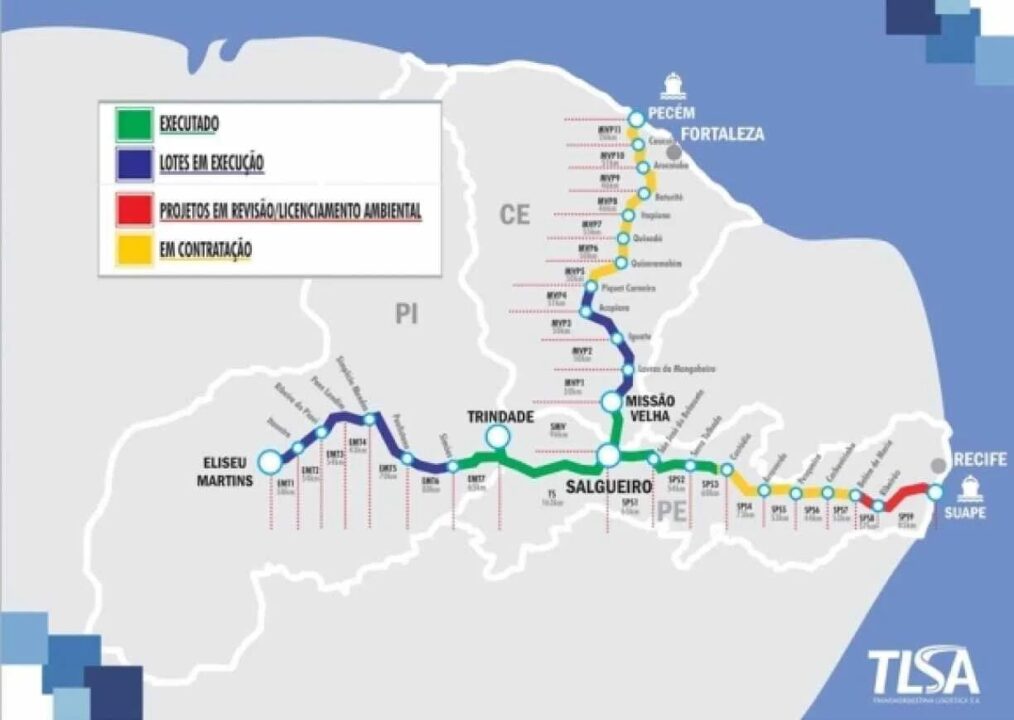
The Future of the Transnordestina Railroad Is in the Hands of the Government and the Private Sector
Despite the optimism of some and the skepticism of others, the future of the Transnordestina Railroad depends on a combination of efforts between government, private companies, and investors.
The integration between road and rail modalities is crucial for the project’s success, and the Port of Pecém will be a key player in this operation.
Doubts still remain about whether the federal government will be able to fulfill all its promises, but the need for diversification of transport in Brazil and improvements in infrastructure is clear.
What is at stake is the economic future of the Northeast and Brazil’s ability to become more competitive in the global market.
With so many promises and challenges, will the Transnordestina Railroad finally become a reality by 2027? Will the impact this project could have on the Northeastern economy be enough to guarantee its completion?





Lula ajudando a ferrovia? Nunca ele n passa de um populista que só sabe mentir, a hj um recurso que foi prometido em janeiro ainda n foi repassado, ele foi um dos que mais prejudicou a obra, isso n passa de balela que esse jornal quer defender.
Brasil é muito atrasado na questão de construção e manutenção de ferrovias. Demoram demais pra “se mexer” e é tudo manual por isso demora anos pra se construir uma ferrovia aqui no Brasil. Tudo demorado, tudo travado, não existe eficiência no Brasil.
Enquanto houver papel prá assinar e hipocrisia o pai dos **** promete tudo