





 Portuguese
  English
  Spanish
  3 min of reading
  0 comments


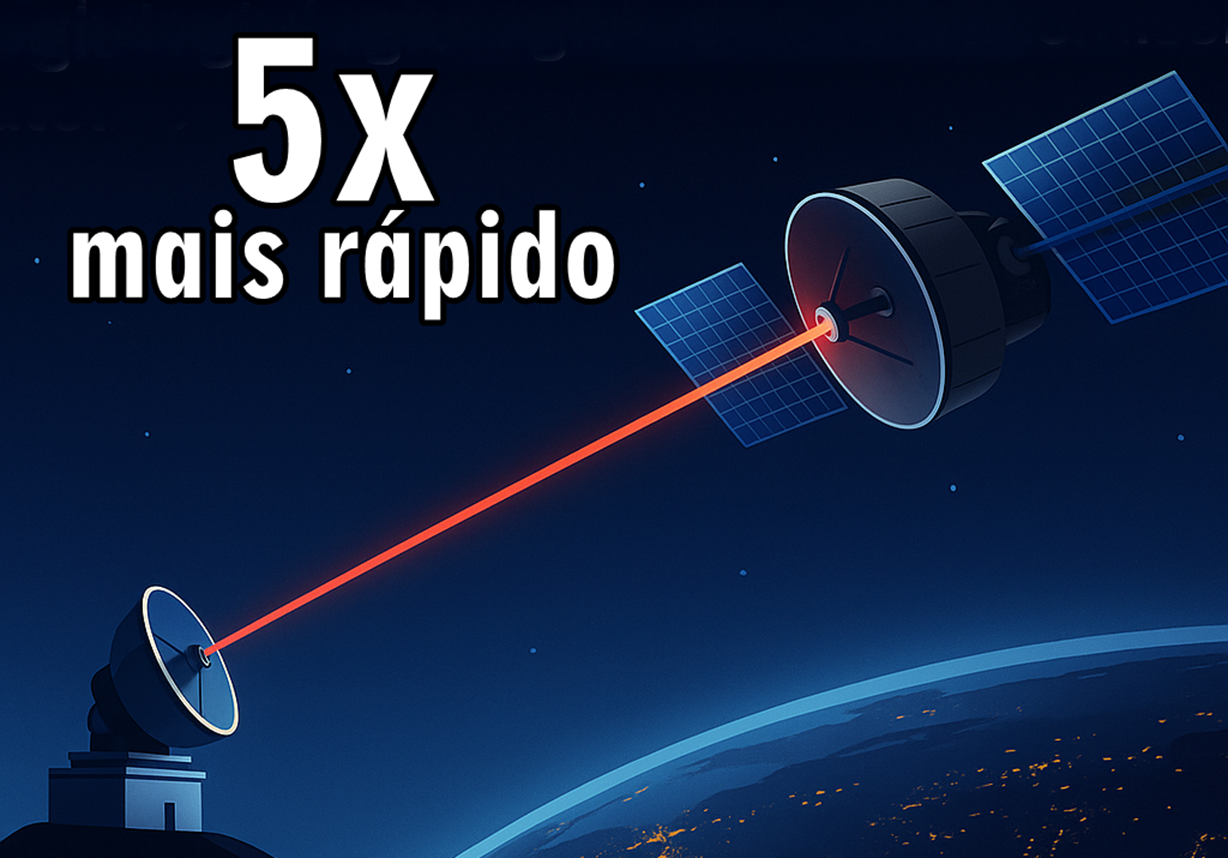
Chinese Researchers Test New 2-Watt Laser Technique and Achieve Five Times Faster Speed Than the Starlink Network.
Chinese researchers managed to transmit data from a geostationary satellite to Earth at a speed of 1 Gigabit per second (Gbps), using a laser of only 2 watts. The result is five times faster than the current services offered by Starlink, from SpaceX.
The innovation was made possible thanks to a new method called AO-MDR synergy, which promises to revolutionize satellite communications.
The Innovation Behind the Speed
The great challenge of laser communication between satellites and Earth is atmospheric turbulence. This turbulence distorts light signals, making it difficult to receive quality data.
-
The Himalayas continue to grow to this day, with tectonic plates advancing 5 cm per year, mountains rising up to 10 mm annually, and the 2015 earthquake that killed 9,000 people may have increased the risk of an even larger seismic mega-event.

-
At an altitude of 400 km by astronauts from the International Space Station, Paris transforms at night into a golden mesh so precise that it reveals the outline of the Seine River, avenues, and entire neighborhoods like a luminous map drawn over the Earth.

-
iPhone 17 reaches historic low price with 256 GB, 120 Hz display, and drops to R$ 5,703 on Shopee, featuring A19 chip, dual 48 MP cameras, battery life of up to 30 hours, and advanced AI features.

-
Trip to Mars getting closer: Pulsar Fusion, from the UK, advances with plasma ignition in fusion engine and could drastically reduce space travel time, making crewed missions faster, safer, and economically viable.


To overcome this obstacle, scientists combined two well-known techniques: Adaptive Optics (AO) and Mode Diversity Reception (MDR).
The novelty lies in how these two techniques were used together, creating the method called AO-MDR synergy. This approach ensures that even low-power signals maintain their quality during transmission.
The project was developed by researchers from the Beijing University of Posts and Telecommunications and the Chinese Academy of Sciences. Among the leaders of the study are Professor Wu Jian and researcher Liu Chao.
The Test With Laser and Satellite
Theory was put into practice at the Lijiang observatory, located in southwestern China. Tests were conducted with an unnamed satellite positioned 36,705 kilometers from Earth. Communication was established using a 1.8-meter telescope, equipped with 357 individually controllable micro-mirrors.
These micro-mirrors are part of the adaptive optical system. They are responsible for correcting the laser light that arrives distorted due to atmospheric turbulence. After this correction, the light goes through an analysis system to identify the most reliable data.
Next, the corrected light enters a multimode fiber. This fiber splits the signal into eight base mode channels, through a component called multi-plane converter (MPLC). A “path selection” algorithm analyzes the eight channels and chooses the three with the best signal. This ensures that the transmitted information is as clear as possible.
Verified Results
The experiment was repeated several times, and the results remained consistent. The signal intensity increased significantly, and researchers carefully documented each test. Verification in multiple rounds reinforced the credibility of the data obtained.
The success rate of usable signals jumped from 72% to 91.1%. This improvement reduces transmission errors and makes it possible to send high-quality content more reliably.
The Importance of Laser Communication
Laser communication offers advantages over traditional radio systems. The main one is the much larger bandwidth. This means that more data can be transmitted in less time, with a lower risk of congestion.
This technology is seen as a solution to growing demands, such as sending high-definition videos. With more usable signals, there are fewer interruptions, fewer lost frames, and a smoother experience for the end user.
Additionally, in January 2025, an even greater advance was recorded in China: a rate of 100 Gbps in laser transmissions between satellites and ground. This result multiplied the previous record by ten and demonstrates rapid progress in the sector.
Closing
The study on AO-MDR synergy was published in the scientific journal Acta Optica Sinica. The tests indicate that, even with low power, laser communication can achieve high speed and reliability. The research reinforces China’s advancement in this field and positions the country prominently in the development of new space technologies.










-

2 pessoas reagiram a isso.