





 Portuguese
  English
  Spanish
  4 min of reading
  32 comments


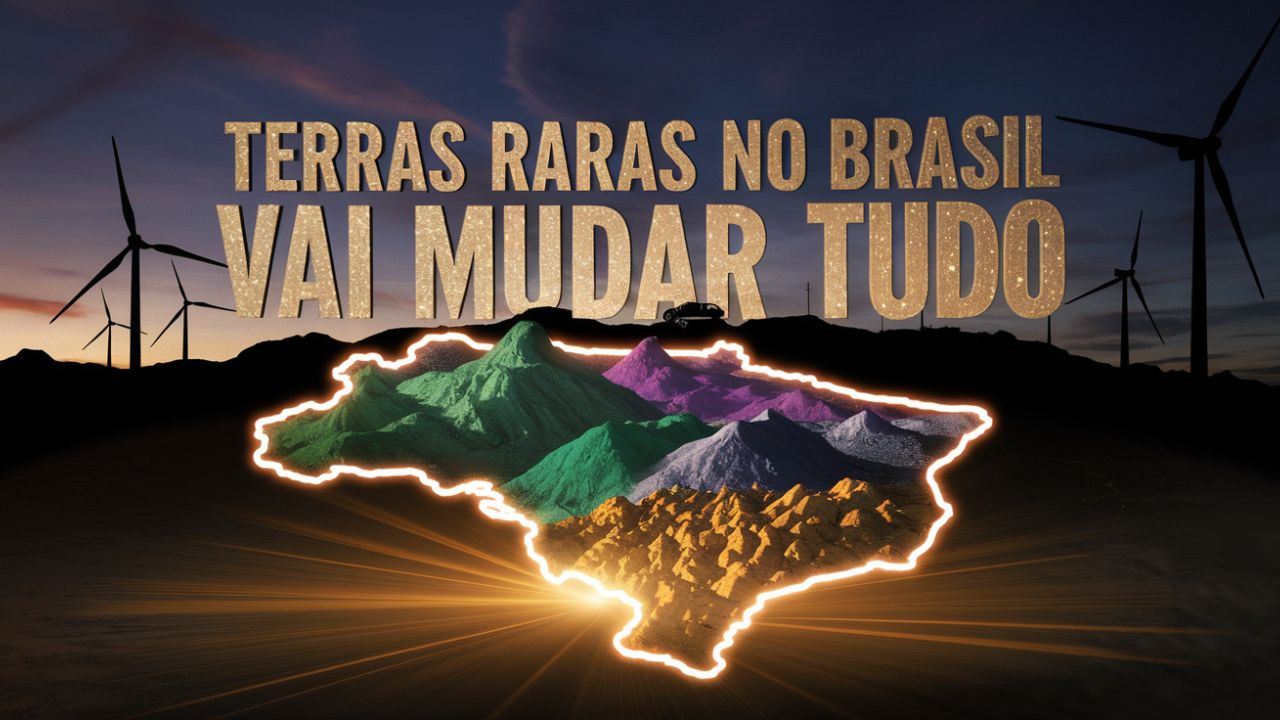


With the Third Largest Rare Earth Reserve on the Planet, Brazil Can Lead the Global Market for Sustainable Technologies, Move Trillions, and Generate Thousands of Jobs in the Coming Years.
Imagine Brazil emerging as a global leader in a new economy. Recently, the discovery of one of the largest rare earth reserves in the world has put the country in the spotlight on the international scene. These minerals, crucial for technologies like electric vehicles and wind turbines, are as valuable as gold in some markets.
But what are rare earths? Despite the name, they are not exactly “rare”. These minerals are present in the Earth’s crust, but in concentrations that are often not economically viable for extraction. In Brazil’s case, luck has changed: the reserves have high concentrations of these elements, which can transform the national economy.
The Potential of Rare Earth Reserves in Brazil
Brazil is currently the third country with the largest rare earth reserves in the world. Regions like Araxá, Morro do Ferro, and Poços de Caldas stand out as true “treasure chests”. These areas have vast concentrations of elements like neodymium and cerium, essential for the production of batteries, high-power magnets, and other technological components.
-
Brazilian city bets on the business environment to generate jobs and attract investments in the energy sector — secretary reveals strategy at Macaé Energy 2026.

-
50 viaducts, 4 tunnels, 28 bridges, and 40 kilometers of bike paths: BR-262 in Espírito Santo will receive 8.6 billion reais for the largest engineering project in the state’s history, inspired by the Immigrant Highway in São Paulo.

-
Brazil produces too much clean energy and doesn’t know what to do with it: over 20% of solar and wind capacity was wasted in 2025 while investors flee and 509 renewable generation projects were abandoned in the last year.

-
Piauí will produce a new fuel that replaces diesel without needing to change anything in the truck’s engine and reduces pollutant gas emissions by half: truck drivers from all over the Northeast are already celebrating the news that will arrive later this decade.


Compared to China, which dominates over 80% of the global market, Brazil is still at the beginning of its exploration. However, this discovery offers the country a unique opportunity to compete in this market. Can you imagine Brazil exporting not only iron ore but also rare earths with high added value?
How Rare Earths Can Transform the Brazilian Economy
The economic impact of this discovery can be enormous. Projects like the “Caldeira Project” in Poços de Caldas are already planning investments of R$ 1.5 billion, promising the creation of hundreds of direct jobs and thousands of indirect ones.

The commercial value of rare earths is impressive. Neodymium oxide, for example, can reach up to US$ 75,000 per ton, according to Minera MT. Compared to iron ore, which hovers around US$ 120 per ton, the difference is astronomical. 625 times more profitable than iron ore. This could exponentially increase Brazil’s GDP and position the country as an economic leader.
Sustainable Technologies and the Role of Brazil
In addition to boosting the economy, rare earths have another advantage: their application in sustainable technologies. They are essential for electric car motors and wind turbines, pillars of renewable energy.
With the world increasingly focused on sustainability, Brazil can take on a leading role by supplying these indispensable materials. It’s as if the country holds the key to the future of clean energy. The question is: are we ready to seize this opportunity?
Challenges in Exploring Rare Earth Reserves
Of course, not everything is simple. To explore these reserves, Brazil will need to invest heavily in infrastructure and cutting-edge technology. The extraction and processing of rare earths require advanced techniques that we do not yet fully dominate.
It is essential to ensure that the exploration is sustainable. No one wants to turn an opportunity into an environmental disaster. For that, the country needs a clear strategy that unites economic development and environmental preservation.
Geopolitical and Economic Opportunities
This discovery also offers geopolitical advantages. By diversifying its economy and investing in high-value-added products, Brazil can reduce its dependence on traditional commodities. This strengthens the country’s position on the international stage and makes it less vulnerable to fluctuations in market prices.
Imagine Brazil competing on equal terms with China in the supply of rare earths. It may seem like a dream, but with the right strategy, it can become a reality.
The discovery of rare earth reserves in Brazil is a historic milestone that could change the course of the national economy. With strategic investments, a focus on sustainability, and technological innovation, the country has every potential to become a global powerhouse in this sector.









Magnífico isso para o BRASIL e para a sua NAÇÃO BRASILEIRA.
O único problema são esses **** **** SANGUE SUGA que estão no PODER, pois agora com tanta riqueza assim, não vão sair do PODER para deixar quem realmente quer um PAÍS BRASIL 🇧🇷 para todos.
Pois eles querem um País Brasil 🇧🇷 só para eles, é nós escravos deles.
Precisamos de GOVERNANTES que queira um PAÍS BRASIL 🇧🇷 para que a sua NAÇÃO BRASILEIRA seja também favorecidas, como é em outras Países de Primeiro MUNDO.
BOM! Essa e a minha opinião 👍🏻🤝🏻
A venda de minérios pelo país deveria ser proibida. Quem quiser que abra uma siderúrgica aqui para beneficiar o minério e obter produto acabado com valor agregado. Assim podemos ocupar mão de obra nacional, obter impostos para investir no social e melhorar nossa balança de pagamentos. Criar riqueza não é exportar minério e sim exportar com valor agregado… Precisamos deixar de ser colônia. Chega de exploração de nossas riquezas…
“…anunciou na última semana de dezembro de 2024…”. Isso que é fur0 de reportagem! Antecipou-se até a data do anúncio.