





At 646.38 meters and about 420 tons of steel, the Warsaw Radio Mast transmitted signals to distant regions for 17 years, until it lost support during cable replacement and collapsed in Poland without causing injuries
Built in a rural area of Poland, the Warsaw Radio Mast reached 646.38 meters and transmitted signals to distant places. However, a problem during the replacement of the support cables destroyed the structure in a few seconds.
For 17 years, a gigantic steel structure installed near the small town of Gąbin, Poland, held the title of the tallest construction on the planet. At 646.38 meters, the Warsaw Radio Mast surpassed even the tallest skyscrapers of the time.
Also called the Konstantynów Mast, it was not a building with floors, but an antenna supported by cables anchored to the ground. Its function was to transmit the main program of the Polish public radio on long waves.
-
Unreleased Honor smartphone appears in the hands of world champion and draws attention with robotic arm and gimbal camera.

-
Toyota puts hydrogen trucks in a race against diesel models in the Arizona desert, showing faster acceleration and emitting only water vapor from the exhaust, while investing in stations and preparing class 8 vehicles for commercial routes of up to 800 kilometers with refueling in 15 to 20 minutes.
-
Goodbye fixed agitator washing machine: Whirlpool surprises and launches a 2-in-1 version that removes the central piece to free up space, stores detergent for up to 20 loads, features a faucet and brush inside the washer itself, and allows for the creation of up to 36 personalized cycles.

-
Selling 67 million tons and growing 3.7% in the year, cement sales in Brazil advanced in 2025, totaling 2.4 million tons more than in 2024, in a sector driven by the country’s construction and housing.


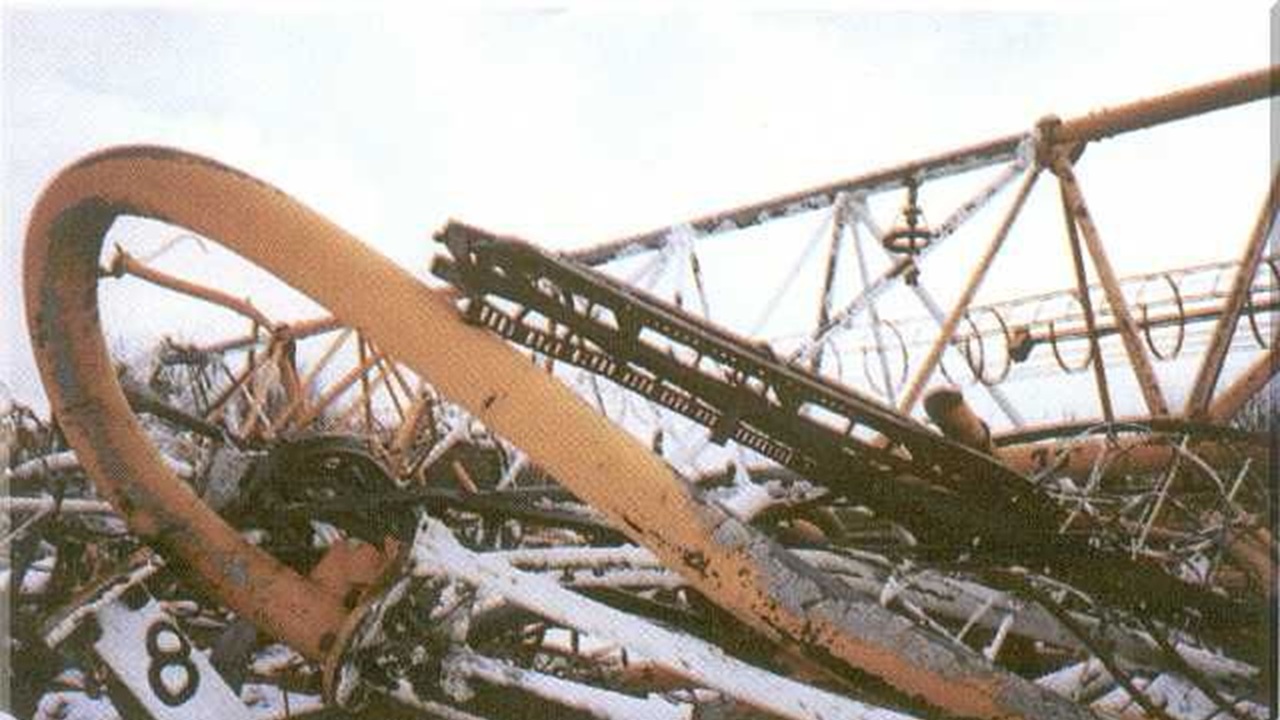
The story ended on August 8, 1991. During a maintenance operation, the temporary system set up to support the mast failed. The structure lost stability, bent, and collapsed. Despite the magnitude of the accident, no one was injured.
An antenna taller than any skyscraper of the time
Construction began in the late 1960s and was completed in May 1974. Regular transmissions began on July 22 of that year, a date of great political importance in communist Poland.
According to the publication specialized in Central Europe 3Seas Europe, approximately 420 tons of steel were used in the structure. The mast was almost twice the height of the Eiffel Tower, whose current total height, including its antenna, exceeds 330 meters.
The installation was erected in Konstantynów, a locality near Gąbin, in the central region of the country. Its position and height allowed the Polish Radio signal to cover the national territory and reach listeners located far beyond the borders.
The transmissions could be received in different parts of Europe and even in regions of North America. The system also served Poles living or working in distant countries, becoming an important link between these communities and their country of origin.
The mast was made up of a triangular metal structure, divided into dozens of sections. As it could not support itself, it relied on guy wires connected to large concrete blocks installed around the area.
Problems arose before the collapse
Continuous exposure to the wind caused movements and vibrations in the structure. Inspections conducted approximately a decade after the inauguration identified damage to the mast, the support cables, and their insulators.
The repair was technically difficult and expensive. The economic situation faced by Poland during the 1980s may also have limited the necessary work. According to the account gathered by Amusing Planet, the lack of equipment and adequate training worsened the deterioration.
Consideration was given to replacing the mast with a more resistant structure of similar height. However, the proposal did not advance. In 1991, it became necessary to replace cables that showed wear.
Failure occurred during cable replacement
On August 8, a team was working on replacing one of the cables responsible for the stability of the antenna. To perform the service, it was necessary to relieve the tension of the main cable and temporarily transfer its load to auxiliary cables.
This provisional system did not adequately support the operation. One documented explanation points out that an auxiliary cable came loose and the second could not handle the additional load alone.
Without the necessary support, the mast became unbalanced. The upper part began to tilt, the structure broke approximately in the middle region, and the metal segments fell onto the ground.
The report by TVP World recalls that the fall abruptly ended the trajectory of the structure which, until that moment, was still the tallest existing in the world.
A crane used by the company Mostostal Zabrze was destroyed, but the transmitter and tuning buildings remained preserved. According to 99% Invisible, no one was injured in the collapse.
Investigation pointed out responsibilities
The investigation held members of the company responsible for the construction and maintenance. The project coordinator and a division chief were convicted for their involvement in the failures related to the accident, although secondary sources present discrepancies about the exact duration of the sentences.
After the collapse, Polish Radio temporarily transferred broadcasts to the old Raszyn mast, approximately 335 meters tall. The government even prepared to rebuild the Konstantynów antenna, utilizing part of the existing foundations.
The project faced strong opposition from residents, concerned about the possible effects of the transmissions, and was eventually abandoned. A new station was later installed in Solec Kujawski, using two smaller masts.
Although it disappeared in 1991, the height of 646.38 meters remained unmatched by another structure until the construction of the Burj Khalifa in Dubai. The skyscraper reached 828 meters and was officially inaugurated in 2010.
The collapse turned a symbol of Polish engineering into one of the most well-known cases of failure during the maintenance of a guyed structure. Parts of the old installation, including foundations and technical buildings, remained on site after the fall.


