





 Portuguese
  English
  Spanish
  5 min of reading
  0 comments


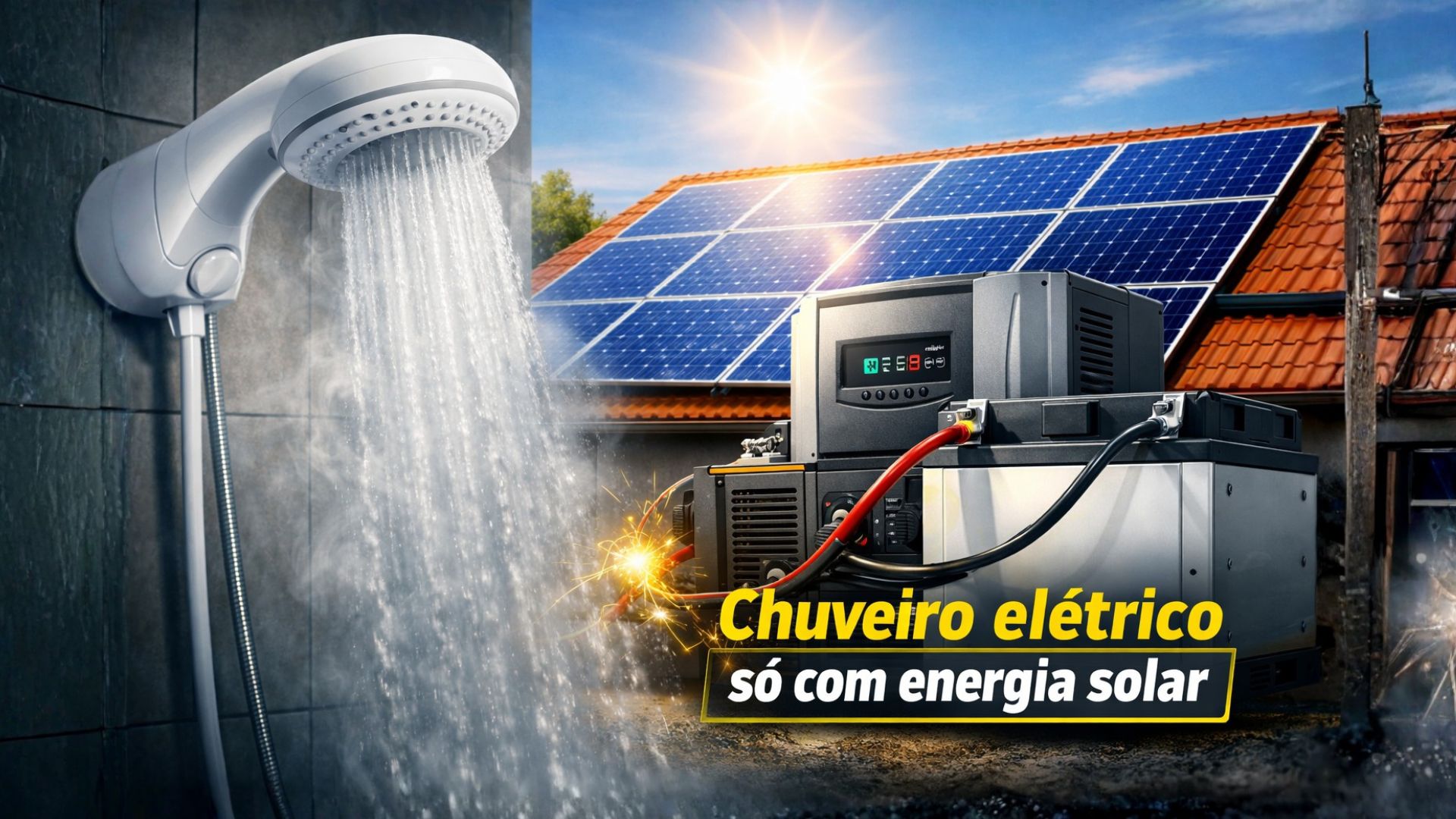
Concentrated Consumption, High Power, and Technical Challenges Turn the Electric Shower into One of the Most Demanding Tests for Residential Solar Systems, Requiring Accurate Calculations, Attention to Instantaneous Peak, and Correct Choices of Inverter, Batteries, and Wiring to Avoid Supply Failures During Showers.
Using a 7,500 W electric shower exclusively with solar energy is technically possible, but the design requires a higher level of attention than necessary for most household appliances.
This is because, although daily consumption may be relatively low when the shower time is short, the instantaneous power demand at the moment of use is extremely high.
This peak directly pressures the inverter, the wiring, the protection devices, and, when the shower occurs outside of sunlight hours, also the battery bank.
-
BYD Dolphin 2027 gains more power, increases in size, changes interior, and abandons controversial feature to face new competition in Brazil.
-
The German economist Wolf-Peter Schill has no doubts: “Electric cars are already far superior to cars with internal combustion engines.”

-
Largest public charging network in Brazil: BYD reaches 125 fast chargers and accelerates national expansion of electric mobility.
-
Goodbye expensive popular car: electric vehicle for less than R$ 70,000 starts being sold in Brazil with a range of 200 km and targets those looking to escape gasoline.

Therefore, the starting point for sizing should be the energy consumed throughout the day, not just the nominal power of the equipment.
In a common scenario of two daily showers, with an average duration of 10 minutes each, the total usage time adds up to about 20 minutes per day.
Converted into hours, this period amounts to approximately 0.33 hours of daily operation.
By multiplying this time by the power of the shower, the daily consumption comes close to 7.5 kW × 0.33 h, resulting in about 2.5 kWh per day dedicated solely to showers.
This value increases rapidly as the number of residents in the household grows.
Maintaining the same duration pattern, a house with four people can easily reach around 5 kWh daily just with the electric shower.


In this context, the total energy consumed directly follows the equipment’s usage time.
Still, the central point remains the same.
The shower is usually a brief event, but extremely concentrated in energy demand.
It is precisely this concentration that significantly alters the size and cost of the photovoltaic system.
How Many Solar Panels Are Needed to Power an Electric Shower
To estimate the number of photovoltaic panels required, three fundamental technical assumptions must be considered.
The first is the nominal power of each solar module.
The second relates to the natural losses of the system during energy conversion and transport.
The third involves the solar irradiation available in the region where the system will be installed.
In practice, these factors combine in the relationship between installed power, hours of full sun, and the system’s performance index.
The energy generated daily results from multiplying the installed power by the hours of full sun, adjusted by the performance factor.
In the analyzed scenario, 400 Wp solar panels are considered.
A performance factor of 0.75 is also adopted, representing global losses of around 25% throughout the system.
These losses include temperature effects, inverter efficiency, cables, connections, and other electrical components.
This level is consistent with widely used estimates in residential projects in Brazil.
The hours of full sun vary according to geographic location and throughout the year.
In the country, average values are known from solarimetric surveys widely used as a technical reference.
In a typical scenario of about five hours of full sun per day, a 400 Wp panel tends to generate approximately 1.5 kWh daily, already considering the system’s losses.
To meet a daily consumption close to 2.5 kWh, about two solar modules would be needed on average.
In practice, however, projects rarely operate at the theoretical limit.
Weather variations, cloudy periods, and safety margins usually lead to the use of a greater number of panels.
When daily demand rises to something close to 5 kWh, the number of panels grows proportionally.
Even in these cases, though, the number of modules seldom represents the project’s biggest challenge.
A Peak of 7,500 W Is the True Challenge of the Solar System
The electric shower requires the system to be able to deliver 7.5 kW of instantaneous power at the moment it is turned on.
In a 220 V electrical network, this corresponds to a current close to 34 amperes, not considering additional losses.
In 127 V installations, the required current is even higher, which increases demands on the electrical infrastructure.
This instantaneous demand is precisely the point where many poorly sized systems fail.
An inverter may meet the average monthly consumption and still not support the peak required by the shower.
The situation becomes more critical when other equipment is running simultaneously.
In this scenario, the system’s operational margin decreases significantly. Therefore, it is not enough to just look at the nomimal power of the inverter.
It is also essential to evaluate its continuous supply capacity, peak tolerance, and stability in the face of rapid load variations.
When the shower occurs outside the solar generation period, the role of storage becomes decisive.
In such situations, it is not enough to have energy accumulated in the batteries. The system needs to deliver high power steadily, without sudden drops in voltage.
Otherwise, protection devices may act and interrupt supply during the use of the shower.
Battery Needs to Support Intense Discharge During the Shower
In the reference scenario, the useful daily consumption of the shower is around 2.5 kWh.
Considering losses and operational limits, the estimate points to about 4 kWh of gross battery.
This difference occurs because the nominal capacity of batteries cannot always be fully utilized.
Depth of discharge limits and strategies to preserve lifespan reduce practical utilization.
Still, the autonomy measured in kWh represents only part of the equation.
For the electric shower, the most critical factor is the instantaneous discharge capacity of the battery.
It needs to sustain the supply of 7.5 kW throughout the shower duration.
In residential systems with banks operating at 48 V, this implies high currents on the direct current side.
In light of this, stronger cables and properly sized connections become essential.
More modern residential batteries often explicitly state their maximum discharge power.
This data is crucial to verify if the system is compatible with high power loads. In homes with more residents, daily consumption tends to double.
If showers predominantly occur at night, the battery bank needs to increase proportionately.
Nonetheless, a battery with high capacity in kWh may fail if it is not designed to provide the required power.
High Costs Limit the Practical Viability of the Project
From a technical perspective, operating a 7,500 W electric shower exclusively with solar energy is feasible.
In practice, however, the project often proves to be unattractive from an economic standpoint.
The cost of an inverter capable of handling high peaks increases significantly. The same occurs with the battery bank and the need for reinforcement in the electrical infrastructure.
When the goal is to power only the shower, the investment tends not to be justified.
For this reason, residential projects usually plan generation to meet the consumption of the entire house. Thus, the cost of the system is diluted among various simultaneous uses.
Even if the number of panels seems modest on paper, the power peak turns the shower into one of the most critical pieces of equipment in the installation.







-

Uma pessoa reagiu a isso.